Minister: Maritime Sector Supports Nearly 70% of Togo's Economic Activity
 Tuesday, 09 June 2026 14:46
(Togo First) - Togo's Minister Delegate for the Maritime Economy, Kokou Edem Tengue, used World Oceans Day on June 8 to highlight the outsized role of the sea in the country's economy and call for stronger efforts to protect marine resources.
"Nearly 70% of our economic activities depend on our maritime sector; more than 75% of our tax revenues come from it," Tengue said in a message to stakeholders. For the minister, protecting the ocean is as much an economic imperative as an environmental one. He described the Port of Lomé as "the lung of our economy and the link between West Africa and the world."
Those statements are supported by measurable data. The tertiary sector, driven largely by port activity, accounts for roughly 57% of national GDP. The direct contribution of the maritime economy is estimated at more than 50% of GDP, based on an aggregate assessment covering port operations, maritime transport, fishing and related logistics services. Togo's economic growth of 5.3% in 2024 was partly driven by strong port performance, according to the French Treasury Directorate General.
Port of Lomé Traffic
Total traffic at the Port of Lomé reached 30.6 million tonnes in 2024, up 1.85% from 30.08 million tonnes in 2023. The main driver of that increase was transshipment, which rose 7.11% to 20.23 million tonnes from 18.89 million tonnes. The segment now accounts for roughly two-thirds of total traffic, reinforcing Lomé's position as a regional redistribution hub.
Container traffic rose 5.19% to 2 million TEUs in 2024, from 1.907 million the previous year. In March 2025, the port set a continental record by handling 123,000 container moves in a single month, equivalent to approximately 175,000 TEUs. The port has set an expansion target of 2.7 million TEUs by 2027.
Tax Revenues, Jobs and International Standing
Nearly 90% of Togo's foreign trade is transported by sea, and port-related activities account for around 75% of national tax revenues. The port authority's own revenues reached 39 billion CFA francs in 2022, up from 29 billion in 2018, representing a 34% increase over four years. The port directly employs more than 6,000 people, including around 5,000 dock workers, while supporting additional indirect employment across the transport and logistics sectors. Fishing, another pillar of the maritime economy, accounts for 4.5% of agricultural GDP and employs more than 20,000 people.
Those results have earned the port several recent distinctions. In November 2025, at the 45th Council of the Association for the Management of Ports in West and Central Africa (AGPAOC), Lomé was ranked the best African port for transit traffic. It ranks 92nd globally in Lloyd's List's 2025 edition and first among container ports in sub-Saharan Africa.
Celebrating the Oceans, Protecting a Strategic Asset
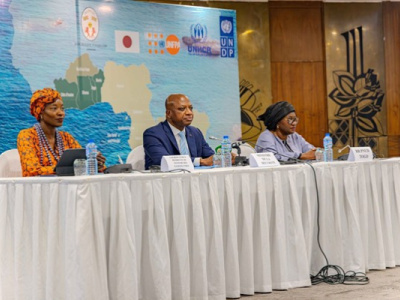
Against that backdrop, the High Council for the Sea organized a workshop in Lomé focused on marine protected areas, bringing together public agencies, researchers, local authorities and economic operators. Participants raised concerns about pollution, coastal erosion and the overexploitation of fishery resources.
The government highlighted several ongoing reforms, including efforts to combat marine pollution, restore mangroves, advance marine spatial planning and modernize port infrastructure. These initiatives form part of a broader blue economy strategy intended to drive growth while strengthening the resilience of coastal communities.
"Saving the ocean is not a slogan: it is, very concretely, defending our jobs, our food sovereignty and our public revenues," Tengue said.
That view was echoed by Laré Penn of the High Council for the Sea. "Protecting the oceans, the coastline and marine resources cannot be confined to a single day of celebration. It must become a permanent commitment," Penn said.
Ayi Renaud Dossavi