

Togo First
In 2018, mobile money transactions amounted to CFA607 billion
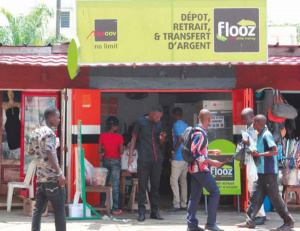
In Togo, the number of mobile money users rose from 83,000 in 2013 to 1.9 million in 2017 and 2.3 million in 2018 (nearly 30% of the Togolese population). This represents an annual growth of 95% over the period considered (2013-2018), with a peak of 21% over the last two years (2017-2018).
This was disclosed by the country’s Posts and Telecommunications Regulator (ART&P), in a report that highlights the sustained growth of Mobile Money - a major “booster” of financial inclusion - in recent years.
In terms of value, says the ART&P, mobile money transactions in 2018 amounted to CFA607.7 billion for 61 million transactions. Daily, around 10,000 transactions, generating an average of CFA1.6 billion, were recorded throughout that year.
Compared to 2017, the volume of transactions recorded in 2018 surged by 54%; a trend recorded by sales points as well (+9% between 2017 and 2018).
The increase was driven by the digitalization initiated in Togo. They were bolstered amidst the pandemic as physical contacts were limited.
Togocom and Moov are the only two telecom operators providing mobile money services through their respective platforms TMoney and Flooz. In the country, 62.7% of the mobile subscribers use the mobile money service and the penetration rate of mobile financial services is estimated at 52%.
Ayi Renaud Dossavi
As cocoa exports soar, coffee’s plunge
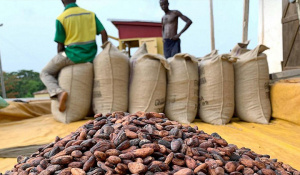
Last Tuesday, the 2020-2021 cocoa and coffee marketing campaign was launched in Kpalimé (120 km from Lomé) in the presence of the ministers of agriculture and trade.
The two sectors were hard hit by the Covid-19 crisis, coffee especially. Indeed, Togolese coffee exports fell by 42%, from 4,500 t in 2018-2019 to 2,600 t in 2019-2020.
“This health crisis hit the coffee economy hard,” deplored Enselme Gouthon, secretary-general of the committee in charge of coordinating the coffee and cocoa sectors (CCFCC). He however emphasized that the 2019-2020 campaign began late.
Poor performances in the coffee sector were also due to a collapsed international demand. The latter crashed as activities of major processors were slowed and global trade flows were disrupted by the pandemic.
Conservation and local processing
To turn the tables, the Togolese government plans to better preserve surpluses (keep unsold stock and sell it in the next campaign), boost local processing (as recommended by the revisited national development plan), and local consumption. This is a major challenge, especially considering that 98% of the coffee produced in Togo is to be exported.
Cocoa fares better
In contrast with coffee, cocoa exports soared by more than 40% - from 7,200 t in 2018-2019 to 10,200 t in 2019-2020.
Coffee and cocoa, let’s recall, are respectively Togo’s second and third export crops, behind cotton. They employ more than 40,000 households.
Ayi Renaud Dossavi
Togo Invest and UNDP Togo to submit $50 million projects to Green Climate Fund
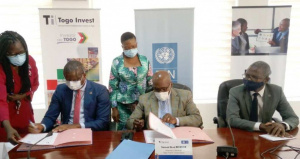
After recently becoming partners, Togo Invest and UNDP Togo are working to submit a $50 million project to the Green Climate Fund.
In effect, UNDP Togo will include Togo Invest in the project since it was already elaborating on it. “We are working with Togo Invest and other institutions to develop this project,” the UN body said.
The project, it should be emphasized, aligns with the key axes of the partnership recently reached by Togo Invest and the UNDP.
Under this partnership, the two institutions will reinforce the corporate social responsibility of businesses and work on boosting environmental sustainability. Lastly, they will preserve the environment and achievements in Togolese societies.
Let’s recall that the UNDP pays consultants to evaluate various potentialities in Togo. Support in this area will also be boosted to enable Togo to Invest to better target its actions as part of the vision for the development of Togo.
Séna Akoda
President Gnassingbé and others call for more financing of IFAD projects
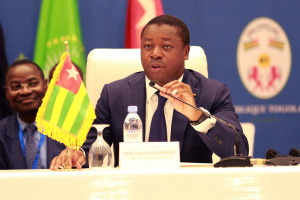
With 9 other African presidents, Togo’s leader Faure Gnassingbé called for a greater financial mobilization for projects carried out by the International Fund for Agricultural Development (IFAD).
In a co-signed letter, the heads of state made the call to make rural communities more dynamic and subsequently protect them against poverty and famine.
“Now more than ever, it is crucial to invest in the reinforcement of the resilience of rural people, to ensure food security, preserve their livelihoods, make sure that the progress we achieved over the years is not brought to naught and prevent other residents of rural areas from falling into poverty and hunger,” the leaders highlighted.
It should be noted that in Togo, the IFAD, among others, funds the risk-sharing based incentive mechanism for agricultural financing (ProMIFA) and the national project for the promotion of rural entrepreneurship (PNPER).
Séna Akoda
Togo: Performance in the trade sector was up in July
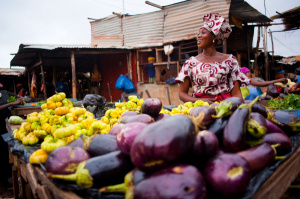
In July 2020, the overall performance of commercial services in Togo grew by 8.8%, driven by sales and business operations.
Right behind the country are Ivory Coast (+2.9%) and Guinea (+0.5%), according to data by the Banque centrale des Etats de l’Afrique de l’Ouest (BCEAO). The three countries, over the period concerned, were the only ones to have recorded a positive performance.
In Mali, Senegal, Niger, Burkina Faso, and Benin, turnovers of businesses operating in the services sector fell by 11.8%, 5.9%, 3%, and 0.4% respectively.
Overall, this figure slumped by 2% in July 2020, thus 5 percentage points less than the figure recorded the same month last year (+3%), despite a recovery of non-finance services.
In general, the retail turnover index was up by 6.8% in July 2020, but less impressive than the month before (+11.5%). According to the BCEAO, the upward trend is attributable to better sales of food products (in Togo, Benin, Burkina Faso, and Ivory Coast), housing equipment (in all WAEMU countries apart from Niger and Senegal), and new cars ( in Benin, Ivory Coast, Senegal, and Togo).
Ayi Renaud Dossavi
Diplomacy: Robert Dussey in Mali on an official visit
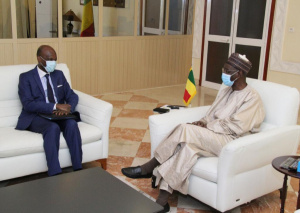
Yesterday, Togo’s minister of foreign affairs, Robert Dussey, went to Mali for an official visit. There, he met the country’s top officials, including the new transitional president, Bah N’daw.
During his visit, the Togolese emissary reiterated the congratulations of Togo (and of the Togolese president, Faure Gnassingbé) to the new Malian leader. He also assured Togo’s availability to support the transition’s institutions to ensure a rapid return to peace and safety in Mali.
According to République Togolaise, Other topics discussed include bilateral, regional, and international cooperation, the liberation of Soumaïla Cissé, and security in West Africa.
Besides the President of Mali, Robert Dussey also met with the transitional vice-president, Col. Assimi Goita, and Prime Minister, Moctar Ouane.
For Togo, the goal of this visit was to somehow normalize relationships between the two countries and with the ECOWAS following the recent political, institutional, and economic tensions.
Indeed, the ECOWAS had imposed some sanctions (including a commercial and financial embargo) after the military coup that overthrew the former president, Ibrahim Boubacar Keïta. The sanctions were lifted earlier this month.
Ayi Renaud Dossavi
Young entrepreneur Ghislain Awaga to enter the private equity market

A successful entrepreneur and one of the key economic players in Togo, Ghislain Awaga intends this quarter to venture into the private equity business.
Via his company Global Trade Corporation (GTC), which specializes in stock speculation and is present in around 20 African countries, the entrepreneur wants to support or buy out firms struggling to grow or are going through a cession or adjustment.
Also, Awaga has started building about 100 housing units and plans to launch agribusiness activities; producing and processing soybeans as well as making essential oils with ginger.
Part of the operations will be financed with equity.
Séna Akoda
Togolese authorities improve traceability to boost soybean export revenues
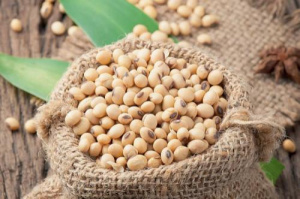
The new soybean commercialization campaign was just launched and it will close in July 2021.
In the previous season, soy exports generated nearly FCFA50 billion, a figure the interprofessional soybean council aims to exceed. It plans to do so by better tracking revenues generated, and subsequently, transparency while purchasing for export.
In parallel, the body also wants to increase the country’s output. The latter stood at 176,100 t (organic and non-organic) in the 2019-2020 campaign.
It’s worth noting that the soybean sector is booming in Togo and the country is even the leading exporter of organic soy to the EU. Regarding job creation, during the previous season, hundreds of thousands of jobs (temporary and permanent) were created in the sector.
Séna Akoda
Togo: Upcoming academic year to resume in two stages
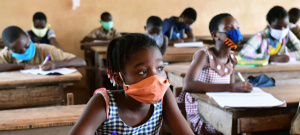
In Togo, the 2020-2021 academic year will resume in two stages. The first - the administrative and pedagogic resumption - will cover the week from October 26 to 30, and the second or effective resumption will begin on November 2.
The next academic year will start with many challenges, related to the Covid-19 notably, the same as the previous academic year.
Regular monitoring of the health situation in schools and universities will be compulsory for adaptation purposes and a successful academic year, said ministers of education Dodzi Kokoroko and Eké Hodin.
Ahead of the resumption, the national council for the fight against Covid-19 is elaborating on a health protocol. Various suggestions such as alternated classes or holding classes 6 days a week, are mentioned in the framework of the protocol.
Ayi Renaud Dossavi
FAO launches an exhibition hall in Lomé to promote made-in-Togo agricultural products
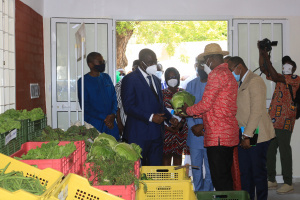
On the world food day, the FAO inaugurated an exhibition hall in Lomé to display fresh agricultural products.
Located near the headquarters of the Central Bank of West African States (BCEAO), this hall will help boost the visibility of "made in Togo" products, especially fruits and vegetables (mangoes, cabbage, pepper, cucumber, etc.)
"The vitrine for food products benefits farmers, especially those growing organic products, spices, as well as goods processed and preserved in line with health and safety standards," said the new Minister of agriculture, Antoine Lekpa Gbégbéni.
Let’s note that a similar hall was opened in the country three years ago. Also, the government announced that this month, it would release a national strategy aimed at promoting local products.