
Togo First
Togo: Public procurement regulator teaches public agents best practices for providing procurement

The Public Procurement Regulator of Togo (ARMP) is introducing public agents in charge of procurement to standards governing these contracts. It started a 10-day workshop to this end last Tuesday, July 5.
In detail, the workers will learn quality standards that are applicable in Togo. According to the ARMP, the standards cover the planning, provision, and execution of procurement.
The initiative comes as Togo works on relying more on public-private partnerships and expanding the regulatory scope of public procurement. Recently, the ARMP launched an awareness campaign on its code of ethics and conduct for public procurements.
Togo sets up a risk analysis cell to better fight terrorism
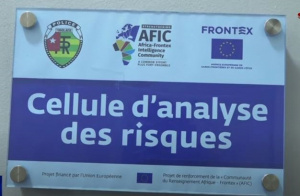
Togo inaugurated last Tuesday a risk-assessment cell in Lomé.
The cell will collect data on terrorist threats that other countries face. Then, resident experts will analyze this information towards taking adequate steps to eliminate or mitigate a given threat. "These data allow us to know the nature of the threats, which will help experts in Togo to propose better responses," said Akseli Saviranta, Head of the Africa-Frontex Intelligence Community (AFIC) project.
The new cell will help Togo fight organized crime, cross-border smuggling, and terrorism, by boosting police and judicial cooperation.
This is in a context where international cooperation in fighting terrorism has become essential, according to the Togolese security minister, Yark Damehane. “To tackle the challenges that our countries face in fighting cross-border crimes, we need strong cooperation and mutual support which will help us find together efficient and effective responses,” he said.
The risk analysis cell of Lomé is a project of the European Border and Coast Guard Agency (Frontex). The cell, which the European Union financed with CFA2.5 billion, is the seventh in the sub-region.
Esaïe Edoh
Togo: IB Bank partners with the National Council of Employers to help SMEs and SMIs thrive

IB Bank Togo (former BTCI) and Togo’s National Council of Employers (CNP-Togo) inked last Friday a partnership agreement that will help local SMEs and SMIs readily secure financing. The agreement was signed by the bank’s MD, Nabil Tahari, and Laurent Tamegno, who heads the CNP.
“The goal is to review the offer provided to these types of clients,” said Tahari before adding that “IB Bank Togo will do everything to help SMEs materialize their projects.”
According to the two partners, SMEs and SMIs make up 90% of the country’s economic fabric, and developing them is one of the government’s top priorities. However, they stressed that these businesses are the most vulnerable to global crises. That is why IB Bank Togo, which belongs to Burkinabe mogul Mahamadou Bonkoungou, proposes accessible offers tailored to Togolese businesses, especially in agribusiness, transport, and infrastructure sectors.
Before its purchase by Bonkoungou, the BTCI was Togo’s last fully public bank. Now, the State owns only 10% of the bank. The remaining 90% are held by IB Holding.
Esaïe Edoh
World Food Program approves a five-year food security program in Togo
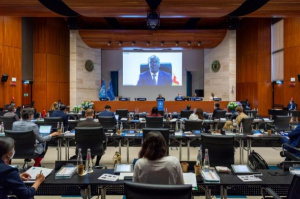
The World Food Program, WFP, greenlit Togo’s 2022-2026 food security strategy last month in Roma. The $17 million plan aims to help around 260,000 people who face food insecurity in the West African country. Also, it aligns with the ambitions falling under the government’s 2020-2025 roadmap.
Concretely, the WFP will provide food and cash to those facing multi-dimensional crises in Togo. This support should allow the beneficiaries to prepare ahead of, and appropriately tackle emergencies.
Besides, a pilot school feeding program will be implemented as part of the five-year strategy backed by WFP. This initiative will be based on local production and help smallholder farmers reduce their post-harvest losses. In effect, supply contracts will be established between these producers and school canteens, in line with the government's priorities relative to the Sustainable Development Goals (SDG 2030).
The WFP’s support complements the World Bank’s $716 million financing for the Regional Food Systems Resilience Program in West Africa (PRSA), which covers Togo and six other countries in West and Central Africa.
Esaïe Edoh
Togo’s government will compensate families of soldiers killed during operations within the country
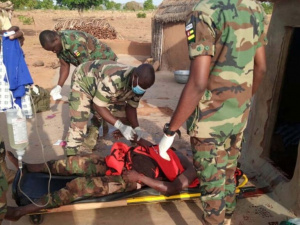
The Togolese government will indemnify the families of soldiers killed during military operations carried out inside the country. The grief-stricken will get CFA10 million.
Both agreeing on the amount, the minister of economy, Sani Yaya, and the minister of security, General Yark Damehane, disclosed it in a joint decree.
According to the decree, the sum, “chargeable to the State budget,” will be shared between the deceased’s beneficiaries, in line with succession-related provisions in force in Togo.
The new measure follows the killing of eight Togolese soldiers in a terrorist attack that happened in Kpekpakandi, located in the Kpendjal prefecture.
Esaïe Edoh
Togo: Government to digitize 75% of administrative processes by 2025

Togo plans to digitize 75% of its administrative processes, via the dematerialization of 20 public services, by 2025. The country will spend no less than CFA8 billion on this massive project.
“When we speak of digitization, our goal is to make life easier for citizens and get them closer to the administration. As for the administration, this digitization will make it more efficient. Our ambition is to dematerialize and digitize all existing services,” said Cina Lawson, the Togolese minister for digital transformation.
According to the information obtained by Togo First, the digitization wave should also cover human resource management with public administrations and procurement procedures.
It should be emphasized that the government of Togo is striving to turn the country into West Africa’s digital hub. Foundations for this project have been laid in recent years, notably with the West African Regional Communication Infrastructure Development Program (WARCIP) and the E-gouv project, financed respectively by the World Bank and Eximbank China.
These two projects indeed allowed Togo to install basic connectivity infrastructures–such as a fiber-optic network connecting public administrations, hospitals, and public universities–build its first Data Center, and birth the national cybersecurity agency.

Other major achievements include the landing of Google’s Equiano subsea cable which is set to be operational by the end of the year. This cable, Togolese authorities hope, will speed up the country’s digital transformation.
Then, there is the recent launch of Togo Digital Agency, a state-run agency in charge of digital projects carried out in the country–such as the national portal for public services, or the digitization of procedures like passport or resident permit applications, construction permit applications, grid connection request, e-visa, etc.
Fiacre E. Kakpo
Togo’s National Credit Council discusses agricultural financing

At the last quarterly meeting of the National Credit Council (CNC) held on July 1, Sani Yaya, the Togolese minister of economy, brought back agricultural financing to the table.
"At our previous meeting, I suggested the organization of a national workshop to reflect on the financing of the agricultural and housing sectors. But, to be more pragmatic and efficient, I asked instead to put the issue of agricultural financing on the agenda of this session. We will examine the issue of housing finance at the next meeting of the Council," he said at the meeting, which brought together the banking and finance actors of Togo.
The goal was especially to identify "the constraints to which the actors of the agricultural value chain are exposed; the requirements of banks and decentralized financial systems to further increase the financing of agriculture.” The idea was also to see how to strengthen and accelerate the effectiveness of the Risk-Sharing Agricultural Finance Incentive Facility (RFAIFF), and to identify "a set of measures to address financing issues in the agricultural sector."
These reflections involved stakeholders from the Ministry of Agriculture, Livestock and Rural Development; the Regional Office of the International Fund for Agricultural Development (IFAD); the MIFA; and the Togolese Coordination of Farmers' Organizations and Agricultural Producers (CTOP).
Ultimately, the government and its partners will have to “identify a set of measures to further increase funding for the agricultural sector.”
In Togo, the agricultural sector, although representing about 40% of the national GDP, benefits from only 0.2% of total bank financing.
Togo scales down growth forecast due to Russia-Ukraine conflict
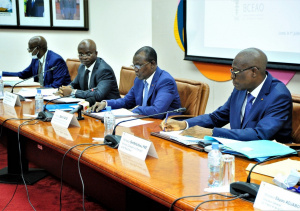
Due to the war in Ukraine, Togo scaled down its growth forecasts for the year. From 6.1% the figure was reduced to 5.9% by the ministry of finance.
Sani Yaya, who heads this ministry, disclosed the information last Friday, at the National Credit Council of Togo (CNC), a meeting that gathered the country's bank and finance actors.
"As you know, since the end of February, the world has been shaken by geopolitical tensions induced by the Russia-Ukraine conflict. This has disrupted post-Covid-19 recovery plans," Yaya said. "This conflict is directly affecting economies through trade and indirectly through its impact on rising energy prices and imported food products," he added.
While new projections, at the national level, confirm an improvement in economic activity, they highlight a slight decrease of 20 base points (0.2%) which explains the forecast revision.
The government is more optimistic than the African Development Bank (AfDB) which expects Togo to record a growth of 5.8% in 2022. However, both parties agree on the decrease of about 20 base points (AfDB initially issued a forecast of 6.2%).
Some good news
Not everything is bad. Indeed, Sani Yaya revealed last Friday that bank lending has risen sharply since the beginning of the year. It grew by 39% YoY to CFA270 billion in Q1 2022.
Over the same period, decentralized finance systems loaned CFA50 billion to economic operators, up by 37% compared to Q1 2021.
Another good news is the sustained improvement of lending by banks and microfinance institutions in the first quarter of this year. The gross deterioration rate of the credit portfolio of banks (the ratio between gross outstanding loans and total loans), has decreased by 5 percentage points, from 16% in Q1 2021 to 11% in Q1 2022. A positive trend that Togo First had already noted.
Ayi Renaud Dossavi
What is Togo's share in intra-WAMU rapid cash transfers?

With over 5.4% of rapid cash transfers made within the WAMU, the Togo-Benin corridor is the fourth most dynamic in the region, according to data from the BCEAO. Transactions between residents of these two countries were more significant than those between Mali and Senegal.
Meanwhile, traditional corridors, which include Burkina Faso, Côte d'Ivoire, and Mali remain the most active.
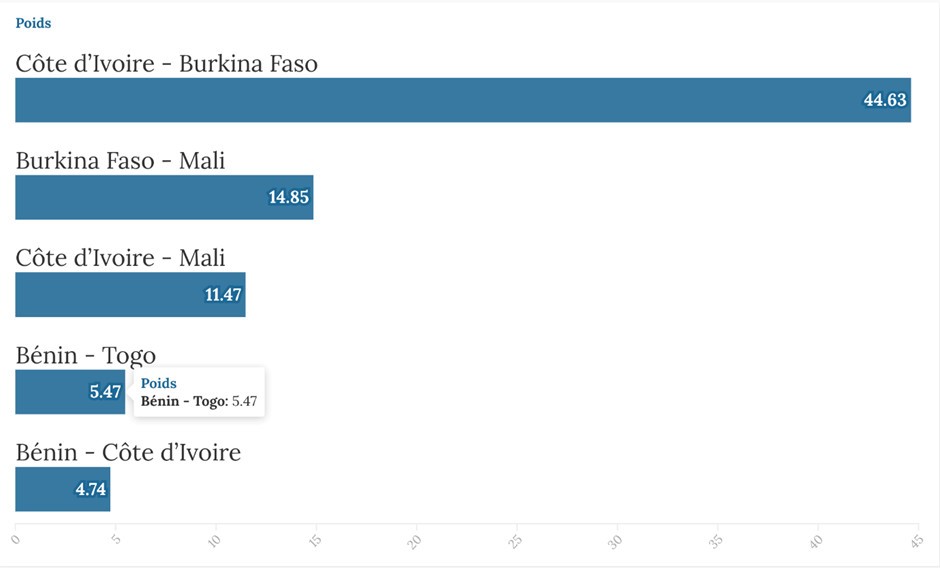
Intra-WAMU rapid cash transfers reached CFA432 billion in the first half of 2021, up 25% year-on-year. In this period, the volume of transactions swelled by 18%, passing 8.6 million.
Côte d'Ivoire, WAMU's economic powerhouse, sends 54% of all funds transferred within the region. Burkina Faso captured 54% of the money sent by other WAMU countries, in terms of value.
Togo: Coris Bank International launches e-money service

Coris Bank International Togo launched its e-money service, Coris Money, last Friday, July 1. Through the move, the lender wants to boost financial inclusion in the country.
“Beyond its innovative aspect, launching this tool today is CIB Togo’s contribution to the financial inclusion policy of Togolese authorities,” said Alassane Kaboré, Managing Director, CIB Togo.
Coris Money lets the bank’s customers and non-customers deposit and withdraw money using their phones. The app’s users can also pay their bills and transfer money within and outside Togo.
According to CIB Togo, in its pilot phase, Coris Money had 15,000 users. The lender expects this figure to reach 35,000 by the end of the year.
Active in Togo since 2015, CIB’s subsidiary recorded a total balance sheet of CFA309.9 billion in 2020, or 50% more than it did in 2019–CFA205.38 billion.
Esaïe Edoh