
Togo First
Togo: Telecom regulator tells mobile operators to allow users to deactivate ad messages

Togo’s telecom regulator, ARCEP, issued a statement last Tuesday asking local mobile operators to enable their users to unsubscribe from advertising and commercial SMS.
The call was made after consumers complained about receiving these messages too often from their operators (Togocel and Moov Africa). These complaints were collected in a satisfaction survey that the ARCEP carried out between May 30 and June 17, 2022.
Specifically, the regulator is asking that operators “allow each customer to choose to no longer receive advertising or commercial messages on mobile via a USSD code and to add at the end of every advertising or commercial message a USSD code that can be used to let the operator know they do not wish to receive such messages anymore.”
Under their specifications, operators must allow customers to deactivate mass-targeted ad or commercial messages, according to the ARCEP.
Esaïe Edoh
Togo is set to spend nearly CFA167 billion on social housing in 2023-2025
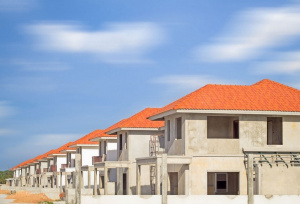
From 2023 to 2025, the Togolese government plans to spend CFA167 billion on housing and collective equipment. This is written in its multi-year economic budget program.
In detail, Lomé should disburse around CFA50 billion next year, and respectively CFA52 billion and CFA64 billion in the following two years.
The monies should specifically finance a State project for building 20,000 social housing units in the country by 2025. This will be done by integrating changes made by the government in response to the Covid-19 pandemic.
Another part of the funds should also finalize the code of urbanism and construction in Togo.
This year, spending on housing projects is expected to reach CFA50 billion. In 2019 and 2021, they exceeded CFA72 billion according to official sources.
Esaïe Edoh
Togo: Government expects State agents' wages to reach CFA270 billion by 2025
Lomé plans to pay CFA270 billion in wages to state agents by 2025. This is stated in its multi-year economic and budget document (DPBEP), obtained by Togo First.
In detail, these expenses are expected to grow from CFA253 billion this year to CFA263 billion the next, CFA268 billion in 2024, and CFA270 billion in 2025. This would represent a growth of 6% between 2022 and 2025.
According to the DPBEP, the increase will be mainly due to the financial effect of the retirement allowance for State workers, sectoral recruitments, and the revision of their administrative situation.
Another reason is the forecasted increase in the incentive bonus for teaching.
Regarding the recruitment of new agents, 2,500 civil servants are presently being hired.
It should be emphasized that there is presently no accurate data on the number of civil servants in Togo. However, the latest census carried out in November 2011, found between 54,000 and 60,000 of them.
Esaïe Edoh
Togo is looking to adopt a major policy to transform its textile and clothing industry
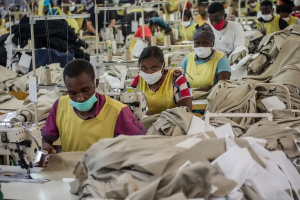
The Togolese government wants to adopt a textile and clothing policy covering the period 2022 to 2030. A decree was examined in this framework last Monday, during the council of ministers.
“Toward increasing its cotton processing capacity and being more attractive, our country has adopted an integrated policy for the textile and clothing industry that will focus on improving the production and processing of cotton produced in Togo,” the council’s statement reads
For now, few details are known about this new policy. But, it was revealed that it should leverage Togo’s capacity to attract foreign investors, through administrative and tax incentives, and the textile processing capacity of the Industrial Platform of Adétikopé (PIA).
It should be noted that a few weeks ago, the government adopted a bill to introduce a free zone in the textile and clothing sector. According to the authorities, the goal is to boost employment and “increase the per capita income of the population, thus improving the national economy.”
“Implementing this policy will also help to achieve the country's ambition to create real extractive and transformative industries, per the government's 2020-2025 roadmap,” the ministers added.
Ayi Renaud Dossavi
Here are Sandra Johnson’s recommendations for curbing the impact of Russia’s war on Africa
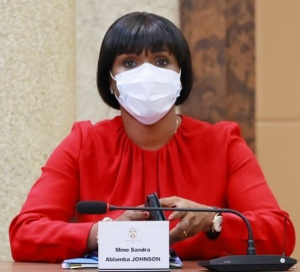
A week ago, on July 21, Togo’s minister, secretary-general at the Presidency, Sandra Ablamba Johnson, took part in a political webinar on the Russia-Ukraine war’s impact on the prices of commodities and food products in Africa.
The webinar was organized by the United Nations Economic Commission for Africa (UNECA). It gathered the ministers of planning and finance of Togo, Rwanda, Ethiopia, and Egypt, as well as academics and representatives from research and statistics institutions.
The talks were mainly on how the war affected African economies’ development and how to curb subsequent shocks.
“The Covid-19 pandemic has put a brake on the ambitions of African countries, including Togo. The Russian-Ukrainian conflict has aggravated an already fragile post-Covid socio-economic situation. This situation, paired with climatic shocks, is disrupting supply and prices on the global and local markets for commodities and food products. It strains African countries’ goal to implement a policy for wealth redistribution. It limits the capacity and effectiveness of their budgetary plans, thereby undermining economies,” Sandra Johnson said during the webinar.
To tackle these issues, "the Togolese government has taken a series of measures to strengthen the country's economic resilience,” the minister added.
With these efforts, the country expects to record robust economic growth this year–5.9% against 5.5% in 2021. Initially, the forecast for 2022 was 6.1%.
It should be emphasized that security issues, fuelled by terrorists in West Africa, add to the country’s economic ones. To deal with both, Sandra Johnson suggested the adoption of a “Marshall plan” for Africa.
“To better play its role as guarantor of security, welfare, and prosperity for all on the national territory, the Togolese government is organizing itself to tackle this double challenge, knowingly the consequences of the Russian-Ukrainian war and the jihadist threat and violent extremism.”
The Togolese official asked for greater allocation of special drawing rights (SDRs), the speeding up of their reallocation, and the creation of more flexible mechanisms to access these resources. This, she claims, will help African countries buy oil and gas, fertilizers, and food products. These measures, Johnson added, should be paired with accelerated debt restructuring and deficit reduction to enable countries to increase public spending and finance resilience and economic recovery.
To boost local consumption and tackle fertilizer import issues, Togo bets on organic fertilizers, Sandra Johnson told UNECA experts. She thus asked them for support to bolster the production of these fertilizers. The West African country, let’s recall, is a significant importer of organic products.
Fiacre E. Kakpo
Togolese government works on restructuring urban public transport
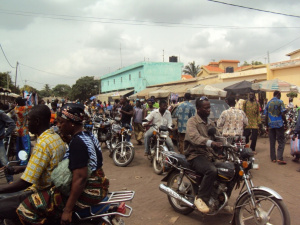
In Togo, the public transport sector will soon be restructured. This was announced on Jul 25, 2022, after the council of ministers held that day.
The project was presented by the minister of road, air, and rail transport, Affoh Atcha-Dedi. Specifically, it aims to update the regulatory framework of urban transport, which covers taxi-bikes, taxis, and tricycles.
The change, according to the government, will allow the sector to fully contribute to the growth of other sectors. “The transport sector is one of the levers that can produce strong and sustainable economic growth, notably by creating externalities that are favorable to production,” Lomé noted.
The road sub-sector, let’s recall, employs many young people, and according to the authorities, over 90% of people and goods moving through the country pass by the road.
Esaïe Edoh
Togo: Rehabilitation of Avepozo-Aneho road set to be completed by December 2022, government forecasts
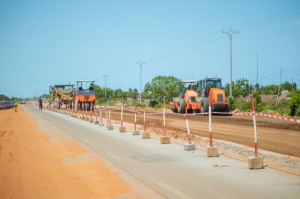
The two rehabilitation projects ongoing on the Avepozo-Aneho road should be completed next December. Their respective completion rates are 84% and 65%.
This was disclosed during a field visit by the minister of public works, Zouréhatou Tcha-Kondo Kassa-Traoré. The official was with a delegation from Togo’s technical and financial partners (EU, AfDB, BOAD).
"Overall, the quality of the works is satisfactory, except for some adjustments to be made. The work is progressing well, except for some delays that we have noted, and is carried out according to international standards. We have given instructions for the deadline to be met, the minister added.
The two projects include the implementation of 2x2 lanes of the national road 2 on the Avépozo-Togokomé axis (10 km) and related developments; and the implementation of 2x2 lanes of the national road 2 on the Togokomé-Aného axis (20 km) and related developments. The works are carried out by the Chinese Road and Bridge Company, CRBC, and the Tunisian Soroubat.
These works are part of a larger one, the rehabilitation of the Lomé-Cotonou road. They should have been completed in March 2022 but were delayed. In May, Prime Minister Dogbé was at the site to assess the progress made. At the time, she urged contractors to speed up the works which were estimated to have reached a completion rate of 20 to 27%.
In 2021, the cost of the two projects was estimated at CFA47 billion.
Mining: A majority of Togolese citizens want better regulation (Afrobaromètre)
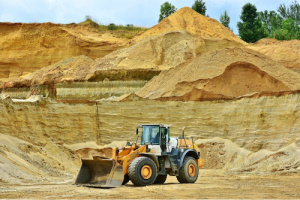
Most Togolese citizens “agree” or “strongly agree” that the country needs more environmental regulation in its mining sector. This is one of the conclusions of a survey that Afrobaromètre carried out last March. The study covered 1,200 people.
Specifically, 86% of the surveyed shared this opinion; while 60% of them believe that the benefits exceed the costs, such as pollution, when it comes to extracting natural resources in Togo.
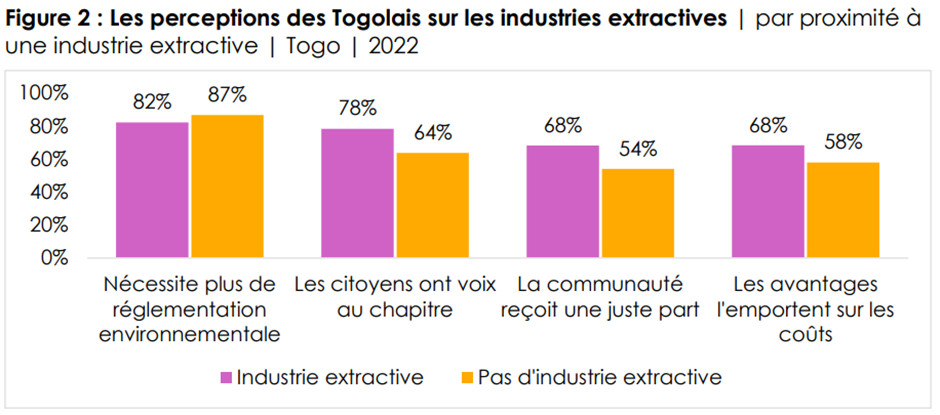
“Besides asking for better regulation, Togolese people living in prefectures with natural resource deposits agree more than other citizens that they have a say in the matter, that they receive a fair compensation, and that benefits exceed the costs regarding the mining of natural resources that takes place near them,” the study indicates.
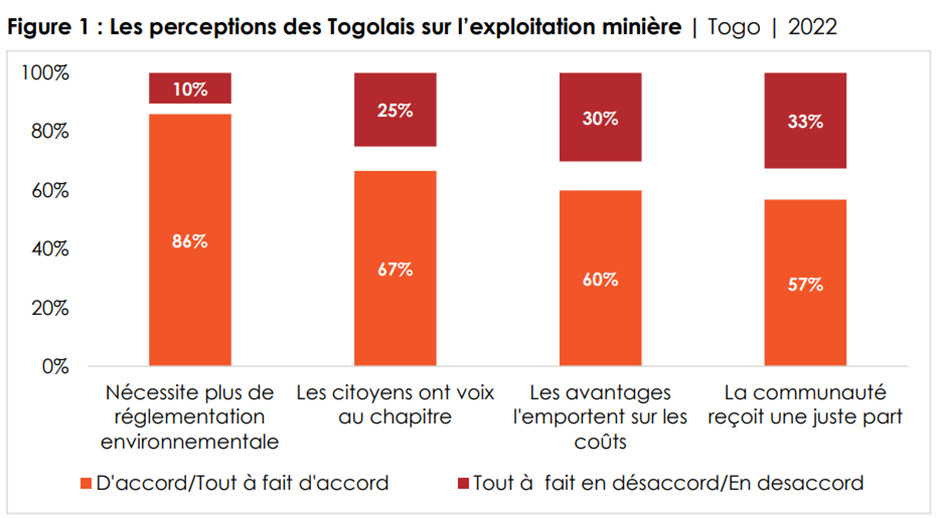
Exactly 67% of all those surveyed claim that ordinary citizens can influence the mining operations, while 57% of them estimate that populations get fair compensation.
Reality vs Perception
These opinions contrast a little with the situation on the field since it is not evident that the people living in areas where mining happens benefit more than communities without resources, in terms of infrastructure, services, or road quality.
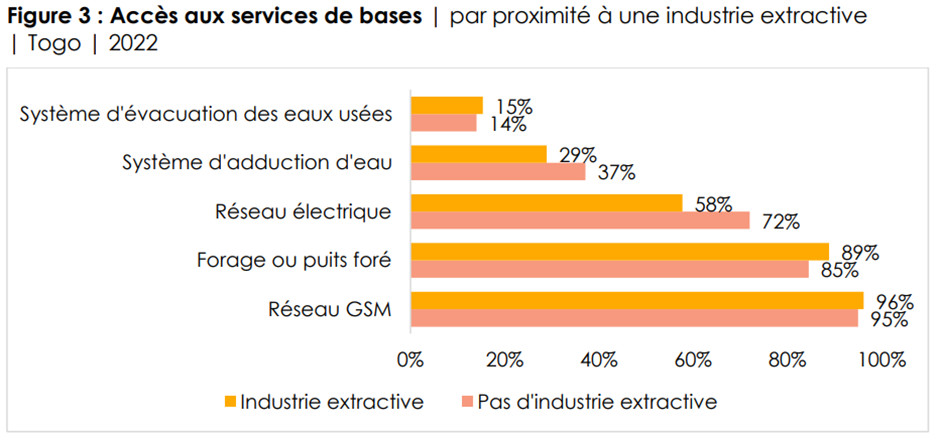
Fig. 3 somehow highlights the perception of those surveyed, even if it does not really match the observations made on the fields and if “efforts must still be made in regards to the legal framework of extractive industries.”
Ayi Renaud Dossavi
Togo looks to adopt a master plan for irrigated agriculture
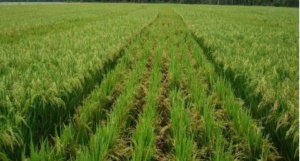
Yesterday ended a two-day workshop to validate a master plan for irrigated agriculture in Togo, in a context where only a few farmers in the country use irrigation, according to experts.
“In Togo, only 1% of agriculture is irrigated, the average in the world is 20%,” says Hugo Van Tilborg, head of the European Union's cooperation in Togo.
To draw the master plan, Togo has the financial and technical support of the EU, through a water survey project.
“To develop agriculture, you need a plan, you must know where the water is, how to use it. It is very important to have a plan that clearly states where the water resources are. And that is why the European Union has decided to finance this plan,” added Van Tilborg.
Togo, like many other countries, is looking for ways to protect itself against climate change’s negative impacts, such as the impact on agricultural output. The master plan aligns with this goal.
“To improve agricultural output and productivity, in line with the P12 project, this plan will allow the Ministry of Agriculture, especially farmers, to carry out their activities in all seasons,” said Konlani Dindiogue, Director of Cabinet at the Ministry of Agriculture.
Togo: Mobile money users grew by about 7% in 2021
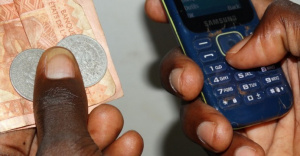
In Togo, the number of Mobile Money users grew by about 7% in 2021, to stand at 4,588,386. This figure was disclosed by the country’s telecom regulator, the ARCEP. According to the source, the increase was driven by the resumption of economic activity, and digitalization.
The performance recorded last year was lower than that recorded in 2020: 24%. That year, freshly-introduced anti-Covid measures had propelled distance payment.
Mobile money was launched in Togo in 2013. The following year, it recorded a growth of 291%, then 75% in 2017, 3% in 2019, and 24% in 2020.
Mobile money in Togo is dominated by Togocel, the incumbent mobile operator, and Moov Africa, a subsidiary of Maroc Telecom. In 2021, Togocel's momo service, Tmoney, had thrice the number of subscribers of its only rival Moov Africa.
Recently, the two rivals reduced their rates, after it was announced that a third player, Wave would join the market. The price adjustment hurts sales points across the country. Now, these sales points, whose number grew by 25% in Q3 2021, try to draw in new users.
It should be emphasized that Togo is a country where most people still prefer hand-to-hand cash transactions to mobile transactions.
Fiacre E. Kakpo