
Togo First
Togo: Parliament passes bill to simplify the declaration of goods and assets
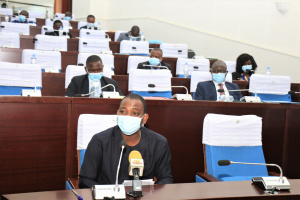
On June 17, the Togolese parliament unanimously passed the bill relating to the reform of the goods and asset declaration procedure.
The new bill facilitates the declaration, allowing actors concerned to only fill a form, online and physically, that will be submitted to the Mediator of the Republic.
Regarding the declaration basis, the minimum single fee which was supposed to be perceived, under the Jan 24, 2020, organic bill, has been canceled. New minimum fees will be fixed by a future decree, taking into account the type of property being declared.
“This decree,” reads a report from the Parliamentary Committee on Constitutional Laws and Legislation, “will help adjust fees, up or down, depending on the assessment of institutions involved in the declaration process.”
Klétus Situ
Van Vliet supplies new trucks to BB Lomé

Last Thursday, Vliet Automotive Togo supplied 11 MAN trucks and 11 SCHMITZ CARGOBULL trailers to the hauliers of Brasserie du Bénin (BB Lomé). The provision of the equipment, worth CFA700 million, is part of a strategy to renew the brewer’s commercial fleet.
Keys of the vehicles were given to the hauliers in Lomé (where Van Vliet is based) by African Lease, the lessor that financed the purchase.
We are very grateful for the trust put in us, again, by the hauliers of BB Lomé who picked us to supply their road equipment, said Marc Boisgarnier, managing director of the Dutch manufacturer.
According to him, “there are too few new trucks sold in Togo” at the moment. To change this, he added, tax cuts and VAT exemption are necessary. “Our wish is that authorities maintain tax incentives as long as possible to renew the fleet of trucks, most of which have become too old.”
On their side, the hauliers, RANSPORT NASSIF, AFRIQUE DES 2M, and RADJI TRANSPORT, welcomed the arrival of new trucks which should allow them to provide the best services to BB Lomé.
Séna Akoda
Néré sector records improvements
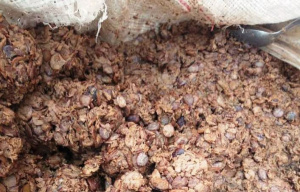
In the past three years, Togo’s néré seeds output rose from 110 t in 2018 to 126 t in 2020. The figure was reported in a study conducted by the FAO and the Agricultural Statistics, Information and Documentation Directorate (DSID).
According to this study, the earnings of actors operating individually in the sector rose from CFA42 million in 2018 to CFA79 million last year. As for those regrouped as cooperatives, their gross sales generated CFA1.3 million in 2018, CFA1 million in 2019, and 1.2 million in 2020.
Sales of mustard and néré juice generated CFA70 million for actors operating individually and nearly CFA4 million for cooperatives, over the same period.
Overall, there are 1,321 individual actors and 14 cooperatives active in the sector, the study shows. A majority of the former (58.6%) are in the Kara region, while the Savanes region is home to 71.4% of the cooperatives.
Esaïe Edoh
Government to amend micro and medium-sized enterprises' chart
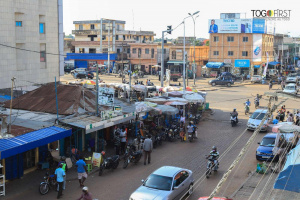
The government plans to amend the chart of micro and medium-sized enterprises, to make it match the current economic and social context more. This was discussed during this week’s council of ministers, held on Wednesday.
“Due to the challenges preventing a true expansion and growth of the people’s entrepreneurship capacities, it became necessary to amend the existing chart to adapt it to our current social and economic environment,” the statement of the council reads.
This revision directly aligns with the government's efforts, started a few years back, to push the youth towards entrepreneurship.
It should be recalled that in Togo, micro and medium-sized businesses are mostly financed by family and friends as they struggle to get bank loans.
Esaïe Edoh
Rencontres Africa, a business forum for French investors and African businesses, to be held next October in Lomé

From October 5 to 7, this year, Lomé will host the Rencontres Africa summit, a gathering of French investors and African economic operators.
This was disclosed yesterday by the event’s general commissioner, Marc Hoffmeister, in the presence of Jocelyne Caballero, France’s ambassador to Togo, Laurent Tamegnon, president of the national employers’ council of Togo, and Rose Kayi Mivedor, the Togolese minister for investment promotion.
The event’s promoters hope to attract 150 French decision-makers, physically, and between 700 to 1000 of them virtually, and introduce them to business and partnership opportunities available in Togo.
During the three days the summit will be held, top-level conferences, B2B meetings, networking sessions, and many more, will take place. "We believe that beyond the public support needed for development, it is up to the private sector to create value through sustainable partnerships; and Togo is a good example with structuring projects such as the PIA, the Kékéli Power Plant, and the Data Center," indicated Marc Hoffmeister.
Meanwhile, Minister Midevor urged local companies to participate in the upcoming forum, saying they could win contracts and secure investments by doing so.
Séna Akoda
Construction of two solar plants to soon start

Preliminary works for the construction of two solar plants, one at Salimde (in Sokodé), and another one at Awandjelo (Kara), will commence soon. Two decrees were passed to this end during the government’s latest council of ministers, held on June 16.
The council said adopting the decrees would “enable the start of compensation and expropriation procedures to secure the areas needed for the project.”
The plants will respectively have an installed capacity of 60 MWp and 80 MWp. The government, it should be recalled, had launched in March 2020 a pre-qualification notice in the framework of the project.
The latter, authorities emphasized, will allow the government to complete its diversification strategy and boost the national power output. This strategy was recently enacted as the country commissioned the Kekeli Efficient Power plant and the Blitta solar plant.
Togo wants to achieve universal power coverage by 2030, having 50% of its energy mix coming from renewables.
Esaïe EDOH
About 91% of monies needed for Covid-19 solidarity and recovery fund already raised
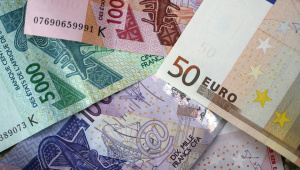
So far, the government of Togo has mobilized CFA363 billion out of the CFA400 billion it set its eyes on for its Covid-19 recovery and solidarity fund. This was recently disclosed by the minister of trade, Kodjo Adédzé.
According to the official, the sum came mostly from goodwill donors, technical and financial partners, but also the private sector. “Part of the money came from technical and financial partners. We appreciate the key role which the private sector played by supporting the government throughout the mobilization process.”
With the funds raised, the government covered the costs involved in supporting the poorest (Novissi scheme), countering the pandemic, and various measures aimed at ensuring economic resilience. In all, these were estimated, Adedze said, at CFA132 billion. The Novissi alone, a cash transfer scheme, cost more than CFA13 billion.
Germany and Togo recently signed a major deal to advance their partnership
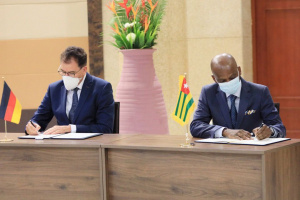
Recently in Togo, Gerd Müller, Germany’s minister for economic cooperation and development, inked a new partnership with Togo. The €142 million deal will revolve around three axes that will contribute to the country’s socio-economic development.
In detail, the first axis of the agreement aims to improve Togo’s business environment, by leveraging quality professional training, one that matches the labor market. The second axis will bolster processing in the agro-industry, in addition to fostering job creation and growth in related value chains.
The third, and last axis focuses on the promotion of good governance and the development of territories, using those as leverage to achieve inclusive growth.
Commenting on the partnership, President Faure Gnassingbé tweeted: “This new partnership attests to the dynamism of the bilateral cooperation and is an important support to the transformation of our economy, in line with the governmental roadmap.”
For his part, Müller said, “We wish to cooperate with Togo in the economic area, to further promote agribusiness, youth training and partnership relative to energy.”
Germany, let it be noted, is one of Togo’s key partners. It spent over CFA6 billion to support the Togolese government’s actions to tackle the Covid-19 pandemic.
Togolese State welcomes PIA and Arise in MIFA’s shareholding
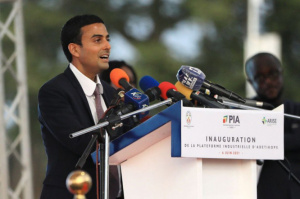
The government has opened up the shareholding of the MIFA, a mechanism promoting agricultural financing in Togo, to the PIA, an integrated industrial platform, and Arise Special Economic Zone, a Mauritian company and mother company of Arise IIP which designed the PIA. The two newcomers join the State and the FNGPC, a federation of cotton farmers.
The announcement was made in a statement released at the end of the council of ministers held on June 16. It comes on the sidelines of the assessment of a decree that allows the acquisition by private actors of the State’s shares in the PIA.
“This strategic partnership with PIA and ARISE Special Economic Zone aims to tackle the challenges encountered by the implementation of the MIFA SA mechanism, when it comes to financing agriculture - its key sectors notably, improving farmers' incomes and providing enough raw materials to local industries,” the government declared.
Klétus Situ
Togo: Regional investors better perceive debt securities

Last Friday, Togo closed its fifth bond issue, with a 7-year maturity, on the regional money market. The operation, a treasury recovery bond issue, enabled the country to raise CFA27.5 billion. This new success reflects investors’ sustained trust in Togo since the end of the sociopolitical crisis it experienced in 2017.
For the fourth issue, which closed on May 21, average weighted yield was 5.95%. For the issue before that, it was 6.09% on April 16 and 5.90%, for last week’s.
Over the past two months, Togo gained 19 base points. In comparison, Mali, the last country to issue a bond with the same maturity, recorded a yield of 6.02%.
The Togolese economy is expected to recover rapidly, after it was hard hit by Covid-19. The pandemic indeed halted growth which was being driven by the 2018-2022 national development plan.
As the pandemic keeps receding globally and recovery continues, Togo should record a growth of 4.3% in 2021 and 5.6% next year, the AfDB, a pan-African bank forecast. The increase should be driven by agriculture, greater investment in the transport, energy, and industry sectors.