

Togo First
Togo: EU Pumps €5M in Two Projects to Prevent Violent Extremism and Bolster Resilience in Savanes Region
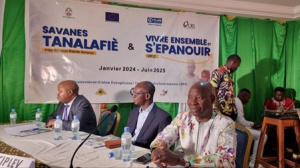
Plan International and Catholic Relief Services (CRS) spearhead two key projects in Togo’s Savanes region. Launched last week in Dapaong, the projects aim to prevent violent extremism and foster social cohesion and resilience. The European Union (EU) backed the projects with €5 million.
The first project, "Renforcement de la prévention de l'extrémisme violent, de la cohésion sociale et de la résilience des populations de la région des Savanes" (Savanes Tanalafiè), will provide technical and financial support to 10 local organizations for the implementation of micro-projects, with the goal of boosting employability and lowering people’s vulnerability. The project also involves building or repairing 10 solar-plate boreholes in 10 cantons hosting displaced persons and refugees.
@PlanIntTogo et CRS Togo ont lancé conjointement ce 6 Juin 2024 deux projets 'Savanes Tanalafiè' et 'Vivre Ensemble et s’Epanouir (ViEE)' financés par l’@AmbUETogo afin de contribuer à la réponse relative à la situation de crise sécuritaire qui prévaut au Togo#TgTwittos #Urgence pic.twitter.com/SiT3F1SaHJ
— Plan International Togo (@PlanIntTogo) June 6, 2024
The second project, "Vivre Ensemble et s'Epanouir", will be deployed in the prefectures of Tchaoudjo and Tchamba, in the Central region, and will directly affect 16,100 beneficiaries as well as 64,400 indirect beneficiaries. The initiative includes the distribution of school and health equipment to 10,000 people, financial support to 4,000 women, conflict prevention skills training for 2,000 individuals, including local authorities, and grants to 100 young entrepreneurs.
These projects complement the government-backed Programme d'urgence pour la région des Savanes (PURS), which aims to improve living conditions for people in Togo's northern region, which has been facing terrorist threats since November 2021.
The two new projects are expected to be completed by June 2025.
Esaïe Edoh
Papa Madiaw Ndiaye Takes the Helm of Ecobank’s Board of Directors
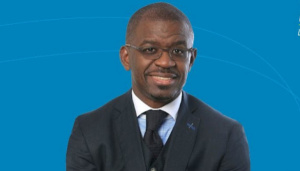
Papa Madiaw Ndiaye, the CEO and founder of AFIG Funds, has taken over as Chairman of the Board of Ecobank Transnational Incorporated (ETI), succeeding Cameroonian Alain Nkontchou.
Ndiaye's experience extends far beyond his work at AFIG Funds. He was Investment Director at Emerging Markets Partnership (EMP) in Washington, where he played a key role in raising USD 407 million for the AIG African Infrastructure Fund in 2000, the largest pan-African fund at the time.
Before joining EMP, Ndiaye worked for the International Finance Corporation (IFC), managing equity and debt investments for African financial institutions between 1996 and 2000. He also worked at Salomon Brothers and later with JP Morgan's Emerging Markets Group, laying the foundations for his expertise in securities trading in Africa and the Middle East.
Ndiaye's academic background is equally impressive, with an MBA from the Wharton School of Business, an MA in International Business from the Lauder Institute of the University of Pennsylvania, and a BA in Economics from Harvard College.
In addition to his business responsibilities, Ndiaye is also on the board of several entities, including the African Private Equity and Venture Capital Association (AVCA).
As the new Chairman of the Board, Ndiaye will have to work on returning dividends and tackling the problems encountered by the group's Nigerian subsidiary, which is going through a difficult period.
Fiacre E. Kakpo
Togo: Trade Ministry Launches E-Commerce Training Program for Entrepreneurs

The Togolese Ministry of Commerce is planning to train 25 entrepreneurs in e-commerce through a series of practical training courses across the country.
The aim is to "select an incubator of qualified and competent entrepreneurs to provide them with in-depth training," and to "significantly strengthen the knowledge and skills of entrepreneurs, with particular emphasis on e-commerce best practices," the ministry stated.
The ministerial department recently launched a call for expressions of interest, open to individual entrepreneurs and companies. Selected entrepreneurs will be trained in legal, technical, managerial, communications, and marketing skills.
This initiative is part of the e-business capacity-building program for Togolese SMEs, supported by the Arab Africa Trade Bridges (AATB) program. The deadline for applications is June 25, 2024.
The training program is designed to equip Togolese entrepreneurs with the necessary skills and knowledge to succeed in the rapidly growing e-commerce sector. By providing practical, hands-on training, the ministry hopes to create a pool of qualified and competent entrepreneurs who can drive the growth of e-commerce in Togo.
Ayi Renaud Dossavi
Togo Makes Progress on Urban Infrastructure Project with World Bank Support

Togo's Minister of Urban Planning, Kodjo Adédzé, met with a World Bank delegation in Lomé earlier this week to discuss the progress of the Urban Infrastructure and Development Project (PIDU).
The meeting highlighted the construction of drinking water infrastructure in Naki-est and Dapaong (in northern Togo), the rehabilitation of the Kpèlèou bridge, and roadworks in Kara. Both parties noted positive results in terms of infrastructure and job creation, with nearly 142,000 people employed during the project's implementation phase.
Adédzé and his team announced measures to initiate studies for the supply of drinking water to Naki-est from the Dalwak dam in Dapaong. The Ministry also highlighted the ongoing development of the Schéma directeur d'aménagement et d'urbanisme in six communes (Zio 1, Kloto 1, Ogou 1, Tchaoudjo 1, Tône 1 and Kozah 1).
The aim of the PIDU, financed by the World Bank, is to improve access to urban infrastructure and basic services in Togolese towns and cities. The project has made significant progress, with the construction of critical infrastructure and the creation of thousands of jobs.
Esaïe Edoh
Ecobank Plans to Raise $600M in Eurobonds in 2024
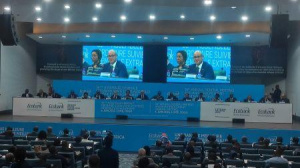
Ecobank seeks to raise $600 million to bolster its financing structure. This year, the Bank’s shareholders will not receive dividends, after the lender resumed their distribution last year. Ecobank’s revenues recently exceeded $2 billion.
Ecobank Transnational Incorporated (ETI) prepares to raise up to $600 million via Eurobonds. Alain Nkontchou, Chairman of the bank's Board of Directors, announced the plan on June 6, 2024, in Lomé. The move, according to the executive, is necessary to reinforce the lender’s financing structure.
This is the second consecutive year shareholders have been asked to vote on a new capital raising. Last year, they were asked to approve raising $500 million.
"On April 18, 2024, we repaid the $500 million Eurobond issued in April 2019 with short-term bridge financing. Today, we are seeking shareholder approval to replace this financing with a longer-term facility through a new Eurobond issue," Nkontchou said.
Togo's President Seeks Investment Opportunities in South Korea
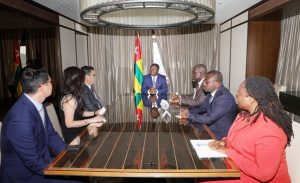
Togo's President Faure Essozimna Gnassingbé met with South Korean business leaders during the Africa-Korea Summit in Seoul, highlighting investment opportunities in his country.
The Togolese leader met with Cho Chaeho, Chairman of the Korean National Agricultural Development Authority, to discuss future collaboration in the agricultural sector. Togo's integration into the Korea-Africa Food and Agriculture Cooperation Initiative (KAFACI) would provide technical support, particularly in the rice sector. A delegation of KAFACI officials will visit Togo soon to put this collaboration into practice.
C’est dans cette même dynamique, que le Président de la République s’est entretenu respectivement avec le PDG de la Compagnie SEJIN. G&E, Monsieur Lee Kyoung Yeo et Madame Mafalda Duart, Directrice exécutive du Fonds vert pour le climat.
— Présidence Togolaise/Togolese Presidency (@PresidenceTg) June 5, 2024
La compagnie souhaite accompagner le Togo… pic.twitter.com/FwQIlryAfL
Discussions also focused on potential investments in the digital economy and environmental sectors. President Gnassingbé met with officials from the Korea-Africa Foundation and the Korea International Cooperation Agency (KOICA) to discuss Togo's ambitions in these areas.
Projects linked to sustainable environmental management were also discussed with representatives of the Green Climate Fund and the Korean company SEJIN G&E. The talks centered on support for government policies on climate change resilience, environmental remediation, and waste-to-biogas conversion.
These exchanges pave the way for future collaboration between Togo and South Korea, which already enjoy excellent relations.
Esaïe Edoh
Togo Prepares for Senatorial Elections

Togo is gearing up for senatorial elections after the legislative and regional votes on April 29. The Minister of Territorial Administration, Hodabalo Awate, has started the process by asking mayors to provide personal information on each municipal councilor.
This data will help the Independent National Electoral Commission (CENI) create the electoral list of grand electors for the 2024 senatorial elections. The required documents must reach the Ministry by Friday, June 7, 2024.
Municipal and regional councilors will elect 2/3 of the Senate members. The President of the Republic will choose the remaining 1/3.
The Senate's establishment is crucial for electing the next President of the Republic and the President of the Council of Ministers, as per the new Constitution in force since May 6. This will be a first for Togo.
The country, it should be noted, held regional and legislative elections on April 29.
Esaïe Edoh
Togo: Lomé to Host 5th European Film Festival on June 11-15

The 5th edition of the European Film Festival will take place in Lomé from June 11 to June 15, 2024. The event celebrates the best of European cinema and aims to encourage co-productions with Europe and foster exchanges between Togolese, West African, and European film professionals.
For five days, cinephiles will be able to enjoy a variety of films at the auditorium of the Institut français du Togo and the conference room of the Goethe-Institut in Lomé.
"Far from being aimed solely at professionals, this year's festival will offer screenings of carefully selected films to bring Togolese and European cinephiles together in front of the big screen. On the program are the best of Afro-European co-productions and major European festivals such as Cannes, the Venice Mostra, and the Berlinale," the Institut Français announced.
Alongside the screenings, a specific program is dedicated to professionals, providing Togolese scriptwriters and directors a platform to discuss with and learn from European experts. The best projects will be rewarded, thanks to the initiative of TOGO CRÉATIF, which supports the festival, to support the development and production of local cinematographic works.
Ayi Renaud Dossavi
Road Safety Workshop Held in Lomé to Promote Safe and Sustainable Transport
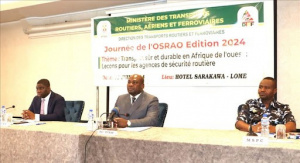
A workshop was held in Lomé on Wednesday, June 5, to promote road safety in West Africa. The event, organized by the Ministry of Road, Air and Rail Transport, brought together road safety agencies and transport stakeholders from several countries in the sub-region.
The workshop, part of the Organization for Road Safety in West Africa (OSRAO) day, focused on two major themes: "Safe and sustainable transport in Togo: issues and prospects" and "Modern technology at the service of road safety." The main aim of the proceedings was to raise awareness of road safety issues and explore effective ways of reducing road accidents and saving human lives.
"We have around 600 road deaths and more than 6,000 injuries every year in Togo. So it's really a question of public safety. It's a question for us to see how we will proceed to reduce traffic accidents on our roads," noted Dermane Tadjudini, Director of Road and Rail Transport.
The Secretary General of the Ministry of Road, Air and Rail Transport, Dr. Komlan Tindano, stressed the importance of safe, sustainable transport for the country's ecological and economic future. In Togo, reforms have been underway for several months, gradually transforming the transport sector and making it more organized and professional.
The government has also made it compulsory for all two-wheeled users, who account for over 70% of the Togolese vehicle fleet, to wear helmets to reduce the severity of accidents.
Togo: Cotton Output Surges but Farmers Remain Unsatisfied

Togo's 2023/2024 cotton season has come to a close. Compared to the previous season, output and yield, respectively, stood at 67,718 tonnes and 844 kilograms per hectare, up 45%.
According to Olam, all regions of Togo saw their performance improve, generating gross revenues in a surplus of CFA20 billion. However, farmers are not pleased.
"We've been watching Olam for over three years, and right now, it doesn't give us the confidence to be with them moving forward," said Koussouwè Kouroufei, president of the Fédération Nationale des Groupements de Producteurs de Coton (FNGPC).
The organization regroups five regional Unions for 27 prefectural Unions with 3075 producer groups, totaling 153,000 cotton growers.
Kouroufei complained that compared with other countries such as Chad and Côte d'Ivoire, where Olam is said to have significantly increased yields, results in Togo are far from expectations, stagnating at between 600 and 700 kilograms per hectare.
He also complained about stagnant yields well below expectations, unexplained debt increase, and chronic delays in distributing essential inputs such as fertilizers and pesticides.
"And worse still, they hang debts on the federation every campaign, without us knowing where these debts come from," the FNGPC’s boss added.
Olam took over Togo’s Cotton Company, Nouvelle Société Cotonnière du Togo (NSCT), in 2020. Its arrival was expected to have led to output doubling but the Asian group failed to meet expectations. Except this year, the output has declined steadily since Olam came.
"We, the farmers, that's our job and we've already started planting. Olam wasn't there, we were producing, so even if he leaves or stays, we're still going to produce. As head of the federation, we've already given instructions to our fellow growers to prepare the fields, and we're encouraging them to start sowing. The problems are there, but we reassure them that solutions will be found as they come," Koussouwè Kouroufei told Agridigitale.
Fiacre E. Kakpo