

Togo First
Lomé raises 88 billion CFA in latest operation on WAEMU-securities market

Togo raised CFA88 billion on the WAEMU-securities market, through its latest operation on the platform - a simultaneous issue of fungible treasury bonds. This is the amount retained for the triple issue in which Lomé initially expected to mobilize 80 billion from regional investors.
Overall, a note from the WAEMU-securities indicates, subscriptions to the issue amounted to 201 billion CFA (252% coverage rate).
In detail, bonds with a maturity period of 36 months garnered CFA76 billion but only 24 billion was retained. For bonds maturing over 60 and 84 months, they mobilized respectively 52 billion (22.78 billion retained) and 73 billion (40.84 billion retained).
It should be noted that interest rates for the three types of bonds are respectively 6.15%, 6.4%, and 6.5%.
Séna Akoda
Togo to emulate Gabon’s experience to advance the Adetikopé industrial platform project

To run the Adétikopé industrial platform (PIA), Togo will learn from Gabon’s experience in this area.
Over the past two weeks, Idiola Sandah, general manager of the platform was in Gabon for a professional immersion visit at the administrative authority overseeing the Nkok privileged economic zone (ZERP). This is an industrial site located around 30 km east of Libreville.
During his stay, the Togolese official met with his counterpart, Anne Nkene Biyo’o, and her collaborators, to discuss operations at the ZERP’s 23 administrations and its single window. Sandah took the opportunity to learn about the ZERP’s processes and missions.
Idiola Sandah also discussed with executives of the Gabon Special Economic Zone (GSEZ), which is the Zerp’s logistics partner. The GSEZ is a joint-venture established by the Gabonese government and Olam. The latter handles the PIA in Togo through Arise IIP, its arm in charge of integrated industrial infrastructure.
“Gabon’s success model inspires many countries, including Togo which wants to adopt this model to attract investors,'' Sandah said at the end of his trip. “There will be sustainable cooperation between the ZERP’s administrative authority and that in charge of Adétikopé’s industrial platform,” he concluded.
Klétus Situ (intern)
Covid-19: No vaccine in yet
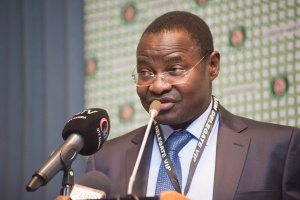
The Covid-19 vaccine is not yet available in Togo, let alone already being distributed. The confirmation debunking various rumors and fake-news circulating on social networks, causing the people to fear and panic, came from a statement issued by the ministry of health.
The ministry however noted that like many other countries, Togo “is getting ready to introduce the vaccine in the coming weeks.” And when that happens, “details concerning the period of the vaccination will be communicated officially.”
The public institution also emphasized that the vaccination “does not concern children.”
In this regard let’s recall that according to prior information, an inoculation campaign should first take place among healthcare workers, people more than 50-years old and less than that with co-morbidities.
Ayi Renaud Dossavi
The telecom regulator puts “some order” in the sector to benefit consumers

Togo’s post and telecommunication regulatory organ (ARCEP) has announced a number of measures regarding tariffs of communication and telecom services in the country. The measures aim to put some order in the sector and ensure transparency to favor consumers.
In a press release dated Friday, January 22, 2021, the body recalls “the principles of fair and reasonable pricing” which must henceforth govern the offers. It thus calls on telecom actors to boost “transparency and comparability of the offers available on the market,” to “allow consumers to guide their choices.”
To this end, the Regulatory Authority “obliges operators to communicate to users, in a clear and unequivocal manner”, everything that concerns the basic tariffs for their services, in terms of costs per minute, per number of SMS messages and per megabyte.
This need for transparency is also applicable to the rates for packages and promotions, in relation to actual rates which are in CFA.
“Unlimited” credit
It is worth noting that under the ARCEP’s new rules, credit on a SIM card cannot expire anymore, as long as that SIM card is active. In effect, this cancels expiration periods of credit cards (as long as SIM cards are valid).
A similar change is imposed on phone bundles which must now last a reasonable period, that the consumer is well aware of and is based on the subscription’s amount.
Lastly, credit transfer rates will cost “no more than 3% of the amount transferred, and cost to reach customer services cannot exceed CFA20 per call, regardless of how long the call lasts.”
Ayi Renaud Dossavi
80,000 tons of fertilizers to be stocked for the 2021-2022 agricultural campaign
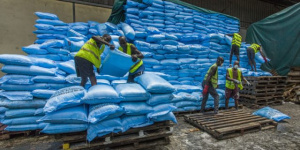
For the coming 2021-2022 agricultural campaign, Togo seeks to set aside 80,000 tons of fertilizers for farmers. This was disclosed last week by the Centrale d’Approvisionnement et de Gestion des Intrants Agricoles (CAGIA).
“We have been instructed to inform the various agricultural actors about the need to have sales points in every canton. We have the obligation to store the stocks by mid-February, before rains begin,” said Madadozi Tezike, managing director of CAGIA.
The amount targeted is far lower than the 120,000 tons that was set aside in 2020-2021. According to the head of the management committee of the CAGIA, this target falls under the ministry of agriculture’s roadmap involving, “first, the improvement of agricultural yield and productivity, second, the MIFA’s expansion to serve one million farmers by 2025, and third, the development of Kara’s agropoles.”
Klétus Situ (intern)
African Lease Togo lance Alease pay, sa solution mobile paiement

African Lease, établissement financier spécialisé dans le crédit-bail, lance une solution de paiement mobile à destination des particuliers.
Il s’agit d’une application mobile baptisée Alease pay et disponible pour iOS et Android. Cette solution utilisable uniquement en prépayé ne nécessite pas de compte bancaire, ont indiqué les responsables de la société.
L’entreprise dirigée par Toussaint Sossou précise par ailleurs que sa solution devrait permettre à ses utilisateurs d’effectuer des opérations de mobile banking, des paiements de frais administratifs (CNSS et OTR notamment), et des paiements par code QR. Les transferts d'argent entre utilisateurs sont également possibles.
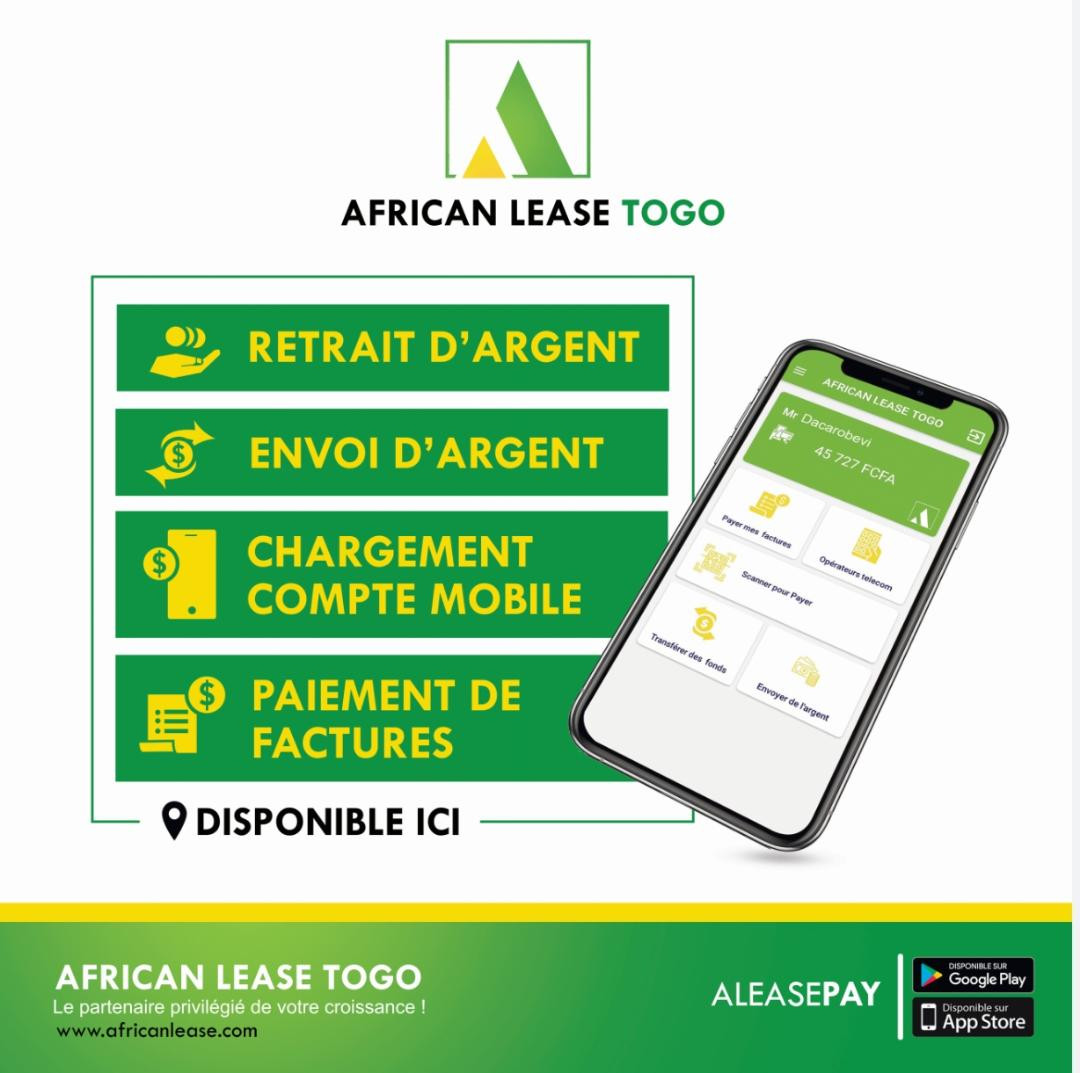
African Lease Togo qui avait déjà lancé en février dernier une solution similaire veut s'appuyer sur un partenariat noué avec la Société des Postes du Togo (SPT) dont les agences vont servir de point de recharge pour les comptes Alease Pay.
Klétus Situ (stagiaire)
UMOA-Securities: the 3rd edition of public securities markets conference is ongoing
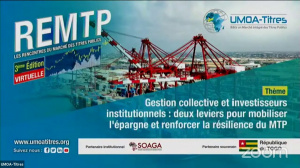
On Wednesday, the UMOA-securities agency launched the 3rd edition of its public securities markets meetup (REMTP 2021).
Due to the pandemic, the three-day event is happening online via Zoom and on the agency’s YouTube account. The chosen theme for the 2021 edition is “Collective management and institutional investors: two levers to raise funds and boost the resilience of the public securities market.”
“Held once every year, this conference is one of the major ways to boost the leadership of the public securities market, and help position it as a true investment option for all investors, and institutional investors especially,” said Adrien Diouf, director of UMOA-securities agency.
“It is most importantly an occasion for the actors operating in this market to meet, build partnerships, and make significant progress in their common projects,” Diouf added.
So far into the meeting, around 150 participants have registered. There are 30 speakers and four panels.
The conference is sponsored by the Togolese Treasury and Serge Ekué, president of the West African Development Bank (BOAD) was the guest speaker for its launch.
Online ads now taxed in Togo

From now on, advertisements on digital platforms will be subject to the value-added tax (VAT) in Togo.
The reform is one of the innovations of the 2021 finance bill. It aligns with the public authorities’ ambition to broaden the tax base. The authorities wish to boost the State’s tax collection capacity, in a context where the current capacity is insufficient to meet public charges and needs.
In effect, says a source close to the Togolese Revenue Authority, digital platforms will collect the VAT from every user conducting a financial transaction through ads, and give this tax to the State.
Séna Akoda
In 10 years, the ANADEB disbursed over CFA100 billion for grassroots development

Over the past decade, the National Agency Supporting Grassroots Development (ANADEB) spent more than CFA100 billion in projects to reduce poverty and improve lives in Togo.
The institution, set up in 2011 by the government, focused mainly on micro-projects involving the construction of community infrastructure and support to local businesses.
Since its creation, the ANADEB rehabilitated over 2,600 markets and sanitation facilities, built and rehabilitated 505 classrooms, and equipped hundreds of health centers. Each year, the public institution’s activities benefited more than 1500 communities, across 300 poor cantons.
However, amid the Covid-19 pandemic, the ANADEB redirected its actions toward sensitization and resilience. “Works are still ongoing in this framework, in line with the government’s vision, and we wish for our collaboration, with municipalities especially, to continue for the good of the people,” the entity declared.
Séna Akoda
The decrease in phosphate sales caused mining exports income to slump in 2019
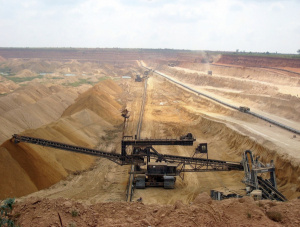
In 2019, Togo’s mining exports slumped by 8.2%, from nearly CFA100 billion in 2018 to nearly CFA92 billion. The figures were revealed by the Central Bank of West African States (BCEAO).
In detail, clinker exports in 2019 made up 60% of the country’s mining exports that year. They generated CFA53.8 billion, up 1% compared to 2018. Benin, Ghana, and Burkina Faso were the main buyers.
Meanwhile, phosphate exports fell from CFA46.2 billion in 2018 to CFA37.5 billion in 2019 (-19%). According to the BCEAO, volumes exported were 15% lower from one year to the other. The main buyers in 2019 were India, Australia, and Canada.
In 2019, Togo’s total export income was CFA618.2 billion, up 3% from the amount recorded in 2018.
Klétus Situ (intern)