
Togo First
Saudi Arabi to invest in Togo
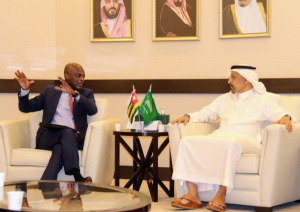
In Saudi Arabia since Monday, Togo’s Foreign Affairs Minister, Robert Dussey, recently met with the Saudi Minister of Investment, Khalid Al Falih. “I thank my dear elder Khalid Al-Falih, the Saudi Minister of Investment for his willingness to invest in Togo. In comparative terms, our country is very attractive,” the Togolese official wrote in a tweet posted on Tuesday. Dussey presented partnership opportunities that exist for the two nations’ private sectors.
“I discussed possibilities of partnerships between our two governments and also between the private sectors in the areas of trade, agriculture, tourism industries. I explained to the Minister of Trade that in line with the 2018-2022 PND and the government's 2020-2025 roadmap, Togo launched an industrial platform in Adétikopé (PIA), and put in place mechanisms and infrastructure to boost agriculture," the foreign affairs minister said.
Besides investment opportunities, Dussey emphasized “the opportunities and comparative advantages of Autonomous Port of Lomé,” and positioned the platform as an entry point for Saudi goods in the sub-region.
The port is the best, both in the sub-region and Africa, when it comes to container traffic and transhipping.
Robert Dussey, it should be recalled, was in Saudi Arabia last July, as part of efforts to boost economic cooperation between Lome and Riyadh.
Ayi Renaud Dossavi
WAEMU Commission launches 2nd edition of Tremplin Startup WAEMU contest
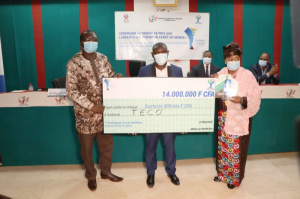
The WAEMU commission has recently launched, in partnership with its regional consular chamber (CCR-WAEMU) and national consular chambers of its member states, the second edition of the Tremplin Startup WAEMU contest. The five best startups will get respectively CFA14 million, CFA13 million, CFA12 million, CFA11 million, and CFA10 million to grow their activity.
A CFA5 million prize will also be given to each of the three best startups from every participating country.
It should be emphasized that only startups officially registered after January 1, 2017, and operating in the WAEMU can participate. Primarily, these are businesses that leverage digital technology to boost productivity in the agro-industrial sector.
The main goal of the commission, via this contest, is to foster modern and innovative entrepreneurship, as well as support the efforts of entities that support entrepreneurs in the region.
Startups interested have until October 25 to apply. Application forms are available at national consular chambers.
The previous edition of the contest was won by a Burkinabe Startup, TECO2.
Esaïe Edoh
Togo: Government and BBOXX ink deal to boost access to smartphones

The Togolese government signed with BBOXX, a British startup, a memorandum of understanding to boost access to smartphones in the country. The MoU, inked on Sept. 27, concerns a project called Togo Smartphone, which enables a flexible payment of smartphones.
Under the agreement, BBOXX will first proceed to a market study to find out people’s needs and preferences. The pilot phase will follow and here, the British firm will supply the phones to civil servants and public workers. In the last phase of the program, anyone will be able to get a smartphone on a Pay-As-You-Go basis.
Cina Lawson, Togolese minister for the digital economy, said the program is "crucial to achieve the government’s targets regarding financial inclusion and to provide populations more digital services like the Novissi."
The program should also make it easier to get criminal records, as this can be done online since last August.
BBOXX has been operating in Togo since 2017. It supplies solar systems to households on a Pay-As-You-Go basis. In 2020, it signed an agreement with EDF, the French power developer, to supply solar-powered irrigation systems to 5,000 farmers.
Esaïe Edoh
Organized Crime: Which countries have the highest levels in West Africa?
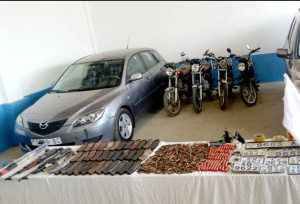
The Global Initiative Against Transnational Organized Crime released last week its Global Organized Crime Index. This study, developed over two years, evaluates levels of crime and resilience in all 193 UN member states.
The index evaluates countries according to their criminality on a score of 1 to 10, lowest to highest organized crime levels, based on their criminal markets score and criminal actors score, and their resilience to organized crime.
Togo
Twenty-fourth (24th) in Africa and 4th in the WAEMU, Togo has a score of 5.33. It comes just before Benin (26th in Africa with 5.25), Guinea (27th in Africa with 5.2), and Senegal (34th in Africa, with a score of 4.81, the lowest in WAEMU).
Across the Union, Côte d’Ivoire had the highest score (6.15), and was ranked 11th in Africa and 36th worldwide. Next comes Niger (6.01), Mali (16th in Africa with a score of 5.89), and Burkina Faso (21st in Africa with a score of 5.49).
Togo’score is below West Africa’s average of 5.47.
Nigeria, number one in West Africa
In West Africa and the ECOWAS, Nigeria has the highest score, 7.15. It is right behind DRC which has the highest score in Africa (7.75). The least impacted African country is Sao Tomé & Principe, with a score of 1.78 over 10.
East Africa is the part of the continent where organized crime is most prevalent (5.66). It is followed by West Africa (5.47), Central Africa (5.11), North Africa (4.8), and Southern Africa (4.67).
Ayi Renaud Dossavi
2021 Ranking of West African Countries with Highest Levels of Organized Crime
|
World |
Africa |
West Africa |
Country |
Score |
|
5. |
2 |
1 |
NIGERIA |
7.15 |
|
36. |
11 |
2 |
CÔTE D'IVOIRE |
6.15 |
|
41. |
14 |
3 |
GHANA |
6.01 |
|
41. |
15 |
4 |
NIGER |
6.01 |
|
49. |
16 |
5 |
MALI |
5.89 |
|
67. |
21 |
6 |
BURKINA FASO |
5.49 |
|
68. |
22 |
7 |
GUINEA BISSAU |
5.45 |
|
71. |
23 |
8 |
SIERRA LEONE |
5.4 |
|
72. |
24 |
9 |
TOGO |
5.33 |
|
76. |
26 |
10 |
BENIN |
5.25 |
|
78. |
27 |
11 |
GUINEA |
5.2 |
|
100. |
33 |
12 |
GAMBIA |
4.83 |
|
102. |
34 |
13 |
SENEGAL |
4.81 |
|
119 |
40 |
14 |
MAURITANIA |
4.38 |
|
141. |
44 |
15 |
CABO VERDE |
4.04 |
Adiwale Partners reaches final close of its first fund, raising €60M
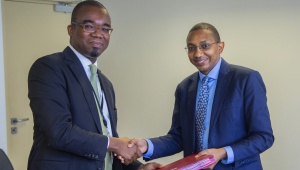
Adiwale Partners, the private equity firm founded by Jean-Marc Savi and Visseho Gnassounou (both Togolese), made a final close of its first fund, Adiwale Fund I. The news was reported by Agence Ecofin.
The fund manager which is committed to financing SMEs in Francophone West Africa raised €60 million ($69.6 million), less than the €75 million it expected. According to the firm, its target was missed because of “a very difficult fundraising environment, a situation exacerbated by the Covid-19 pandemic.”
Regardless, Adiwale still has the ambition to build a portfolio of growing, attractive assets, in West Africa’s French-speaking countries.
Initially, Adiwale Fund I will focus on four countries - Côte d’Ivoire, Senegal, Mali, and Burkina Faso- where it will invest between €3 million and €8 million per transaction, in well-established SMEs that can grow rapidly. The Fund will primarily finance businesses that operate in the consumer services, business services, and industrial sectors.
Last June, it acquired stakes in an Ivorian maintenance climatization technique firm, Agence Ecofin indicated.
For its final close, Adiwale Fund I welcomed as the last investor the International Finance Corporation, the private-sector investment arm of the World Bank. Before that, however, the Fund had attracted several African and international financing institutions, including the African Development Bank (AfDB).
Ayi Renaud Dossavi
Organizers of Rencontres Africa launch registration for the 2021 Neofarming Africa contest
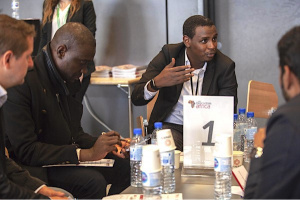
Registrations for the next Neofarming Africa contest have been open since last Thursday. The previous edition of the contest was won by a Togolese, Dodji Ognankitan.
Businesses that are active in the agriculture and agribusiness sectors and interested in developing innovations or have promising projects can submit, until November 20, their projects via the new platform dedicated to the event.
Applicants will be selected based on proposals for solutions to specific agricultural challenges in Africa. The best project will be backed. For example, last year’s winner won €20,000 and was able to set up a factory that turns cassava into gari, for consumption, and starch for the pharmaceutical industry.
“Neofarming”, it should be recalled, attracts many well-known professionals from financial institutions. The contest aims to help identify and promote great projects. Also, it is part of the Rencontres Africa forum, which should take place from Nov 30 to Dec 2, 2021.
Esaïe Edoh
UNDP Togo seeks cooperation framework with the private sector
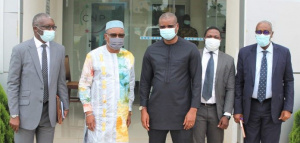
UNDP Togo wishes to have a cooperation framework with the Togolese private sector. The ambition was expressed by the institution’s resident representative, Aliou Mamadou Dia, as he met with the head of the National Employers’ Council (CNP-Togo), Laurent Coami Tamegnon, last week.
The framework should serve as a platform to discuss issues the sector faces and recommend solutions.
Recommendations made via the framework will, in fine, enable the UNDP to take steps to “discuss the real issues of the private sector.” This is in line with the entity’s main mission, which according to the CNP, is to support “economic growth and create major changes.”
Aliou Dia added that other UN bodies would be mobilized to support Togolese private enterprises as part of efforts to achieve the sustainable development goals (SDGs).
UNDP Togo has been active in the country for many years. Recently, it launched the Togolese Facility for Acceleration and Innovation (FTAI). This project gets annual financing of CFA265 million and is aimed at supporting innovation led by local startups and SMEs.
Esaïe Edoh
World Bank disburses first tranche of CFA145 billion to support the Lomé-Ouagadougou-Niamey corridor project
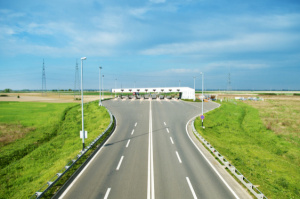
The World Bank approved last Wednesday the disbursement of CFA145 billion for the Lomé-Ouagadougou-Niamey corridor.
Half loan, half grant, the facility will allow Burkina Faso to develop the smart corridor project which it steers through the deployment of an integrated information system. The funds will also be used to build community infrastructures to boost the resilience of people living around the corridor.
The Lomé-Ouagadougou-Niamey corridor spans 1,065 km. This project will boost connectivity, security and create economic opportunities along the road axis that connects Burkina Faso, Niger, and Togo. It will also boost trade between these three countries by cutting delays and costs for moving goods.
The facility is the first tranche of a $470 million commitment -for the project- approved by the World Bank’s board on July 15, 2021.
Esaïe Edoh
Togo: Gvt will Soon Set Up an Agency for its Digital Projects
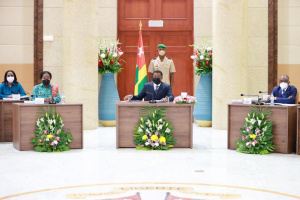
Agence Togo Digital (ATD) is the name of the agency that the Togolese government will soon set up to coordinate all its digital projects. A draft bill for its creation, organization, and operation was examined and adopted last Wednesday, during the council of ministers.
The new agency will back the government in the implementation of its digital projects - projects that concern 75% of the 5-year roadmap. It will also “ensure their relevance and the efficient use of State resources,” reads the statement issued after the ministers’ council.
Another mission of the ATD is to help ministries and public administrations digitize their services.
The related bill’s examination seems to align with Lomé’s ambition to use the digital industry as a lever to achieve inclusive and sustainable economic growth. Last March, the government passed a decree to dematerialize payment modes in public administration and focused on financial inclusion.
Still, in line with the same ambition, Togo established last June its first center to store and secure sensitive data - Lomé Data Center.
Esaïe Edoh
Shelter Afrique to commence affordable housing project very soon in Togo
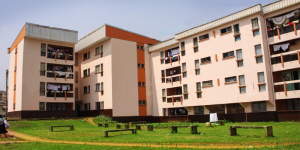
Togo’s President, Faure Gnassingbé, met with Shelter Afrique’s CEO, Andrew Chimphondah, last Thursday. Just after the meeting, Chimphondah said the firm would send to Lomé a technical team for the effective launch of its social housing project in the capital.
The project falls under a public-private partnership inked by the State and Shelter Afrique last March.
“We talked about the partnership between Shelter Afrique and Togo. This partnership includes supporting the construction of 20,000 social housing units, a project that is part of Togo’s development plan,” said Andrew Chimphondah.
Under the agreement, Shelter Afrique will partly finance the construction of 3,000 affordable social housing units in Togo. It will also act as an arranger to gather the rest of the financing needed from other investors.
The Togolese government, let’s recall, wanted to build 20,000 social housing units by 2022, but the deadline has been extended to 2025 due to Covid-19.
For this project, the country is supported by the West African Economic and Monetary Union (WAEMU) Commission, through the WAEMU Affordable Housing Finance Project (financed by the IDA).
Esaïe Edoh