Togo Among Top Five African Countries for Positive Perception of Russia
 Tuesday, 03 March 2026 13:59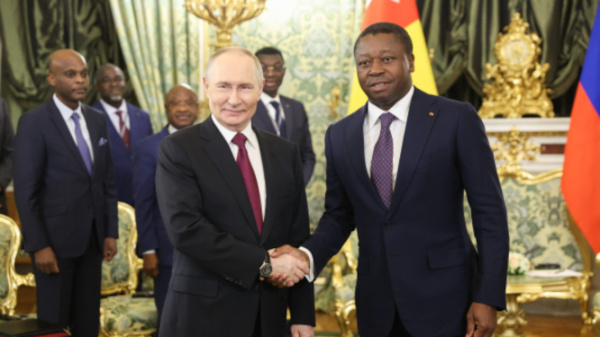
(Togo First) - Nearly half of Togolese view Russia’s economic and political influence on their country as positive, according to Round 10 of the Afrobarometer 2024-2025 survey covering 38 African nations.
This places Togo in the upper tier of the continental ranking. However, it remains below levels recorded in several other West and Central African countries. A majority of Togolese aware of the Russia-Ukraine conflict also say their government should remain neutral.
A broadly positive but mixed perception
Specifically, 49% of respondents say Russia’s economic and political influence is “somewhat” or “very” positive. This ranks Togo fifth among the 38 countries surveyed, tied with Chad, Congo-Brazzaville and Guinea.
Togo remains well behind Mali, where positive perceptions reach 88%, and Cameroon at 60% — two countries where Russia has expanded its presence, particularly through security partnerships.
At the other end of the scale, Botswana (13%), Eswatini (14%) and Lesotho (14%) post the lowest figures.
The continental average stands at 36%, placing Togo above the African norm and broadly in line with several Francophone Sahelian and Central African states.
A further 9% of Togolese express a neutral view, while 27% say they have no opinion or decline to answer. Sixteen percent consider Russia’s influence negative.
However, an important qualification applies. Although perceptions of Russia in Togo exceed the continental average, they remain below those of other major external actors.
Across the 38 countries, China leads with 62% positive views. Regional organizations follow at 56%, the African Union at 55%, the United States at 52%, and the European Union at 50%. Russia, at 36%, ranks near the bottom behind India (39%) and France (41%). This pattern holds across much of the continent. While Russia benefits from notable support in countries such as Togo, it does not match the standing of long-established economic partners or multilateral institutions.
Limited awareness of the war in Ukraine
Only 54% of Togolese surveyed say they have heard of the Russia-Ukraine war, placing the country in the lower quartile of the ranking, tied with Chad.
The African average is 70%. Island states or countries with higher levels of information connectivity — including Cabo Verde (98%), Seychelles (94%) and São Tomé-et-Príncipe (91%) — report significantly higher awareness. Within West Africa, Ghana (72%) and Senegal (71%) show higher levels of awareness than Togo. Benin and Nigeria report similar figures at 49%.
Among Togolese aware of the conflict, 75% say their government should remain neutral, slightly above the continental average of 72%. Support for Russia stands at 16%, while only 3% back Ukraine.
This preference for neutrality is widespread across Africa. Mali is a notable exception, where 72% favor Russia, reflecting closer political and security ties between Bamako and Moscow. Neutrality also exceeds 75% in Senegal, Côte d’Ivoire and Ghana.
Ayi Renaud Dossavi