Regional disparities drive food price gaps across Togo
 Tuesday, 17 March 2026 12:24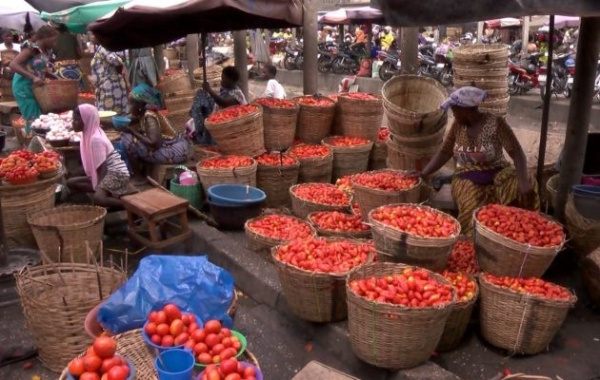
(Togo First) - A kilogram of tomatoes costs 992 CFA francs in Lomé in February 2026. In Kara, the same quantity sells for 529 francs. In the Savanes region, it drops to 471 francs, less than half the capital’s price. The gap reflects a reality Togolese households face daily: food prices vary widely across regions.
Data published by the National Institute of Statistics and Economic and Demographic Studies (INSEED) for February 2026 provides a precise measure of these differences, product by product.
Cereals: Cheaper outside Lomé
For staples such as rice and corn, the pattern is clear: the farther from Lomé, the lower the price. Imported long-grain rice sells for 636 CFA francs per kilogram in Greater Lomé, compared with 415 francs in Plateaux-Est, a difference of more than 50%. White corn follows the same trend, at 231 CFA francs per kilogram in Lomé versus 143 francs in Kara and 147 francs in the Savanes. For households consuming several kilograms of cereals each week, the gap quickly adds up over a month.
The difference largely reflects proximity to production areas. Northern Togo is a major agricultural zone, where cereals move directly from farms to local markets without the transport costs and intermediaries that push up prices in the capital.
Fresh vegetables: The pattern reverses
For some vegetables, the trend moves in the opposite direction. Green chili peppers are far more expensive in Plateaux-Est, at 1,356 CFA francs per kilogram, than in Lomé at 919 francs or in the Savanes at 624 francs. Yam costs 451 CFA francs per kilogram in Lomé, compared with 338 francs in the Centrale region. These gaps reflect local supply chains and harvest cycles specific to each area.
Palm oil: Higher prices in the north
Traditional palm oil, known as zomi, highlights these geographic imbalances. It sells for 1,621 CFA francs per liter in Lomé but rises to 2,382 francs in the Savanes and 2,364 francs in Kara. The reason is straightforward: production is concentrated in the south, and transport costs increase with distance.
Meat and fish: Lomé remains the most expensive
Beef is most expensive in Lomé at 3,003 CFA francs per kilogram, compared with 2,154 francs in the Savanes. Smoked fish presents a more mixed picture. Smoked horse mackerel, known locally as akpala, costs 3,596 CFA francs per kilogram in Lomé, but 4,269 francs in the Maritime region and 3,924 francs in the Savanes, areas reached through longer distribution chains.
Administered prices: A national constant
One constant applies nationwide: fuel and butane gas prices are identical across regions. Gasoline sells at 680 CFA francs per liter, diesel at 695 francs, the small gas canister at 4,740 francs and the large one at 9,875 francs, whether in Lomé, Kara or the Savanes. These prices are set by the state, which absorbs transport cost differences to avoid penalising landlocked regions.
These regional price gaps are significant. The same salary does not carry the same purchasing power depending on where people live. In Lomé, incomes are generally higher, but so are prices. In rural northern areas, households pay less for certain local products but face higher costs and greater difficulty accessing goods sourced elsewhere.
INSEED collects this data monthly, tracking 810 products across nearly 4,800 points of sale nationwide.
Fiacre E. Kakpo