CAMES adopts “Lomé Declaration” on common research policy
 Friday, 13 March 2026 11:13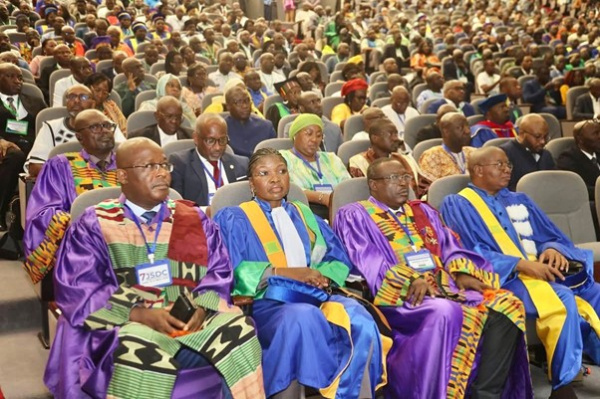
(Togo First) - Member states of the African and Malagasy Council for Higher Education (CAMES) adopted a common research policy during a four-day scientific conference held in Lomé, aimed at harmonizing research strategies across French-speaking Africa.
The conference’s main outcome was the adoption of the "Lomé Declaration," a framework designed to strengthen scientific cooperation among the organization's 19 member states.
The declaration was drafted at preparatory meetings in Bamako before being amended by ministers gathered in the Togolese capital.
CAMES Secretary General Professor Souleymane Konaté described the moment as a turning point for the organization. "The first major step forward is the declaration of the common research policy for the CAMES area, affectionately named the Lomé Declaration," he said. "This founding text is not another statement of intent. It is our collective vision for the scientific research we want."
The 7th edition of the CAMES Scientific Days, held from Monday, March 9 to Thursday, March 12, brought together more than 1,000 participants, including 903 presenters from Africa, Europe and other regions. The scientific program featured nearly 1,000 papers, delivered as oral presentations and posters.
In his closing remarks, Togolese Education Minister Mama Omorou welcomed the adoption of the common framework. "It is now up to us to strengthen the bridges between these capacities and our national research institutions in order to create a genuine space for the circulation of knowledge, technologies and talent," he said.
Beyond academic coordination, discussions focused on research funding and on directing it toward productive sectors such as energy, agro-industry and local resource processing.
Member states are now expected to incorporate the Lomé Declaration into national policies to deepen scientific integration and support the continent's economic development strategies. The call comes as research funding faces significant structural challenges across the continent. Africa, which accounts for more than 18 percent of the world's population, produces only around 2 percent of global scientific output, with the CAMES area contributing close to 1 percent.
Ayi Renaud Dossavi