
Togo First
Togo: WAEMU deputies meet in Lomé to discuss two major topics
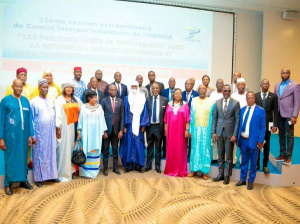
Lomé is hosting the 33rd extraordinary session of the Interparliamentary Committee of the West African Economic and Monetary Union (CIP-UEMOA). Started on May 8, the meeting gathers deputies from all eight Member States and ends on May 12.
The deputies will discuss the Union’s Program Budget reform and its Fiscal Transition strategy. According to Adam Efangal, president of CIP-UEMOA, the reform should enable member countries to better manage their public finances, while the strategy aims to reinforce the Union’s budgetary space.
The ongoing meeting is part of the Committee’s annual activities. Its goal is to enable the WAEMU’s deputies to know more about new public finance management techniques, to foster social harmony and economic development across the Union.
Togo: Parliament allows the government to ratify the African Medicines Agency Treaty
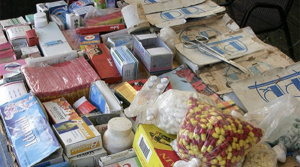
Togo’s parliament approved, on May 8, the ratification (by Togo, ed. note) of the African Medicines Agency (AMA) Treaty. This should allow the country to better fight the use and distribution of fake drugs, and bolster its pharmaceutical industry.
Fighting counterfeit drugs is one of Lomé’s main priorities. In 2020, after a summit on the issue, Togolese authorities, several African leaders, and the Brazzaville Foundation launched the “Lomé Initiative”, a project aimed at criminalizing the trafficking of fake drugs.
The AMA Treaty, which was ratified in Addis Ababa in February 2019, has the objective of enhancing and safeguarding the health of Africans by guaranteeing prompt and dependable availability of secure and quality-assured medications. The Agency will collaborate with African Union (AU) member countries and Regional Economic Communities (RECs) to achieve this goal. The Treaty officially became effective in November 2021.
According to the World Health Organization (WHO), fake drugs kill over 100,000 people every year in Africa, and this highlights the importance of an institution such as the AMA.
Togo: BOA Togo teams up with BKG Distribution to help farmers easily get loans and equipment

Last week, the Bank of Africa (BOA) and BKG Distribution, a group that sells agricultural equipment, formed a partnership in Togo to provide support to local farmers.
Under the deal, BOA Togo will provide individual farmers or groups of farmers a lease to finance their activities. Meanwhile, the BKG Distribution group, newly established in Lomé, will provide them with agricultural equipment (such as combine harvesters, tractors, etc.).
Borrowers, according to the agreement, will be able to repay the lease over three years, with "competitive interest rates".
The new partnership responds to a demand of farmers for funds, said Bassirou Bonkoungou, Director, BKG Distribution Group. “Through the lease solution, they (farmers, ed note) will be able to secure funds easily and rapidly,” added Youssef Ibrahimi, General Manager of BOA-Togo. Simply put, the farmers will be able to get loans without an upfront payment.
The partnership between BOA and BKG Distribution aligns with the government’s commitment to support agricultural transformation and make the sector a development lever.
Among the steps that Lomé took to achieve this objective is the recent launch of a Centre for Agricultural Mechanization (CRMA) in each of Togo’s five regions.
Esaïe Edoh
World Bank Concludes Assessment of Food System Resilience Program Implementation in Togo
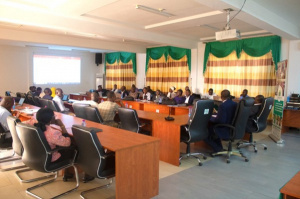
A World Bank delegation, present in Lomé, Togo, since May 2, 2023, finished, on May 8, evaluating the implementation of the Food System Resilience Program (FSRP) in the country.
The delegation reviewed, with Togolese actors, suggestions made during the first support mission and assessed work done under the 2023 annual budget as well as work plans for the Program. The various parties also assessed financial management and procurement towards enhancing the FSRP’s performance.
The evaluation allowed the State to recommend new steps to improve the Program’s implementation.
The FSRP, a program covering West Africa, is backed by the World Bank. The Bretton Woods institution has invested $90 million (over CFA50 billion) in the program.
Esaïe Edoh
Togo-France: Gnassingbé and Macron meet today to talk peace and cooperation

The President of Togo, Faure Gnassingbé, and the President of France, Emmanuel Macron, are meeting today in Paris. The Togolese leader was invited by his European counterpart.
According to the Togolese Presidency, the two men will mainly talk about cooperation between their countries, and regional issues, especially relative to security and peace.
"The dinner scheduled at the Élysée should, indeed, be an opportunity to discuss Togo's notable role in the fight against terrorism, cross-border crime, and violent extremism in West Africa and the Sahel, as well as His Excellency Faure Essozimna Gnassingbé's constant commitment to regional peace and stability," the Presidency said
Recently, the Togolese leader mediated in and helped solve a dispute between Mali and Côte d’Ivoire, involving 49 Ivoirian mercenaries.
The last time Gnassingbé had a face-to-face meeting with Macron was in April 2021. At the time, they had talked about bilateral cooperation, economy, and investments, and on the sideline, the Togolese leader had met various bosses of big French firms, active in sectors like energy, water, infrastructures, and the digital industry.
Ayi Renaud Dossavi
Togo: BOAD to support Duval’s mall project in Lomé
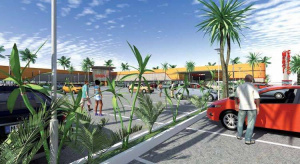
During its 135th board meeting on May 8, the West African Development Bank (BOAD) announced its plan to invest CFA5.13 billion in a mall project in Lomé, Togo.
"The project will contribute to making Togo a premier business center by setting up a commercial platform of international standing," the Bank noted. The project is carried out by the Duval Group, a French real estate company.
In detail, the project involves constructing a food hypermarket with a floor area of 5,350 m² (equivalent to a sales area of 3,200 m²), 4,863 m² of medium-sized areas divided into six volumes, 1,340 m² of boutique space, a food court area of 525 m² with an outdoor terrace, 1,075 m² of office space upstairs, and 304 parking spaces.
According to projections, the center can accommodate a total of 3,500 people, of which 3,150 will be visitors and 350 will be staff. Overall, the project is expected to cost CFA5.94 billion and be completed within 18 months. The costs should be divided as follows: CFA2.13 billion for the hypermarket, CFA1.39 billion for the shopping gallery, and CFA1.26 billion for the other attractions around the shopping center.
Two years ago, the Duval group started preliminary works for the project located at Bè-Massouhouin-GTA (Golfe 3 Commune, Lomé).
Ayi Renaud Dossavi
BCEAO could soon increase its key interest rates for the fifth time since June 2022
This could strongly impact regional financial markets and mirrors a global trend of monetary tightening by Central Banks.
The Central Bank of West African States (BCEAO) might increase its key interest rates at the upcoming monetary policy meeting, scheduled for June 2023, according to information from Agence Ecofin. This would be the fifth consecutive time within a year that the Bank will raise its rates, mirroring a global trend of monetary tightening among major central banks such as the European Central Bank (ECB) and the US Federal Reserve (Fed).
Between June 2022 and now, the BCEAO has raised its key interest rates four times. Through this, the apex lender aimed to control inflation, safeguard foreign exchange reserves and stabilize economic growth. The latest hike was in March when the Bank increased its refinancing rate to 3%.
Despite inflation decreasing for four consecutive months, it steadied in March 2023 reaching 5.7%, far above the BCEAO's target of 3%. Analysts believe raising the key interest rates more would send a strong signal to the market, indicating the Central Bank's commitment to controlling inflation and maintaining financial stability. This could bolster investor confidence in the regional economy and potentially impact the equity market, favoring bond investments and other less risky financial assets.
However, this monetary adjustment also suggests the BCEAO is not convinced that the recent downward inflation trend will continue, and it fears a long-term increase. More tightening could be seen as "overconfidence" in the WAEMU’s economy. According to the IMF, the latter is expected to grow at 6% this year compared to 5.5% in 2022. Last February, the BCEAO predicted that the WAEMU’s real GDP would stand at 5.1% and 5.3%, in Q1 and Q2 2023, respectively. In Q4 2022, the figure stood at 5.4%.
It's worth noting that previous increments in key interest rates led to higher bond yields and a liquidity crisis in the sovereign bond market. However, the situation stabilized in April, thanks to a measure allowing banks to buy their sovereign shareholders' securities in large quantities. The average coverage level for issues rose to 157.10% last week (first week of May) from less than 100% throughout March. It was already at 132% in the last week of April, reflecting a growing appetite among investors for public securities.
A new increase in key interest rates might be welcomed by investors looking for attractive returns in the bond market. But for the region's States, already cut off from international financial markets, the challenges posed by a rise in the cost of regional financing would only grow. This could impact the financing of budget deficits. The net financing needs of governments are estimated at over 4,300 billion FCFA (about $7.2 billion) this year.
On the other hand, states like Benin, which have managed to keep inflation within the BCEAO's target range, find themselves bearing the brunt of the increased key interest rates and the resultant rise in the costs of regional financing.
Fiacre E. Kakpo
Togo: the Autonomous Road Maintenance Financing Company raised CFA30 billion in 2022
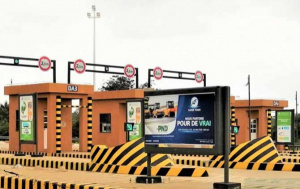
In Togo, the Autonomous Road Maintenance Financing Company (SAFER) raised CFA30.46 billion for the 2022 fiscal year from its maintenance activities. This is about 2 billion less than its target for the period–CFA32.84 billion.
The government disclosed the figure on May 8, 2023, during its latest council of ministers. The Minister of Public Works, Zourehatou Kassah-Traoré, on the occasion, stressed the importance of modernizing the country's road transport infrastructure.
Many of the social measures that the government introduced to reduce the cost of living had an impact on the SAFER’s efforts to raise funds. Among these measures was the suspension of the Motor Vehicle Tax (TVM) which caused SAFER to lose nearly CFA2 billion. However, when the tax was reinstated in 2019, the Company was able to raise CFA1.32 billion the next year.
Ayi Renaud Dossavi
Togo: Almost a million citizens live abroad, foreign affairs minister reports
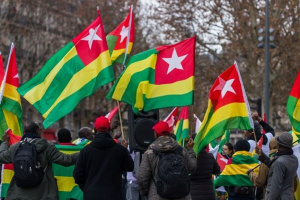
Nearly one million Togolese citizens live outside their home country. The figure was disclosed by Robert Dussey, the Minister of Foreign Affairs, on May 8, during a Council of Ministers.
The diaspora counts exactly 950,436 people, according to a censure carried out in 2022. Among them are 52.82% men and 44.18% women.
Leveraging the data, the government will better guide its policies and decisions to make the diaspora a key contributor to Togo’s development.
In 2019, Togo set up a High Commission for Togolese Abroad (HTCE) in this same framework. The Commission serves as a bridge between the government and the diaspora.
The Togolese diaspora contributed $441 million (238.3 billion FCFA) to the country’s diaspora, down from $458 million (247 billion FCFA) in 2019, according to Robert Dussey.
Esaïe Edoh
Togo: Government to adopt a new law to better fight climate change

The Togolese government wants to adopt a law to better fight climate change. On May 8, 2023, during its council of ministers, Lomé greenlit a draft bill "on combating climate change".
"It has become necessary to take measures aimed at strengthening the implementation of activities with high potential for reducing greenhouse gases, as well as promoting the development of innovative technologies in the field of climate change," the government stated in a communiqué issued after the meeting.
Adopting the draft bill is part of "key reforms outlined in the government's roadmap," especially those related to environmental legislation. The bill still needs to be approved by the parliament.
A few months ago, Lomé adopted a decree to boost the country’s carbon storage in Togo, also to fight climate change.
Ayi Renaud Dossavi