Togo Taps Regenerative Farming to Build a More Resilient Cotton Sector
 Saturday, 04 July 2026 04:21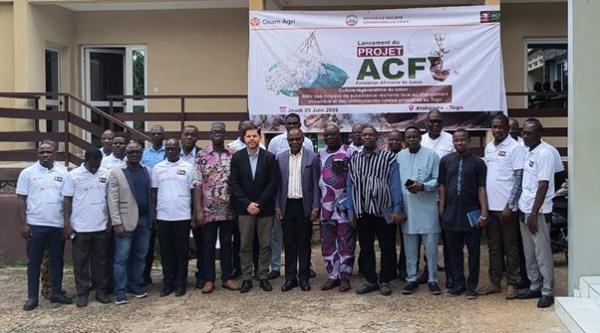
(Togo First) - Togo's New Cotton Company (NSCT) has launched a three-year program to promote regenerative farming practices as part of efforts to make the country's cotton industry more resilient to climate change while improving farm productivity.
The initiative, launched on July 2, in Atakpamé, is built around eight components designed to reduce greenhouse gas emissions, restore soil fertility, protect biodiversity, and improve water management. It also aims to increase cotton yields and farmers' incomes over the long term.
Beyond agricultural production, the program includes measures to improve living conditions in rural communities through investments in access to clean water, healthcare, and literacy.
Led by NSCT in partnership with Olam Global CRS and financed by the African Cotton Foundation, the project comes as land degradation and increasingly erratic weather continue to weigh on cotton production. The initiative will reach 23,850 farmers by promoting climate-resilient practices such as deep tillage to improve soil moisture retention and contour farming to reduce soil erosion.
According to NSCT Managing Director Martin Drevon, nearly 37,000 cotton growers have already received training on regenerative farming practices. "Regenerative agriculture is not a trend—it is a necessity. It is the most sustainable response to the challenges climate change poses for our farmers," he said at the launch ceremony.
Kounoutchi Kokouvi, regional director of agriculture for the Eastern Plateaux Region, said adopting these practices would help make farms more sustainable while protecting the country's natural resources.
The initiative is part of broader efforts to make Togo's cotton industry more sustainable. Cotton remains one of the country's leading cash crops but has experienced declining production in recent years.
Esaïe Edoh
REFORMS OVERVIEW
STARTING A BUSINESS (more info)
At the fifteenth position, worldwide, and first in Africa, under the Starting a Business index of the 2020 Doing Business ranking, Togo sustains its reformative dynamics with more reforms….
ENFORCING CONTRACTS (more info)
Compared to some years ago when it was one of the lowest rankers under the Doing Business’ Enforcing Contracts indicator, Togo, leveraging many efforts to improve its business climate, was able to jump significantly on the index in the recent years... .
CONTRACT EXECUTION (more info)
Creation of special chambers of commerce for small debts • Creation of chambers of commerce at the Court of Appeal • Civil and commercial cases now handled by distinct clerks • Establishment of commercial courts in Lomé and Kara • Lawyers and bailiffs now have access to the FORSETI COMMERCIAL platform • A maximum period of 100 days was fixed to settle a commercial dispute .
TRADING ACROSS BORDERS (more info)
In comparison to previous years,Togo has significantly improved its ranking under the“Trading across borders” indicator by adopting multiple reforms that focus mainly on the digitization and reduction in delays, for import and export procedures related to import and export.
In comparison to previous years, Togo has significantly improved its ranking on the “Trading across borders” index by adopting multiple reforms that focus mainly on the digitalization and reduction in delays, for import and export procedures related to import and export.
CONSTRUCTION PERMIT (more info)
After moving from the 133rd to 127th place under the 2020 Doing Business’ construction permit index, Togo intends to reiterate this feat in the coming edition of the global ranking. To this end, it has introduced this year multiple reforms.
GETTING ELECTRICITY (more info)
Over the past two years, Togo’s ranking under the Doing Business’ Getting electricity and water indicator has increased consistently. Owing this performance to multiple reforms aimed at making it easier for businesses to access power and water, Lomé plans to introduce even more reforms this year to keep up its improvements.
REGISTERING A PROPERTY (more info)
Out of all the 'Doing Business’ indicators, Property Registration is where Togo has improved the most since 2018. Indeed, after spending years in the lowest part of this ranking, the country now seeks to beat Rwanda which is the best performer on this index in Africa. To do so, Lomé has been introducing many reforms, with the latest batch implemented this year.
PUBLIC PROCUREMENT (more info)
From professionalization to digitization, through legislative regulations, Togo’s public procurement framework is constantly being modernized. Several reforms have been implemented to improve the sector much to the benefit of the private sector, which is the focus of the National Development Plan.
PAYING TAXES AND DUTIES (more info)
To improve its business environment, Togo introduced some important reforms related to the payment of tax and duties. From the replacement of some taxes to the cancellation of others through exemptions, the country has only one objective: offer the most attractive tax framework to investors and economic operators. To achieve this, the authorities relied on digitization.