Togo businesses, tax authority hold rare open debate in Lomé
 Monday, 13 April 2026 15:25
(Togo First) - No business leader agreed to appear on the panel. The organizer flagged that fact himself at the opening. It said much about the state of relations between Togo's private sector and its tax administration.
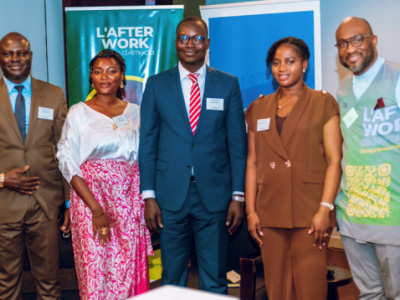
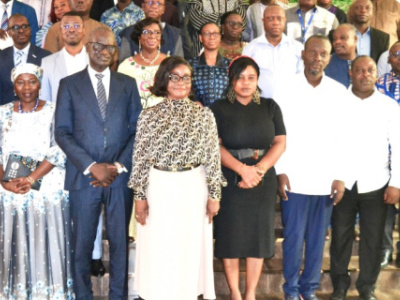
That unease was precisely what the ninth edition of Edem Adékunlé d'Almeida's Afterwork sought to address on April 2 in Lomé, drawing dozens of business leaders to the Onomo Hotel despite a rainy evening.
Yawa Djigbodi Tsègan, the new commissioner-general of the Office togolais des recettes (OTR), was represented by the institution's director of communications and user services, Konlani Kampatibe, a legal and tax specialist with 15 years of experience at the OTR and a participant in several of Togo's fiscal reforms. His presence alone sent a signal. This kind of dialogue between the tax administration and the private sector, outside formal audit settings, remains rare.
"How Do You Want Us to Be Perceived?"
When the room opened the evening by associating the words "vulture," "leopard" and "snake" with tax inspectors in a word-association exercise, the OTR representative did not sidestep the moment. "How do you want us to be perceived, when we send a representative to intercept you and take a share of what you’ve earned through your sweat?" he said, acknowledging that entrepreneurs' frustrations were legitimate.
He offered a structural explanation for the sense of tax pressure. A large portion of potential taxpayers escape taxation through the informal sector, concentrating the burden on formalized businesses. "When we have more taxpayers, you will feel that taxation weighs less on your shoulders," he said, calling for a more human approach between the institution and the private sector.
He also provided context on the OTR itself. Created in 2012 through the merger of the directorates-general of taxes and customs, and made operational in 2014, the institution is in a new phase under a commissioner-general who took office in October 2025 and has recently been joined by two new technical commissioners drawn from within the organization. Since its creation, revenues collected by the OTR have risen from 458.2 billion CFA francs in 2014 to 990.1 billion in 2023, an increase of more than 116% in under a decade. In 2024, the institution crossed the symbolic threshold of 1,000 billion for the first time, collecting 1,098.1 billion CFA francs, up 10.7% year on year. In the first nine months of 2025 alone, revenues reached 830.5 billion CFA francs, representing nearly 69% of the annual target of 1,208.4 billion and a year-on-year increase of 5.6%. Despite that progress, the tax-to-GDP ratio remains below the regional norm of 20%, with a taxpayer base that is still narrow.
An Asymmetry That Frustrates
The discussion featured two experts with unusual professional backgrounds. Sandra Akakpo Mondja, a chartered accountant and former public finance inspector trained at the OTR's tax and customs training institute, pointed to the absence of progressivity in corporate income tax, which is applied at the same rate to small and large companies alike. She also criticized a persistent asymmetry in tax audits. "You never see an audit end with the administration telling the taxpayer they overpaid and are due a refund. That kind of transparency needs to exist in that direction too," she said. She further raised the problem of delays in processing contested cases. Under Togolese tax law, a failure by the administration to respond is treated as a rejection rather than approval, which effectively pushes many taxpayers toward the courts and further complicates their situations.
Bakafitine Banque, a legal and tax specialist and former OTR administrator who now advises taxpayers, urged the room to separate two debates it tended to conflate. These are the duty to pay taxes, on one hand, and how the state uses that revenue, on the other. He questioned the absence of any genuine public debate on finance laws in Togo. "The administration does hold consultations, of course, to discuss the finance law. But the proposals you make are rarely accepted," he said.
Concrete Grievances
Several participants illustrated their frustrations with specific cases. One entrepreneur recounted how the OTR had disallowed legitimate business expenses, including airline tickets and hotel costs incurred in carrying out a contract, on the grounds that they had been incorrectly categorized in the accounts. "It hurt me deeply," he said, before announcing his intention to raise the issue with employers' organizations so that Togo's tax system better distinguishes operating expenses from representation costs. A woman entrepreneur who runs a business centered on Labor Day events raised the case of short-lived companies whose founders later return to find accumulated tax debts despite no real business activity. "Could we not have a framework for consultation between the OTR and smaller companies, to reflect their reality?" she asked.
"I Regretted It"
A pre-event survey of the Afterwork community had already sketched the broader picture. The relationship between businesses and the tax administration was described as a "strained relationship" by a majority of respondents.
The Afterwork organized by Edem Adékunlé d'Almeida is held regularly in Lomé and brings together professionals around topics related to the private sector's economic environment. A Franco-Togolese entrepreneur who heads Africa Global Recycling and has been based in Togo for 13 years, Adékunlé d'Almeida said he had wanted, when starting out, "to do everything by the book." "I regretted it," he said simply, to applause from the room. The remark condensed what many had not dared to say aloud. In Togo's current fiscal environment, full compliance can put businesses at a disadvantage. One other participant offered a counterpoint. "I was in a dispute with a tax inspector. I won, because I was within my rights," he said, noting that avenues for recourse do exist. A second edition devoted to taxation is being considered for the coming months.
Fiacre E. Kakpo