The Togolese Minister of Health is the new board chairman of Africa CDC
 Thursday, 19 December 2019 14:38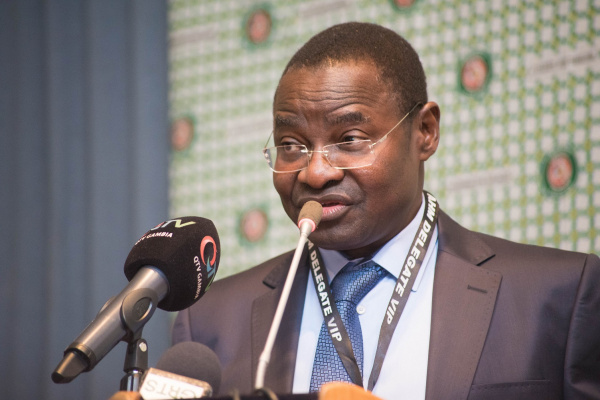
(Togo First) - Moustafa Mijiyawa, Togo’s minister of health, is the new board chairman of the Africa Centre for Disease Control and Prevention (Africa CDC). The Togolese official was elected earlier this month for a three-year term, in Addis Ababa, at the sixth meeting of the organization’s board.
Mijiyawa, professor of Rheumatology, has been active for more than 30 years in the health sector, both in Togo and outside. His new mission at CDC is to improve upon achievements of his predecessors.
Africa CDC is an organization of the African Union (AU). Created in January 2017, it collaborates with all 55 member-States of the Union, preventing the transmission of diseases, putting in place a system for medical surveillance and disease detection, especially epidemics and health threats.
The governing board of Africa CDC gives strategic instructions to the organization’s sécretariat, on all health issues, in line with the AU’s policies and procedures. It has 15 members, including 10 representatives of the African Union’s member-States.
R.E.D.
REFORMS OVERVIEW
STARTING A BUSINESS (more info)
At the fifteenth position, worldwide, and first in Africa, under the Starting a Business index of the 2020 Doing Business ranking, Togo sustains its reformative dynamics with more reforms….
ENFORCING CONTRACTS (more info)
Compared to some years ago when it was one of the lowest rankers under the Doing Business’ Enforcing Contracts indicator, Togo, leveraging many efforts to improve its business climate, was able to jump significantly on the index in the recent years... .
CONTRACT EXECUTION (more info)
Creation of special chambers of commerce for small debts • Creation of chambers of commerce at the Court of Appeal • Civil and commercial cases now handled by distinct clerks • Establishment of commercial courts in Lomé and Kara • Lawyers and bailiffs now have access to the FORSETI COMMERCIAL platform • A maximum period of 100 days was fixed to settle a commercial dispute .
TRADING ACROSS BORDERS (more info)
In comparison to previous years,Togo has significantly improved its ranking under the“Trading across borders” indicator by adopting multiple reforms that focus mainly on the digitization and reduction in delays, for import and export procedures related to import and export.
In comparison to previous years, Togo has significantly improved its ranking on the “Trading across borders” index by adopting multiple reforms that focus mainly on the digitalization and reduction in delays, for import and export procedures related to import and export.
CONSTRUCTION PERMIT (more info)
After moving from the 133rd to 127th place under the 2020 Doing Business’ construction permit index, Togo intends to reiterate this feat in the coming edition of the global ranking. To this end, it has introduced this year multiple reforms.
GETTING ELECTRICITY (more info)
Over the past two years, Togo’s ranking under the Doing Business’ Getting electricity and water indicator has increased consistently. Owing this performance to multiple reforms aimed at making it easier for businesses to access power and water, Lomé plans to introduce even more reforms this year to keep up its improvements.
REGISTERING A PROPERTY (more info)
Out of all the 'Doing Business’ indicators, Property Registration is where Togo has improved the most since 2018. Indeed, after spending years in the lowest part of this ranking, the country now seeks to beat Rwanda which is the best performer on this index in Africa. To do so, Lomé has been introducing many reforms, with the latest batch implemented this year.
PUBLIC PROCUREMENT (more info)
From professionalization to digitization, through legislative regulations, Togo’s public procurement framework is constantly being modernized. Several reforms have been implemented to improve the sector much to the benefit of the private sector, which is the focus of the National Development Plan.
PAYING TAXES AND DUTIES (more info)
To improve its business environment, Togo introduced some important reforms related to the payment of tax and duties. From the replacement of some taxes to the cancellation of others through exemptions, the country has only one objective: offer the most attractive tax framework to investors and economic operators. To achieve this, the authorities relied on digitization.