

Togo First
Cotton: Togolese production is up for the first time since OLAM took over the industry
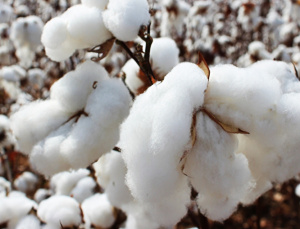
Togo produced 70,000 t of cotton in the 2023-2024 season. The figure was reported by the country’s Cotton company, the Nouvelle Société Cotonière du Togo (NSCT).
The recent output is a significant improvement compared to 2022 and 2021 where the country had produced respectively 46,549 t and 52,528 t of cotton. The increase is thus the first since 2020, the year in which the cotton company was taken over by Singaporean giant OLAM.
The NSCT’s director, Martin Drevon, reported the statistics at the launch of the new sales campaign on January 31. "This development is the result of the combined efforts of cotton growers and technicians as a whole, but also of structural and technological developments in the field,” Drevon declared.
For their part, the sector’s stakeholders attribute the increased output to a greater sown area. Indeed, in 2023-2024, about 79,200 ha of land was sown for a yield of 815 kg/ha, against 66,017 ha in 2022-2023 (for a yield of 705/ha).
Despite surging, the recent output failed to meet the expectations of stakeholders who had forecast a minimum production of 93,500 t grown on 110,00 ha (thus corresponding to a yield of 850 kg/ha).
Esaïe Edoh
Togo-China: Chinese Ambassador forecasts a stronger cooperation
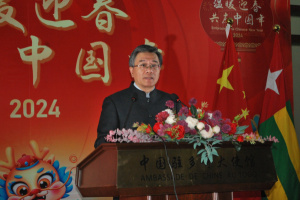
Ahead of the New Chinese Year of the Wooden Dragon, which begins on February 9, China’s Ambassador to Togo, Weidong Chao, held a reception last Friday in Lomé. On the occasion, Chao said the China-Togo relationship is set to be stronger.
Commenting on the recent visit of China’s Foreign Affairs Minister to Togo, the Ambassador said it was “very successful”. Several members of the Togolese government, chieftaincy, diplomacy, press, and business industry attended the reception hosted by Ambassador Chao.
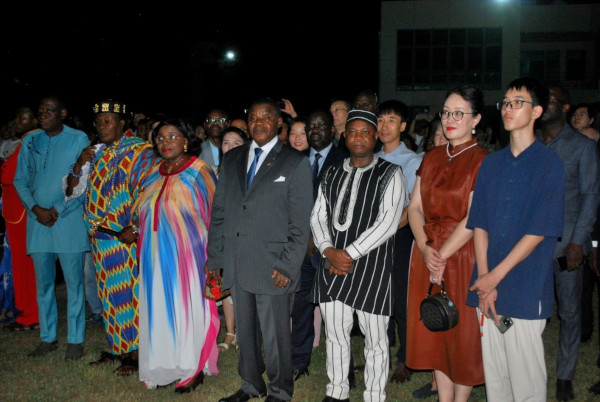
“The China-Togo cooperation has great prospects, a strong potential,” Chao told the attendees, adding that this partnership would record “more progress and new developments.”
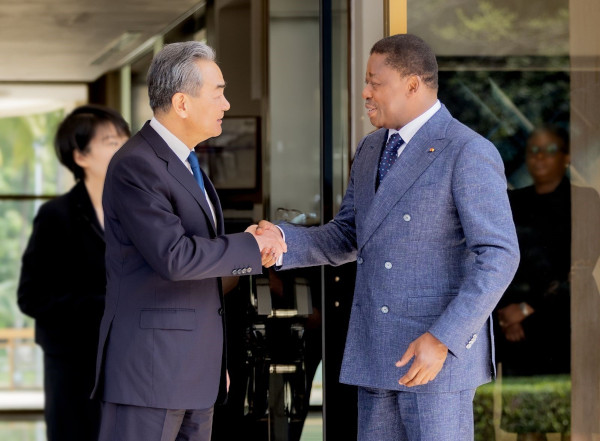
A few days ago, Togolese President Faure Gnassingbé met with the visiting Foreign Affairs Minister of China, Wang Yi. The two men took the opportunity to review the cooperation between their countries, across several sectors, including economy, education, culture, health, agriculture, and infrastructure.
China and Togo have been nurturing their diplomatic relationship since 1972.
This year, China will organize the 9th Forum on the China-Africa Cooperation (FOCAC) to which President Gnassingbé has been invited.
According to the latest data, from January to July 2023, trade between Togo and China stood at $2.3 billion, up 14% year-on-year.
Séna Akoda
Togo: Exporting scrap metal remains illegal, Trade Minister alerts
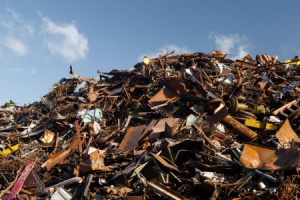
Exporting scrap and ferrous by-products is still forbidden in Togo. The ban, announced in April 2021, was reiterated last week by the Minister of Trade, Rose Kayi Mivedor-Sambiani. The official, on the same occasion, announced new measures to foster local processing.
The minister warned through a note that "only locally-processed ferrous and non-ferrous metals will be exported henceforth".
The same note discloses the sales prices of various non-ferrous metals supplied to local processors. According to the note, a kilogram of aluminum now costs CFA910 minimum and CFA640 per kilogram for batteries.
Also, the country plans to set up a special body and monitoring committee to oversee the metal scrap business. Scrap export will be subjected to their approval.
This move aims to bolster supply for local processors, such as Kara’s concrete-iron factory which was launched in 2019. The plant has a production capacity of 3,000 t per month.
Esaïe Edoh
WAEMU: Togo records its third consecutive success on the regional market this year
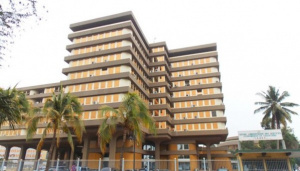
Togo successfully carried out its latest issue on the WAEMU stock market, the third this year. On February 2, Lomé raised CFA30 billion on the regional market via a simultaneous issue of fungible treasury bonds and bills (OATs and BATs).
Proceeds will finance Togo’s annual budget which stands at CFA2,179 billion, expenditures and revenues.
In detail, Lomé secured CFA26 billion via the BATs and the remaining CFA4 billion via the OATs. The former mature over a year and have multiple interest rates, while the latter mature over five years at a rate of 6.4% per annum.
The funds were raised by 24 West African investors. Though CFA30 billion was retained, the investors mobilized CFA31 billion.
Adding this latest issue, Togo has raised CFA82 billion on the WAEMU so far this year. The country targets CFA607 billion in 2024.
Esaïe Edoh
Togo: Lomé will host the 2nd edition of Les Afropéens Music Festival in two weeks

Lomé will host the 2nd edition of Les Afropéennes, a music festival, from February 15 to 18, 2024. This was recently disclosed at the Institut Français du Togo, in a press conference hosted by Togolese musician Florent De La Tullaye.
Les Afropéennes brings together African and European musicians and music lovers. The festival celebrates cultural diversity and fosters inclusion, the youth's especially
Fifteen artists, local and foreign, will perform at the festival. They include FFF (France-Togo), Suspect 95 (Côte d’Ivoire), and Almok (Togo).
Togo and IFC to leverage leasing to speed growth of local agricultural SMEs

Earlier this week, World Bank executives met with Togolese officials to discuss SME financing in the African country. During the meeting, Christopher Balliet Bleziri, country representative of the World Bank’s International Finance Corporation, told the Togolese officials that the Bank’s arm would collaborate with local banks and investors, with a focus on agricultural leasing.
"We have the experience, we have the tools, we have the team and the expertise to help the banking sector, leasing institutions, and the government define a framework,” said Bleziri, while stressing leasing’s importance in acquiring agricultural equipment.
The IFC will work with Lomé to create a leasing-conducive framework to benefit farmers.
It is worth noting that the World Bank and Togo are preparing a "major" project to transform and modernize Togolese agriculture. According to reliable sources, the project should commence this year and run until 2030, costing $100 million.
Another detail worth noting is that Togo has recently adopted a law on leasing.
Esaïe Edoh
Togo: Customer base of Coris Bank International booms, spurred by its Islamic Finance branch
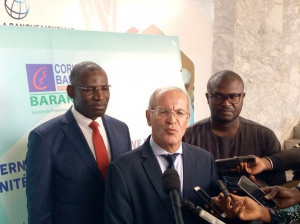
Since it launched in Togo in 2021, CBI Baraka, the Islamic finance branch of Coris Bank Togo (CBI Togo) has totaled a portfolio of 3,520 account openings. CBI Togo disclosed the figure yesterday, Feb 1, during a public conference in Lomé.
In 2021, the Islamic finance branch had 662 accounts, thus representing a surge of 430% over the past three years. Also, by the end of 2022, CBI Togo reports that its Islamic branch had loaned about CFA900 million to its clients. Meanwhile, deposits stood around CFA1,600 billion.
According to Ousmane Tchakpatawo, Head of Islamic Finance at CBI, the figures prove that Islamic finance is in demand in Togo. Based on this conclusion, the lender announced plans to launch new Islamic finance products.
In the same vein, Alassane Kaboré, MD CBI Togo, announced improvements in the bank’s Hadj Savings product. This is a product that meets Islamic laws and aims to facilitate the procedures for the Hajj pilgrimage.
CBI Baraka’s Islamic finance offer is Sharia-compliant. The loans are interest-free, in line with Islamic ethics and morality, and they support socially responsible investments.
Esaïe Edoh
Togo: Ministers review and adopt new bill to curb illegal use and circulation of firearms

During its latest Council of Ministers, on January 31, Togo adopted a bill on firearms and ammunition. The new bill aims to update and improve Togo’s firearms and light ammunition regulation.
In detail, once approved by the parliament, the bill will enable the relevant authorities to better control arms-related activities. The bill specifically provides a framework for the categorization of weapons and their legal acquisition and use. It also aims to curb the proliferation, circulation, and illicit trafficking of firearms, ammunition, and associated equipment.
Through this move, Togo seeks to align with regional and global security standards.
According to the government, "the current legal framework, derived from the law of January 6, 1959, on the weapons regime in Togo and its implementing decree of April 19, 1995, must be revised and updated to meet our country's security needs while complying with the requirements of regional and international standards that impose stricter control on the individual and collective possession of firearms."
Ayi Renaud Dossavi
AHOE Series: Togo PM Tomegah-Dogbe meets with producer Angela Aquereburu
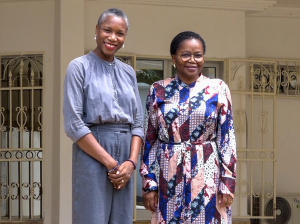
Togolese Prime Minister Victoire Tomegah-Dogbé gave an audience to filmmaker Angela Aquereburu on January 30. Aquereburu produces the web series "Ahoé", a local production that quickly gained popularity in Togo.
Ahoé started broadcasting on YouTube on December 1, 2023. The YouTube channel airing the episodes (46 at present) currently has around 68,000 subscribers. So far, the web series has totaled 3.17 million views, and the pilot has over 500,000 views, a record for a Togolese production.
Season 2: CFA200 million needed
Angela Aquereburu, during her audience with PM Tomegah-Dogbe asked for the government’s support for the project. “Togolese people are very excited about it (ed. Note: the series),” she declared after the meeting.
A few days before, the series’ promoters launched a call for funding on social media. According to the call, they need CFA200 million to produce the next season.
Angela Aquereburu has been active in the Togolese film industry for over 15 years. Before AHOE she produced ZEM, a series about “Zemidjans” (local taxi-bikes) in Togo, "Hospital IT" about collaboration between traditional and Western medicine broadcast on the TV5 MONDE channel, and more recently, the "Oasis" series, for its part broadcast on Canal+.
Ayi Renaud Dossavi
President Gnassingbe recently met with Mali’s Foreign Affairs Minister
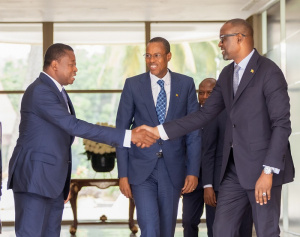
Togo President Faure Gnassingbé received Mali’s Foreign Affairs Minister, Abdoulaye Diop, on Tuesday, Jan 30. According to the Togolese Presidency, they reviewed Mali’s current socio-political situation.
The men met two days after Mali announced it was leaving “with immediate effect” the Economic Community of West African States (ECOWAS), together with Niger and Burkina Faso.
This topic, along with uncertainties-economic, administrative, and political-resulting from Mali’s exit, was likely discussed by Gnassingbe and his visitor.
Initially, the ECOWAS said it was ready to seek a "negotiated solution" to the exit situation. Lomé may play a major role in the negotiations as in the past.
Ayi Renaud Dossavi