
Togo First
Recent socio-political unrests cost Togo $640 mln
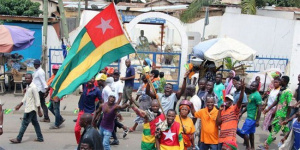
In its Global Peace Index 2019 (GPI), the Institute for Economics and Peace IEP observed that socio-political unrests in Togo over the 2017-18 period cost the country about XOF378 billion, or $646.9 million. This makes 5% of the national GDP.
Togo dropped 9 places in the ranking, compared to 2018, now being the 108th most peaceful country in the world. It gets same score level as Côte d’Ivoire, Burkina Faso, and Uganda. Top 3 of ranking is comprised of Iceland, New Zealand and Portugal.
The 2019 GPI found that the economic impact of violence in Togo reached a bit over $1 billion over the period reviewed.
More than $1.4 billion of commitments secured at Togo-EU economic forum
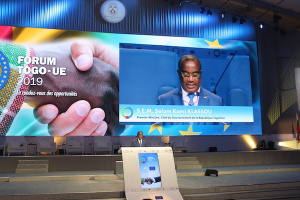
More than $1.4 billion (€1.3 billion) worth of commitments have been secured from European investors at the closure of Togo-EU economic forum.
This is about one-fifth of five billion US dollars of private funds needed for Togo’s national development plan.
Lauding the achievement, Prime Minister Komi Klassou declared: “Togo’s emergence process is underway.”
For his part, Germain Meba, president of Togo’s chamber of commerce and industry, said as the forum was ending: “This ending economic forum is the perfect example of a win-win economic partnership backed by international cooperation.”
“Now, we must get the best from this forum and work together… The EU is ready to boost its support,” added Bruno Hanses, Representative of the EU delegation’s chief in Togo. He then urged the Togolese government to “relentlessly pursue its reform policy.”
Exactly 141 bankable projects were retained at the Togo-EU economic forum
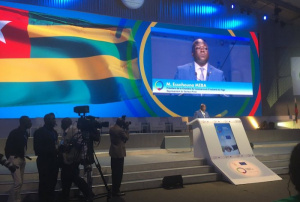
At the recently-ended Togo-EU economic forum, Germain Mèba, president of Togo’s chamber of commerce and industry, revealed that 141 bankable projects were retained by the committee specifically established for this purpose.
The projects are in various sectors, ranging from agriculture to tourism, including oil and manufacturing, and many more. They all align with one of the three axes of the national development plan.
Let’s recall that under the first axis of this plan, Togo plans to have a logistics hub and first-class business centre. Under the second, it wants to develop poles for agricultural transformation, manufacturing and extractive industries. In line with the last axis, Togo’s government plans to consolidate social development and reinforce inclusion mechanisms.
Séna Akoda
MIFA allies with European partners to promote Made-in-Togo products abroad
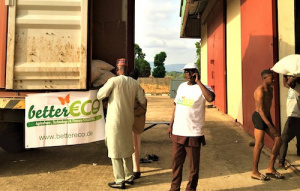
In Togo, the agricultural financing incentive mechanism (MIFA) has signed two agreements with European investors to promote made-in-Togo abroad. This was during the recent Togo-EU economic forum ended last Friday.
In detail, the first agreement is a letter of intention signed with German firm Better Eco. It defines the global framework of a coming convention to “reinforce technical and financial capacities of Togolese producers relating to biologic production in line with international, and European, quality and sales standards.” Products concerned here are ginger, soybeans, sesame, cashew, pineapple and shea nuts. A memorandum of understanding is expected in the next three months.
Regarding the second agreement, it was signed with agro-industry group Tropical Flowers. The latter committed to help MIFA secure funds to produce tropical and ornamental flowers.
The firm based in Togo has a 40 ha land where it produces flowers and employs 20 Togolese.
Ayi Renaud Dossavi
Togo: US embassy launches online training on social entrepreneurship

The US embassy has launched online a new training on social entrepreneurship for young Togolese.
The workshop which will last two months will profit those with “solid ideas fostering social transformation via social entrepreneurship.” Only 12 participants will take part in this first edition and classes will be given thrice a week.
Through the training, the US embassy wants to conciliate economic and social efficiency by involving the people through a single or multiple projects.
Social entrepreneurship is about undertaking an activity with limited profitability, practicing democratic management and fostering participation of people. All those interested in taking part in the workshop must be less than 40. Deadline for registration is June 21, 2019.
Séna Akoda
Togo: Foreign direct investments rise for the second consecutive year
In 2018, foreign direct investments (FDIs) to Togo stood at $102 million, according to the World Investment Report released by UNCTAD on June 12, 2019.
This represents a 15% increase compared to the $88.3 million recorded the year before. It is the second consecutive rise in the past two years. The UN institution attributes this performance to the Free-Trade area of Lomé.
“In some cases, governments grant preferential rates to port services, telecommunications, power and water provided to firms established in economic zones,” says UNCTAD experts, quoting the law n°2011-018 on the status of Free Industrial Area in Togo.
The report is released on the sidelines of the first Togo-EU forum where Togolese authorities plan on securing part of funds it needs for the national development plan (PND). The document comes also on the same day the parliament adopted a new, more competitive, investment code.
In Togo, inward FDI stock stood at $1.79 billion in 2018, against $450 million ten years before.
FDIs rise in Africa while falling in other parts of the world
FDI flows to Africa, amid a global down trend (-13%), soared 11% to $46 billion, after slumping in 2016 and 2017. This is despite FDIs to major economies such as Nigeria, Egypt and Ethiopia having fallen over the period reviewed. Indeed, other countries, especially South Africa, counterbalanced these poor performances.
“This increase was fostered by the continuous resource-seeking, diversifying some investments and economic recovery in South Africa after many years marked by weak capital entries… A growing demand and rising prices of some basic goods, as well as greater investments in non-extractive sectors, largely drove up FDIs to Africa,” according to UNCTAD experts.
In West Africa, Ghana steals Nigeria’s crown
Last year, FDIs flows to West Africa slumped 15% to $9.6 billion, the lowest since 2006. In Nigeria, fears related to presidential elections paired with the government’s aggressive measures against some multinationals impeded direct investment. Data shows that FDIs to the West African country decreased by 43% in 2018.
Hence, Nigeria was dethroned by Ghana, now the leading receiver of FDIs in West Africa. This, despite foreign direct investments in the country fell by 8% standing at $3 billion. Most of the funds was injected in the gas and minerals industries.
Togo joins OECD’s development centre
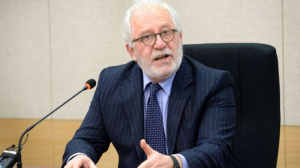
On June 13, 2019, Togo’s minister of finance, Sani Yaya signed the letter of adhesion of Togo to the development centre of the Organization for Economic Cooperation and Development (OECD). This was in the presence of the centre’s director, Mario Pezzini.
The signing comes some weeks after a Togolese delegation led by the minister of grassroot development, Victoire Tomégah-Dogbé, attended in Paris the fifth meeting of the OECD development centre’s steering committee on May 21-23. On this occasion, the official had declared: “Our adhesion to the OECD’s development centre is a unique opportunity to share our experiences, learn from that of other member States and pool our resources.”
The OECD’s development centre is an independent forum for information-sharing and dialogue. Through it, the institution’s member States can collaborate easily.
European chamber of commerce of Togo officially launched
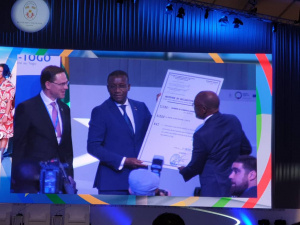
Yesterday, at the Togo-EU chamber of commerce, EUROCHAM-Togo, was officially launched.
This new entity will build and consolidate relations between Togo and Europe. It is chaired by Charles Kokouvi Gafan, CEO of Bolloré Transport & Logistics Togo.
The launch of the EUROCHAM results from the will of European investors established in Togo to have an institution that will defend their rights in the country. Besides, it should boost business ties between European and Togolese private actors.
In regards to this last objective, a memorandum of understanding was signed between EUROCHAM-Togo and the Togolese chamber of commerce and industry (CCIT).
123 European firms registered in Togo last year
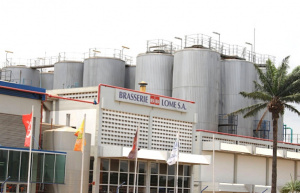
In 2018, 123 European firms were registered at Togo’s Business Formality Centre (CFE).
This is merely 6% of all firms registered by foreigners in the country over the period (1920 firms). While very marginal, this figure contrasts highly with the weight of European or European-owned businesses in Togo.
Indeed, in 2016, Total-Togo, subsidiary of the French oil and gas behemoth, was Togo’s second biggest tax payer with XOF22 billion paid to the Togolese Revenue Office (OTR) that year. Also, the firm paid the most to customs services, XOF19 billion, the same year. In 2017, another French-owned firm, Brasserie du Bénin, joined Total, becoming one of the country’s largest tax payers.
It should be noted that a European Chamber of Commerce of Togo (EUROCHAM-Togo) was just launched on the sidelines of the first Togo-EU economic forum in Lomé. The institution aims to boost relations between European firms and Togo. It is thus very likely that in the coming years, more European businesses and investors will flood to Togo, contributing even more to its economic growth.
Séna Akoda
Faure Gnassingbé launches highly anticipated Togo-EU economic forum
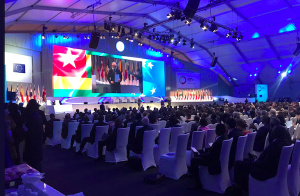
Togo’s President, Faure Gnassingbé, officially launched today the first Togo-EU economic forum in Lomé.
The related ceremony was attended by Jyrki Katained, EU commissioner for Jobs, Investment and Competitiveness, Mario Pezzini, Director of OECD’s Development Centre, various government officials and business moguls such as Africa’s richest Aliko Dangoté.
More than 300 investors from the EU’s 28 countries will attend the two-day event. There will be panels, business meetings and sessions to showcase key projects of the PND.
“The present forum perfectly translates converging visions of the European Commission and the Togolese government for stronger ties to foster investment and job creation,” said President Gnassingbé.
The leader then evoked solidarity between Europe and Togo, “which will be at the heart of talks” during the forum.
“Progress is a long road of solidarity. We are more convinced of this than ever seeing your gathering at this event, which will inevitably make it a success,” he continued before concluding: “Today, through this forum, we take a major step in this new era of renewal between the European Union and Togo.”
More than 1,000 people were present at the event’s opening ceremony. The latter was followed by a panel hosted by Mario Pezzini, Carlos Lopes, former executive secretary of UNECA, Aliko Dangote and Etienne Giros, Chairman of the European Business Council for Africa (EBCAM). The panel focused on sustained, inclusive and balanced development in Togo.
Besides the panel, three other activities marked this ceremony: the signing of Togo’s letter of adhesion to the OECD’s development centre, the launch of the EU-Togo Chamber of Commerce (EUROCHAM Togo) and the signing of a memorandum of understanding between Togo’s chamber of commerce and European chambers of commerce.