
Togo First
11th National Farmer Forum begins in Kara
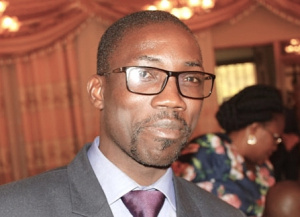
As announced earlier, the 11th edition of the Togolese Farmer Forum (FNPT) was launched yesterday at the Palais des Congrès of Kara, by Noël Bataka, minister of agriculture, fishery and animal production. “As we start this forum, opportunities and exchanges are the two main subjects," the official said.
“We talk of opportunities because the agricultural sector will be presented in its opulent and diverse nature. But beyond showcasing this sector, the forum will serve as an exchange platform regrouping actors operating across the various chains of value, through the systems established in the framework of this event."
The minister expects that various contracts will be signed, and commitments will be taken to deeply transform Togo’s agriculture.
Kodjo Adédzé, minister of trade and industry, was also present at the launching ceremony.
The theme for this edition of the forum is: “Agricultural transformation poles to valorize Togo’s potential: A new vision reflected by the 2018-2022 national development plan”.
Séna Akoda
Coralie Gevers becomes the new chief of operations of World Bank in Togo
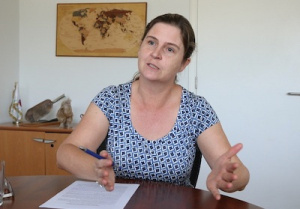
It’s official. Coralie Gevers, former chief of the World Bank’s operations in Mongolia and active in Madagascar and the Comoros since 2014, is the new chief of operations of the institution in Togo.
She replaces Pierre Laporte who oversaw the bank’s operations in Togo, Côte d’Ivoire, Benin, Burkina Faso and Guinea.
Gevers, a Belgian economist, joined the World Bank in 1996, holding various functions at the offices of the president and chief economist, but also in South Eastern Asia and Pacific.
The decision was announced during a meeting, in Washington, between a Togolese delegation led by minister of finances, Sani Yaya, and Demba Tignokpa, the minister of development planning, and officials of the Bretton Woods institution.
World Bank will support the national development plan’s implementation
On the sidelines of the World Bank’s annual assembly, the Bretton Woods institution committed to support Togo’s National Development Plan (2018-2022 PND). This is after meeting a delegation from the West African country asking the institution to increase its financing for Togo.
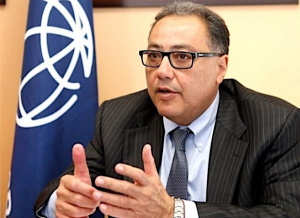
Representing Togo at the meeting was the minister of finances, Sani Yaya, and head of development planning, Demba Tignokpa. On the World Bank’s side, there was the Vice President, Hafez Ghanem (picture), its chief of operations in Togo, Pierre Laporte, and its representative in Togo, Hawa Cissé Wagué. On this occasion, the two parties also assessed Togo’s current macroeconomic situation.
Recently, it should be noted, Pierre Laporte, has been replaced as chief of the WB operations in Togo, by Coralie Gevers.
Séna Akoda
Feasibility studies for Abidjan-Lagos corridor project launched
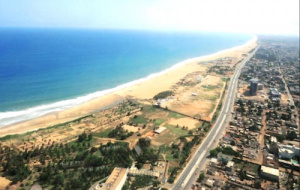
Feasibility studies for the Abidjan-Lagos road corridor project has begun.
Related contracts for the studies, environmental and technical, are already signed, reliable sources indicate.
An execution team was set to steer the project and monitor the ongoing studies. This cell will communicate details about progress made to the ECOWAS Commission, as the project goes on.
While $22 million has already been raised for the project, an additional $3 million should be this year.
Let’s note that 75% of West Africa’s commercial activities depend on the 1,000km-long corridor. It will connect Abidjan to Lagos, passing through Lomé and Cotonou. “In 2020, when the project should be completed, heavy trucks should move from Lomé to Cotonou (150 km) in five hours, against 11 hours at the moment,” says AfDB.
Séna Akoda
Togo: HeidelbergCement plans to invest €25M in its subsidiaries
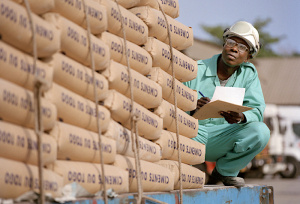
HeidelbergCement, world’s second largest cement maker, plans to invest €25 million in its Togolese subsidiaries, Cimtogo, Scantogo and Granutogo.
At a meeting with the press last Friday, Eric Goulignac, local MD for the firm, discussed projects planned by HeidelbergCement to support the national development plan (2018-2022 PND) whose second axis focuses on the extractive sector.
At the beginning of the summer, this investment programme will be submitted to the German company’s board. It includes the installation of a new grinder in Lomé, and a solar PV plant to fuel factories. All projects are to cost €25 million or more than CFA16 billion.
In its financial statements for 2018, HeidelbergCement revealed that Cimtogo, the group’s largest subsidiary, recorded a net benefit of €3.7 million (CFA2.4 billion) in 2017, while Scantogo in which the German holds an 89% stake had a net profit of €7.7 million (CFA5 billion). Granutogo, its third subsidiary recorded a net profit of €0.3 million (CFA196 million) over the period.
Togo seeks additional CFA95bn on UMOA-securities market before Q2 ends

Leveraging a successful bond issuance recorded last Friday, Togo seeks to raise a total of CFA95 billion on UMOA securities market during five more operations it plans this quarter.
In detail, according to the UMOA-securities debt planning agency, the country will seek CFA40 billion on the regional market, via two fungible treasury bills issuances. The two operations are set for April 19 and June 14, with a respective target of CFA20 billion each. On May 17, another operation, a fungible treasury bonds issuance, is set for a similar target. Two more then, fungible bonds issuances, are set for May 31 (with a target of CFA15 billion) and June 28 (CFA20 billion).
Overall, Togo intends to raise CFA115 billion this quarter, up by CFA20 billion compared to the previous one.
Séna Akoda
Government plans to build a dry port at Cinkassé, in the Far North
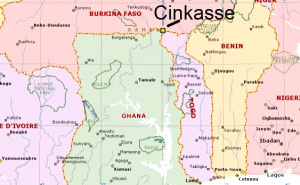
The Togolese government intends to, by 2040, triple freight to landlocked countries to which it has access by building a dry port in Cinkassé, in the Savanes region. From 3.786 million tons now, this volume should stand at 10.230 million in line with the authorities’ target.
The port will be built over a 100-hectare property. It will help containerize and strengthen transport corridor between the Port of Lomé and Cinkassé.
The infrastructure will have customs facilities for goods from Burkina Faso, Ghana and Niger, as well as warehouses for the de-containerization and distribution of freight. In addition, there will be a single desk and offices to handle logistics procedures and organizations, modern equipment and facilities for cargo transfers between trucks.
The project which is estimated to cost $50 million will be developed under a public-private partnership. In this regard, authorities are looking for partners that will ensure conception, financing, construction, exploitation and/or maintenance.
It will be one of the key projects of the PND which will be at the heart of the coming Togo-EU economic forum, next June 13-14.
Togo: HAAC develops a new five-year strategic plan which requires CFA3.5bn to be implemented
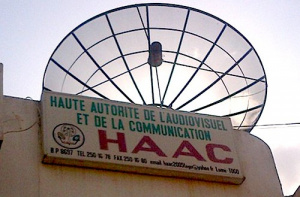
The High Authority for Audiovisual and Communication (HAAC) just adopted a strategic action plan covering the 2019-2023 period.
To carry out this plan, the media regulatory organ should raise CFA3.5 billion. PNUD’s representation which helped draw the plan said it will support.
According to Maurille Agbokou, Advisor on the project, funds alone are not enough to facilitate the plan’s deployment. Beyond raising funds, the regulator must discuss with media and film club managers, in addition to enhancing women’s position in media and governing bodies.
Also, the advisor believes it is important to proceed to a step-by-step assessment to implement necessary adjustments with the main goal being to optimize achievements targeted under the five-year strategic plan.
Séna Akoda
Digital transformation could increase Africa’s economic growth by 2% per annum
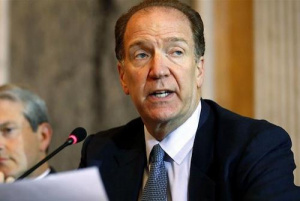
“Digital transformation has the potential of unlocking new pathways for inclusive growth and creating jobs in Africa…Yet, access to the internet remains unattainable for most people in the region, which requires investment to be made in infrastructure and youth education,” the World Bank said in the latest edition of its Africa’s Pulse report.
“The digital transformation can increase growth by nearly two percentage points per year and reduce poverty by nearly one percentage point per year in sub-Saharan Africa alone,” the report adds.
To achieve this, investment must be made in skills and the development of digital platforms which will enable countries to better manage public finances and citizens to better interact with their administrations.
Togo also is at the heart of the digital transformation as reflected by the arrival of firms such as Kobo360, Gozem or Carasigbe which are present in the country.
Octave A. Bruce
Togo raised CFA77 billion against CFA20 billion sought on UMOA-securities market last Friday
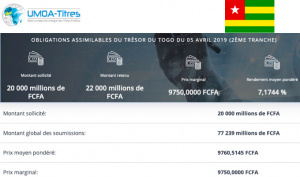
Last Friday, Togo raised CFA77 billion on the UMOA-securities regional market, through a fungible Treasury bond issuance. This operation, the first for this second quarter, initially had a target of CFA20 billion, and was thus oversubscribed by 386%.
This outstanding performance follows another at the close of Q1 2019 where Togo raised CFA22 billion against an initial target of CFA20 billion.
For the recent operation, Togo’s public treasury retains CFA22 billion of the subscription, less than a third of total subscriptions.
Séna Akoda