

Togo First
OTR releases registry of fiscally up-to-date businesses
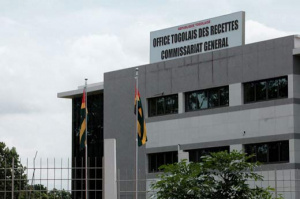
Togo’s Revenue Office (OTR) just released on its website the registry of firms that are fiscally up-to-date.
This release aims at informing business owners about their status in regards to tax payment and firms absent from the registry are those that are yet to have settled all their taxes.
These firms are urged to pay their dues or risk “a 15% levy on customary values of their imports, as imposed by the law.”
Séna Akoda
Togo: Index value to rise starting January 2020

President Gnassingbé committed, at the parliament last Friday, to raise the index value of the public administration starting next January.
This is part of various social measures announced by the leader, most of which will be adopted under the next finance bill. The increase is the second after that of 6% in 2013 recorded subsequent to long talks between the government and workers’ syndicates.
The new improvement will accordingly raise civil servants’ purchasing power. In addition, the government will boost consulting and initiate necessary actuarial studies –starting from January 2020 still – to reinstate retirement allowance, in a way that is compatible with our efforts to improve public finances, declared President Gnassingbé.
Moreover, “measures are already taken to build two retirement facilities that will be managed by associations,” he added. “In the retirement homes, retirees will perform various activities that will enable them to earn money,” said Christian Trimua, minister of human rights, on TV.
Togo : Faure Gnassingbé raises to 25% share of public procurement guaranteed to youth and women

From 20%, the share of public procurements set aside for youth in Togo is now 25%. This was revealed last Friday by President Gnassingbé, at the parliament.
The rise aims at enabling more youth to have access to public procurements. Indeed, on January 3, 2018, the president had committed to guarantee 20% of contracts to local youth and women. However, the move did not bear the results expected with only 4,000 entrepreneurs having benefited from it, winning contracts valued at XOF12.638 billion.
“We can do far better and instructions have already been given to simplify and ease access to public procurement, as well as to establish mechanism to support young entrepreneurs financially in the process,” said Faure Gnassingbé. He then urged “all those (entrepreneurs, ed.note) who have not taken advantage of this measure yet to do so and help improve it by sharing their experience with competent authorities.”
Cotton: Togo should produce 152,000 tons this campaign, according to the USDA
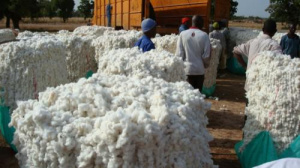
Togo should produce 152,000 tons of cotton during the 2019-2020 campaign according to the United States Department of Agriculture (USDA). This is 18% more than the country did in the last season.
The whole West African region is actually expected to record an uptrend over the period. The USDA’s expectations align with those of the regional programme for the integrated protection of cotton trees in Africa (PR-PICA which regroups Benin, Burkina Faso, Côte d’Ivoire, Mali, Senegal and Togo), whose coordinators recently met in Cotonou, Benin.
Indeed, under the best weather conditions, PR-PICA expects cotton output in West Africa to soar 38% reaching 3.4 million tons, with Burkina Faso doubling its output. Mali is expected to record the highest output, a million tons.
Ayi Renaud Dossavi
Africa Plastic Technology eyes turnover of XOF123 billion over the next three years
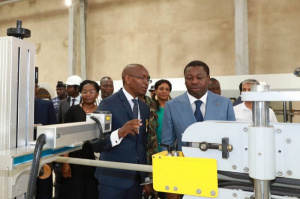
The new Africa Plastic Technology factory recently inaugurated in Tsévié (Zio prefecture) should generate a turnover of XOF123 billion over the next three years.
This was revealed by Kodjo Adédzé, minister of trade and industry, during the inauguration ceremony, on April 25.
In terms of output, the firm plans to make 65,000 tons of plastic over the period concerned with main products being PVC tubes (pressure tubes, telephonic cables sheathing, high-density polyethylene pipes for water adduction).
The installation of this infrastructure which falls under the second axis of the national development plan should generate 200 direct and 500 indirect jobs.
Séna Akoda
AFD disburses XOF3 billion to expand health insurance coverage across WAEMU
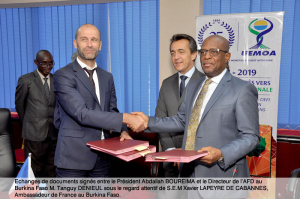
The French Development Agency (Agence Française de Developpement –AFD) has granted WAEMU States a subsidy of XOF3.182 billion to improve access to healthcare in the region.
On April 25, the French institution and the WAEMU commission signed the first amendment of the financing agreement for the health insurance expansion program (PACRM) within the Union. The signing thus puts back into motion this project which had been halted due to lack of funds.
In effect, the PACRM will assess conditions under which health insurers can help improve health insurance coverage of unemployed individuals. It will also support institutional and organizational frameworks that are appropriate for the concerned expansion, with a key focus on improving equity and poorest and most vulnerable populations.
The PACRM was launched on May 19, 2011 and required investment for the project was valued at €3,537,000. Unfortunately, only 18% of this amount was mobilized, hence halting the project’s advancement.
Séna Akoda
Togo: In 12 months, a military clothing factory will open near Lomé

Soon, Togo will have a military clothing and equipment factory. The first stone for this facility was laid by President Faure Gnassingbé himself on Thursday.
Located in Adétikopé (15km north of Lomé), the facility will be built by Canadian firm Logistik Unicorps, which makes and supplies military and industrial clothing and equipment and is active in Australia, Europe and the Middle-East. Reliable sources indicate that the plant will cost more than $10 million (about XOF6 billion) and will be completed in five years.
Besides military clothing, professional attire for industrial, mining, agricultural firms, hospitals and schools will also be manufactured at the factory, all using local input. A total of 2000 jobs (500 direct) are expected to be created with this project.
Togo: A new plastic products plant opens in Tsévié
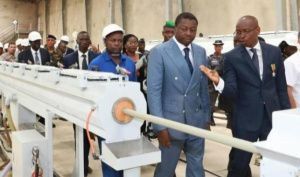
new plastic products plant was inaugurated by President Gnassingbé yesterday. The infrastructure is in Tsévié (about 37km from Lomé), in the Zio prefecture.
Owned by Africa Plastic Technology, a firm based in the same area, the factory cost XOF15 billion. In detail, polyvinyl chloride or PVC tubes (pressure tubes, sheating tubes for telephonic cables, high-density polyethylene pipes for drinking water adduction) will be manufactured there.
Nearly 200 direct and 500 indirect jobs will be created in the framework of this project.
Earlier the same day, an organic pineapple juice factory was also inaugurated. Both facilities were inaugurated under the celebrations of Togo’s 59th independence anniversary.
Ayi Renaud Dossavi
President Gnassingbé inaugurates a pineapple-processing factory in Zio prefecture
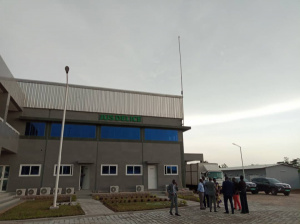
On April 25, President Gnassingbé inaugurated in Gbatopé (Zio prefecture), a pineapple processing factory.
Baptized Jus Délice, the facility will help the country process the fruit and make this sector more competitive. More than eight tons of pineapple per day will be processed into organic juice. This output is to be exported to Europe, according to the ministry of agriculture.
Besides improving producers’ revenues and living standards, many jobs will be created in the process.
To ensure that the target output is reached, the ministry of agriculture will organize producers and make sure standards relating to quality and productivity are met. Also, the ministry will help condition the transformation units and commit to the respect of sanitary norms.
Jus Délice, let’s recall, benefited from a XOF1.7 billion financing from the Moringa Fund back in May last year.
Séna Akoda
Togo launches its first “Tomorrow Connected Community” in Yoto prefecture
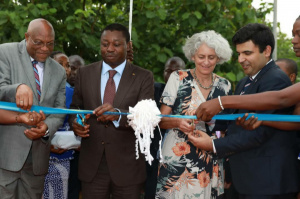
Togo launched April 23 in Siké-Afidegnon, in the Yoto prefecture, the pilot stage of the “Tomorrow Connected Community” project, a project inspired from Rwanda’s “Tomorrow rural home” project. The new project leverages the technology-energy combo to benefit Togolese communities.
It is steered by BBOXX, just like the CIZO, EDF, mobile operators Togocel and Moov, and power utility CEET. In its framework, a 30KVA mini solar plant will be set up to power one of the relay towers of Togocom in Sikpé-Afidegnan. The facility, in parallel, provides the people of this village, and surrounding localities, electricity, but also internet and derived services. Previously, it should be noted, these communities depended on Benin’s network.
“300 families, or more than 4,000 people, live in this village situated in the Southern part of the country. Soon, it will rely on solar as source of power and have access to various services and products, like clean energies to cook, internet and water pumps,” BBOXX declared.
For its part, authorities said: “The Sikpé-Afidegnon village is only the first and others will benefit from this major project. Overall, more than 315 localities across the country’s five regions will soon be electrified in line with our national electrification strategy, with similar mini solar plants built and operated by private actors.”
Concerning the Tomorrow Connected Community, it is connected to a mini-grid developed by General Electric to meet high power consumption needs, as well as to BBOXX’s domestic solar systems to power households and SMEs. It is fully manageable remotely and all related services (power and internet) will be paid for via mobile money.
Last June, Togo adopted a national electrification strategy which aims at raising its rate of electrification to 50% in 2020, 75% in 2025 and 100% in 2030, from a little more than 40% currently. To reach this goal, Lomé intends to rely on clean power sources and expand the CEET’s network.