

Togo First
Ecobank raises $450 million on international financial market
Ecobank raised $450 million during its last bond issuance on the international market.
“The success of this Eurobond reflects the interest of first-class institutional investors and their confidence in our group,” says Greg Davis, financial director of Ecobank. “This issuance is the result of efforts made to strengthen our group and create value for shareholders,” added Ade Ayeyemi, CEO of Ecobank. Yet, like in 2017, the shareholders will get no dividends for the past year.
The bank will be paying a semester-based interest rate of 9.75% for the non-guaranteed loan. The funds will be used to refinance the lender’s short-term debt ($471.2 million for 2019 according to forecasts) and some spent on general expenditures.
Ecobank has declared a net financial result on the rise but its net banking product kept falling and was at $1.8 billion in 2018, its lowest in the past five years.
Togo’s national development plan will boost growth, credit insurer COFACE says

In Togo, the national development plan will boost growth by encouraging investments, the credit insurer COFACE indicates in its 2019 report on sectoral risks and forecasts.
In the report that analyzes 161 countries, the insurer indicates that “the contribution of overall investments to growth should be important in 2019 due to the launch of projects in the national development plan -2/3 of which are private and 1/3 public.”
In addition, internal efforts in sectors like mining and agriculture, as well as the positive impacts of some partners on the country, should also boost exports to an extent to which they will exceed imports.
“Consensual efforts in the agriculture and extractive sectors, as well as the expected recovery of some commercial partners such as Nigeria, should help exports grow and exceed imports, which will be more contained, leading to a positive net contribution of the trade balance to growth,” the report adds.
According to the French insurer, the political environment could slightly affect these economic trends. This environment could slightly reduce public consumption that represents about 14% of national GDP, the report indicates.
Ayi Renaud Dossavi
Do Togolese depend less on remittances than their neighbors?

Nearly one out of five Togolese (18%) depend a little on remittances, Afrobaromètre revealed in its latest poll on emigration and according to the report, 34% of those surveyed in Togo have a relative living outside the country.
This figure (18%) is a little below the average in Africa, considering that the survey concerned 34 countries. Indeed, the study found that 21% of the total population surveyed across the continent depend a little on remittances. Meanwhile, among 25% of this population, one out of four people said they have a relative that has lived outside their home country in the past three years.
Within WAEMU, 28% of Nigeriens say they depend on these funds, 26% Malians do, 23% Senegalese, 22% Burkinabe, and 18% Ivorians. As for Beninese, only 14% of the surveyed in the country declared they depend on remittances.
In Ghana, funds sent by the diaspora are vital for 19% of the surveyed, against 29% for those who have a relative outside.
Looking at these figures, it thus appears that Togolese citizens depend less on remittances than most of their neighbors. The Togolese diaspora according to the World Bank has sent more than $500 million in remittances home in 2018, about 8.5% of the country’s GDP.
Ayi Renaud Dossavi
Togo to conduct its second fundraising on UMOA securities market for this quarter, on April 19

This Friday, April 19, Togo intends to raise another XOF20 billion by issuing fungible treasury bonds on the UMOA securities market. This was announced April 17 by the regional debt planning agency.
Nominal value per unit security for the operation is a million CFA with multiple interest rates and a 12-month maturity period (364 days). Securities issued are to come into value next April 20th. They will be reimbursed on the first working day after maturity date and interests are payable in advance and deducted from the bonds’ nominal value.
Tomorrow’s issuance will be the second this quarter after a successful one last April 5 (oversubscribed at 386%).
Séna Akoda
Crude carrier Olympia Lyra heads to Togo, switching initial destination from UK

Very Large Crude Carrier (VLCC) Olympia Lyra changed its destination to Togo from Southwold, UK, Reuters reports.
The VLCC, which has a capacity of 300,000 tons, comes from Asia and should reach the port of Lomé, the only deep water port in West Africa, on April 25. It was initially expected in Britain around May 7.
The change in course according to Reuters, could affect refining margins.
Togo: CCIT begins 2019 edition of business opinion polls

Initiated April 1, 2019, the business opinion poll will close on April 30.
The survey which is conducted by Togo’s chamber of commerce and industry (CCIT) aims at supporting the private sector by collecting opinions of business chiefs on business climate, as well as know their needs and expectations in order to orient changes in the country’s economy.
Last year, amid political tensions, the poll showed that the business operators had some concerns, driven by a drastic drop of their turnovers. The CCIT then made efforts to convince actors involved in the conflict to peacefully and jointly end it.
Séna Akoda
Togo-EU forum : Deadline for project submission set on April 30

Deadline for the submission of projects to attract European investors during the coming Togo-EU forum is April 30, 2019.
According the event’s organization committee, hundred projects will be selected and their bearers will receive adequate support.
The goal here is to put in place the projects that will be presented, during B2B meetings planned between the projects’ promoters, financiers, development partners, supporting institutions and donor agencies. In addition, the promoters will learn how to efficiently negotiate and close deals.
The Togo-EU forum will take place next June 13-14. It is an opportunity for authorities to secure funds for the 2018-2022 national development plan, as well as to build sustainable relations between Togolese and European economic operators.
Séna Akoda
Togo: Elavagnon’s agro-development training institute will officially start operating next May

Established on December 7, 2017 by President Gnassingbé, Elavagnon’s agro-development training institute (IFAD in French) is currently recruiting trainees for the start of its operations which will begin next May.
The recruiting which began last April 15, will close on April 25, 2019. The new students will receive a three-year training in aquaculture, with a focus on tilapia and clarias species, at the end of which they will get a professional baccalaureate and be able to start their own businesses.
The creation of the institute is part of a larger project under which nine similar schools will be opened across the country, over the next five years. The other institutes will provide training on agriculture, logistics, construction, transport, and digital, among others.
Ayi Renaud Dossavi
Oragroup officially listed on BRVM
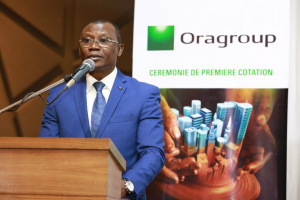
On Tuesday, April 16, Oragroup officially listed 20% (13,883,006 shares) of its capital on the BRVM stock market. This is after getting approval from the financial markets and public saving regional council (CREPMF).
Oragroup was able to raise XOF56.92 billion, during a public offering conducted between Oct. 29 and Nov. 22 2018. An operation arranged by Sociétés de Gestion et d’Intermédiation (SGI), BICI Bourse (arranger and co-lead manager) and Hudson & Cie (co-lead manager also).
“Oragroup’s listing affirms its status of major banking group reached only after about ten years of existence. This is a major moment in the financial history of both Togo and the sub-region,” said Togo’s minister of economy and finances, Sani Yaya.
However, according to experts, the group’s share could struggle before taking off. Indeed, based on the fact that the public offering had to be prolonged by a week, due to weak sales, actors of the regional stock market believe the share price, XOF4100, is overvalued.
Oragroup is present in 12 countries, across West and Central Africa and operates in four distinct monetary zones (WAEMU, CEMAC, Guinea Conakry and Mauritania) with 139 branches and 1811 employees.
Fiacre E. Kakpo
US firm CredoGroup interested in Togo’s solar sector

CredoGroup LLC, a Tenessee-based provider of independent solar energy services and products wishes to invest in Togo. The firm which is headed by US-Togolese Credo Amouzouvik, has actually sent some of its executives to Lomé to discuss the deal with the government.
“We want to help Togo become self-sufficient in terms of power production, harnessing energy from solar panels, mini and micro-grids which are more cost-effective. This will also create multiple jobs for the Togolese youth,” declared Amouzouvik.
The US firm plans to partner with its local partner Dodan, a civil engineering firm focused on renewables, in the framework of its deployment in Togo.
Togo aims to achieve universal electrification by 2030, with milestones of 50% (from 40% now) in 2020 and 75% in 2025.
More than XOF1000 billion is needed to reach full electrification, with renewables making up 50% of the country’s energy mix by then.