

Togo First
CADERT plans to boost agricultural sector through public-private partnerships

In line with government’s efforts to improve agriculture, the Autonomous Centre for Studies and Capacity-Building for Development (CADERT) carried out a study on “the contribution of public-private partnerships to agricultural development in Togo”. Last Friday, the document was submitted for validation.
The study aims to help the government achieve the goals it laid under the 2018-2022 National Development Plan; two of these goals include promoting promising agricultural value chains and developing agricultural hubs.
The study also aims to identify investment opportunities that agriculture can provide to the private sector, and make recommendations regarding public-private partnership (PPP) models which can spur agricultural growth in the country. “A public-private partnership is one of the funding mechanisms involving both the public and private sectors, bringing them to take actions that will benefit populations,” said Odilia Gnassingbé, Chief Executive of CADERT.
Let’s note that the document, prior to being submitted for validation, was subjected to observations by agricultural actors and PPP experts for improvement.
Séna Akoda
Togo seeks again CFA20 billion on regional financial market
After recently issuing fungible treasury bonds at a coverage rate of 85% for a targeted sum of CFA20 billion, Togo will retry the operation next August 31, aiming for the same amount (through similar bonds).
This was revealed by the regional agency in support of the issuance and management of public securities in the WAEMU (UMOA-Titres) in a tender it issued at the end of the past week.
Once again, the government wants to raise monies from natural and legal persons. These proceeds will serve to meet the State’s 2018 financing budget.
For the upcoming issuance, nominal value is CFA10,000, interest rate value is 6.25% and value date was set on September 3, 2018. Corresponding results will be released the same day the operation is to take place.
The term for the issuance is 36 months and its maturity date is September 3, 2021. According to the tender, “the bonds will be totally redeemed in full on the first business day following maturity”.
Séna Akoda
“The Path to Growth has no end” - Faure Gnassingbé (CGTN)
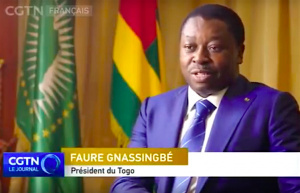
Ahead of the upcoming China-Africa Cooperation Summit, Togo’s President, Faure Essozimna Gnassingbé, gave an interview to Chinese TV CGTN on August 23. During the interview, the leader praised relations between his country and China over the past 40 years. He declared also that the coming summit will further improve these relations.
Interview Transcript
CGTN : Your excellency, we thank you for giving us this interview. Lomé’s Gnassingbé Eyadema International Airport has been operational since two years now. How did this infrastructure affect the Togolese people? Also, has it helped boost trade between China and Togo?
Faure Essozimna Gnassingbé (F.E.G) : I will also thank you for this interview and would like to start off with a topic that the Togolese people are quite proud of our airport. First of all, I must praise all those engaged in its construction for the quality of their work. I believe it is a very nice airport, very efficient, safe in all ways that currently matter.
This airport also serves the region and you may notice, looking at neighboring nations, that it is probably one of the most modern in the region and it directly impacts the lives of the Togolese people. I can affirm that those who benefit most from the infrastructure are travelers and those working there. Did it help boost trade between China and our nation? Well, all I can say is that things are progressing greatly.
Trade between China and Togo keeps improving and this will continue. However, if what you are asking is to know if there will be a direct flight connecting both countries, I would say that in a few years, this will become a reality.
CGTN: Diplomatic ties between China and Togo are more than four decades old. What is your opinion regarding the development of the relationship between our two countries over the past few years and also how you foresee cooperation between us ?
F.E.G : Relations between China and Togo, like you said, are four decades old. Some things do not change. Our friendship is based on loyalty, mutual trust and understanding of major global issues. This has not changed.
What changed, and I would say it is for the best, is our economic relationship. It has become stronger.
Amounts involved are more significant and thus more tailored to our needs. As it gained power, China increased its financial support to African countries generally, and Togo specifically.
What I like most about our relations is that recently, they tend to focus more on exchange between youths. Many young Togolese have the opportunity to either go study in China or learn from the experiences your country has to offer.
CGTN : Which types of Chinese companies do you wish to attract to Togo ? Have investments made by Chinese firms helped Togo advance towards a sustainable development ?
F.E.G : Investments have helped Togo grow and advance in its development. However, you know that the path to growth has no end. There is no limitation to our progress, so far. We have achieved some progress, but more can be done. There are tens of millions of jobs about to be delocalized. So, any Chinese firm ready to delocalize is most welcome.
Regarding our preferred sectors for new investments, I would obviously say agriculture since it is the most important for our economy. Our agricultural sector needs to be modernized and industrialized, transformed into an agro-industry. I would say we need Chinese firms to invest in that sector.
As you may know, in Togo, and some other African nations, there are many young people and for those, the greatest concern is getting a job. We will do everything to create these jobs.
CGTN : In September, Beijing will host the China-Africa Cooperation Summit. You will be present and will meet China’s President Xi Jinping. What are your expectations for this meeting and what impact do you believe this forum will have on relations between China and Africa ?
F.E.G : I think this will be an important summit. As we look around, we can see how the world has changed. We see how the behavior of some powerful economies has changed. The world has become an unpredictable place.
As for China and Africa who are old allies and friends, we need to preserve stability. We also need to assess our perception of political and diplomatic developments actually taking place.
While some economic powers try to do things on their own, the foundation of the relationship between China and Africa lies in dialogue, focusing on a win-win cooperation. Both sides win.
I would like to discuss with President Xi Jinping about the various threats the world actually faces like terrorism and global warming. I know he, just like us, is concerned about those and would do everything to preserve peace everywhere it is threatened and most importantly promote multilateralism. That is it for political and diplomatic aspects.
In regards to economy, I believe we will have the opportunity to discuss a major project, which I praise, the “One Belt, One Road” project. We will discuss how Africa can contribute to this ambitious, generous, and revolutionary project. You know, it is quite rare to see a country, even a huge one such as China which is currently the world’s second leading economic power, launch such a major project that would involve almost every continent.
CGTN : The coming summit’s focus is the Belt and Road Initiative and this event aims to reinforce relations between China and Africa. How do you think the Belt and Road Initiative can improve China-Africa cooperation and what do you think of President Xi Jinping’s idea to build a Community of Common Destiny with Mankind ?
F.E.G : First I praise this idea to make the connection between the two. You see, looking at the world’s actual globalization, the main challenge is a rise above inequalities. Rich people are getting richer and the poor are getting poorer. So with such inequalities, how can we talk about a Community of Common Destiny ? That is why, I laud the Belt and Road Initiative.
What matters is creating adequate conditions for the less fortunate so that they can aspire to wealth and get out of poverty which they live in daily. I also recently read President Xi Jinping’s book on ways to fight poverty so I find there, a common challenge we are facing.
If things continue as they are at the moment, there is no hope for a Community of Common Destiny.
However, building a community of common destiny should not be a mere slogan. Achieving this goal can only be done through action and the “One Belt, One Road” project is an action. So, I can make a connection between the President’s idea and the “Belt and Road Initiative”. Now, my wish, like I said earlier on, is for Africa to benefit and deserve whatever position it will be given in this major project.
Our first ambition is to ensure peace on the continent. With peace, we can move on to other things.
Compared to H1 2017, Ecobank’s profit rose by 37% last semester, however…
During H1 2018 which ended June 30, Ecobank Transnational Incorporated (ETI) recorded a net result of $168.5 million, up 37% compared to the same period in 2017.
According to the CEO of the Lomé-based Pan-African group, Ade Ayeyemi, pre-tax profit also rose by 41% last semester, standing at $213 million.
Similarly, the group’s treasury grew by about $341.03 million. This is good news, even if its pre-provision operating profit (PPOP) slumped 3% over the period reviewed; especially considering actual tensions between emerging markets, attributed mostly to the trade war going on between China and US. Actually, the treasury’s surge prevented Ecobank from issuing Eurobonds to fund its activities as it had planned.
Other improvements were recorded in services segments, distinct from corporate and investment banking. The group’s holding, eProcess, investment and assets management divisions, and its Paris subsidiary recorded a pre-tax profit of $112.3 million.
However, the group’s trading operations fared poorly, slumping 17% to $192.4 million (as compared to $232.6 million in H1 2017). This greatly affected operating profit, despite fee-commission income and interest income on customer loans rising 11% and 3% respectively.
Assessing these results, analysts from Ecofin Agency said they did not take into account some variables that will impact the group’s full year results. These include an exchange difference on translation of foreign operations of $74.4 million, and a potential loss of $31 million on investment securities. Taking these variables into account, Ecobank would end up with a consolidated profit of $63mln for the recent semester, down by 77% compared to $274.3 million during the same period in 2017
Fiacre E. Kakpo
Government changes attributions of urbanism ministry to meet requirements of new land code

Subsequent to the recent adoption of the new land code, the government redefined attributions of the ministry of urbanism and housing.
The new code contains 736 articles and aims to improve land laws tackling speculation and expropriation, and solve the issue of dual registration of a single property, as well as that regarding construction in flooded areas and sell-off of rural lands.
In this regard, the government indeed had to ensure that the ministry of urbanism had an “appropriate organizational and operational framework, allowing the implementation of the new code’s provisions” to satisfy both the people and investors (local and foreign).
Adopted by the parliament last June 14, the new land code takes into account socio-economic and cultural transformations happening in Togo. It also recommends a battery of innovative and fair solutions to develop the agricultural sector.
Togo: From 2011 to 2017, craft industry captured nearly CFA9 billion of public investments
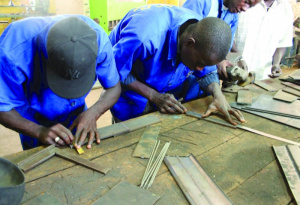
From 2011 to 2017, the craft industry captured more than CFA8.7 billion of public investments according to data released by the ministry in charge of the sector.
Breaking the sum down, CFA3.8 billion was loaned to young artisans (CFA2.7 billion via the Accès des Jeunes aux Services Financiers-AJSEF; and CFA967 million for project development) and four billion was used to provide them with tool kits.
The sector employs more than a million people and is thus one of the country’s major job provider. It contributes 18% of Togo’s GDP and cuts trade balance’s deficit by 20%.
According to the handicraft ministry, this industry attracts more and more young individuals. Every year, about 20,000 people graduate from craft training centers and to date, 53,360 artisans are officially registered in the country’s handicraft information system.
Despite these impressive performances, the ministry yearns to make the sector more professional, fostering the creation of competitive and internationally-renowned handicraft companies. To this end, it developed a five-year plan (2018-2022) which will help valorize the country’s heritage and boost handicraft’s contribution to its economy.
Séna Akoda
Togolese Paul-Harry Aithnard appointed Managing Director of Ecobank Côte d’Ivoire and Regional Executive of UEMOA
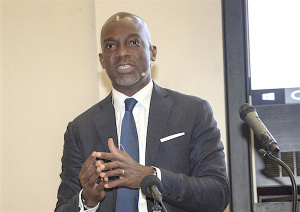
Togolese Paul-Harry Aithnard has been appointed new Managing Director of Ecobank Côte d’Ivoire and Regional Executive, UEMOA designate.
Aithnard was previously head of the group’s securities and asset management division. He joined Ecobank in 2008, as the Group’s Head of Research. Before that, he worked at BBSP Investment Advisory. He will be coming into office in November this year, replacing Ivorian Charles Daboiko who will be retiring officially.
The Togolese holds two masters degrees, one in Finance (from HEC Business School of Montreal) and another in History (from University of Paris IV). He also holds a Post-Graduate Degree in Business Administration.
Besides Aithnard, Ecobank announced other appointments, taking effect immediately. Indeed, the Ghanaian, Josephine Anan-Ankomah, and Congolese, Yves Mayilamene, were respectively appointed group executive in charge of commercial banking and group executive in charge of human resources.
Togo : A CFA100 million project launched in Yoto, to promote agricultural production and boost local economy
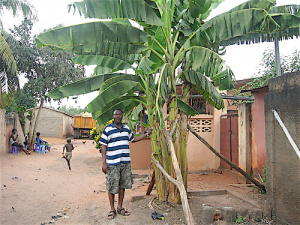
Last week, PROMECO, a project that aims to boost local economy by supporting agricultural and agropastoral activities, was launched in Tabligbo, in the Yoto prefecture (Southern region).
The project benefits from a FCFA100 million financing (spreading over two years) provided by the Tabligbo municipality and Organisation Internationale de la Francophonie (OIF), among others. It will initially profit six pilot villages, boosting local consumption and diversifying sources of financing.
PROMECO is a local component of OIF’s program to “integrate SDGs in regional, national and local policies and strategies”. The latter’s goal is to improve farmers’ yields and ensure the adoption of environment-friendly agricultural practices.
Besides, it includes many aspects such as boosting processing of local products, making food products more available and teaching local communities about project management.
It must be outlined that the project will focus on cassava, fishing and vegetable production. Under its implementation, semi-modern processing units will be set up for each of these sectors.
Séna Akoda
World Bank to lend Togo $30M for its Infrastructure and Urban Development Program
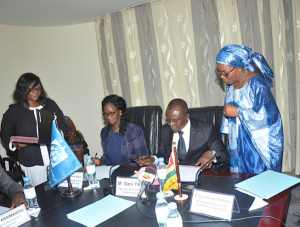
The World Bank will lend Togo $30 million to advance its Urban Development and Infrastructures Program (PIDU). Related agreement was signed on Wednesday in Lomé.
Monies committed by the Bretton Woods institution will be used to improve access to basic urban infrastructures in Lomé, Kpalimé, Tsévié, Atakpamé, Sokodé, Kara and Dapaong.
PIDU is a project that will also boost these cities’ institutional capacity, in terms of planning and urban management, said Sani Yaya, Togo’s minister of economy and finances. It is expected to be completed by the end of December 2023.
For her part, Hawa Cissé Wagué, World Bank’s resident representative in Togo, said the new loan agreement comes to support the country’s 2018-2022 National Development Plan. “The agreement falls under the implementation of World Bank’s Partnership Framework which strongly aligns with main axes of the National Development Plan adopted last month by the Togolese government,” she declared.
With the new loan, World Bank’s investments in Togo now amount to $380 million.
Séna Akoda
From September 3, Togo Telecom users will be able to enjoy a monthly subscription for CFA4720

To tackle the significant decline of landline services in the country, spurred by mobile’s emergence, Togo Telecom decided to apply a single monthly tariff for landline calls.
From now on, all landline users, except major companies and the public administration, will be able to pay CFA4720 monthly to call each other; regardless of consumption levels.
Through this move which will be effective starting September 3, Togo Telecom wishes to boost landline services, as they struggle against mobile services.
The recent decision is part of a series of measures undertaken by the public operator to become more competitive, providing its services at a lower cost. To the same end, Togo Telecom will merge with mobile operator Togocel, its first rival in the voice segment.
Fiacre E. Kakpo