

Togo First
Construction firm Gelloq-Togo opens a branch in Niger
Togolese construction firm Gelloq-Togo has opened a subsidiary in Niamey, Niger.
The new branch will focus on activites such as studies, public works, civil engineering, construction, maintenance and rehabilitation of buildings, roads and hydraulic infrastructures.
The firm is interested in sanitization, siding, maintenance, painting, plumbing and electricity; import-export, trading and transportation, namely transportation of industrial equipment and raw materials, by road across West Africa.
Last July 19, a file containing the firm’s statutes was submitted to the clerk of Niamey’s Commercial court where Gelloq’s subsidiary is registered.
Ministry of Infrastructures hiring for various infrastructure projects
In Togo, the ministry of infrastructures plans to rehabilitate or build regional directorates of public works and sectors, as well as the rural roads directorate.
Leveraging a credit line falling under the 2018 State budget, the ministry seeks to hire a contractor who will carry out technical studies and elaborate bidding documents for targeted works.
The ministry has in this regard addressed registered youths and women-entrepreneurs active in technical studies sector. This aligns with the government’s decision to set aside 20% of procurements to this group of individuals.
Overall, 31 entrepreneurs are called to bid to the tender. Tenders documents is grouped in a single lot. According to well-informed sources, the hired consultant will be chosen based on the quality of its services and the value of its offer.
For 2018, provisional amount of procurements reserved for this group of entrepreneurs is CFA40 billion.
Séna Akoda
Lomé in talks with Chinese firm to build Lomé-Cinkassé railway
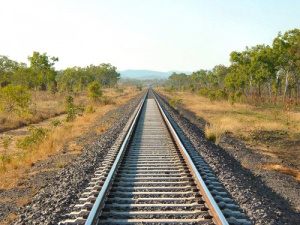
On September 3, Togo’s President, Faure Gnassingbé, met Liang Bin, CEO China Railway Construction Bridge Engineering Bureau Group to discuss the Lomé-Cinkassé railway project.
According to a statement released by the Togolese presidency, this meeting aligns with the President Gnassingbé’s will to make his country a logistics hub, and “identify all investment opportunities” in order to build the 600km-long railway.
Liang Bin, during the meeting, said he was interested in the project which falls under Togo’s 2018-2022 National Development Plan (PND 2018-2022). In fact, the executive plans to visit Lomé soon in order to conclude talks with Togolese authorities.
Séna Akoda
FOCAC 2018 ends with adoption of Beijing declaration, action plan over 2019-2021
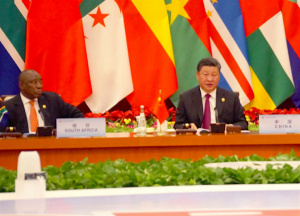
Yesterday, Sept 4, the Forum on China-Africa Cooperation (FOCAC) ended, marked by the adoption of declaration and action plan.
The Beinjing declaration – Toward an Even Stronger China-Africa Community with a Shared Future and the Beijing Action Plan (2019-2021) were indeed adopted at a two-phase roundtable meeting. The latter was chaired by the presidents of China and South Africa, Xi Jinping and Cyril Ramaphosa.
According to Xi Jinping who said Monday that his country will commit more than $60 billion to Africa in the coming years, the declaration is a “strong message” attesting both parties’ will to grow.
Macky Sall, Senegal’s President, who will co-chair FOCAC next, said relations between China and Africa are entering a “golden age”.
Fiacre E. Kakpo, special envoy
President Faure Gnassingbé pleads for more Chinese investment in Africa (Focac)
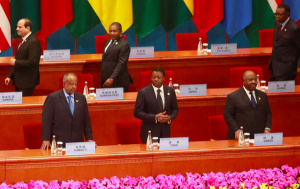
Upon the 7th China-Africa Cooperation forum (Focac), which kicked off yesterday September 3, the Togolese President Faure Gnassingbé pleaded for an increase in Chinese investments in Africa. This was during a Round Table of Heads of State and Government, held today.
During this meeting co-chaired by Xi Jinping and Cyril Ramaphosa, Presidents of China and South Africa, respectively, Faure Gnassingbé first hailed the rapid growing trade between Africa and China. The trade volume had “multiplied by 17 between 2000 and 2017", he said. He also welcomed new opportunities for relationships between both sides. “I am happy that we are about hitting a new level for Focac, opening great common development prospects, with win-win cooperation plans. I would like to welcome this new breath of fresh air, and also plead for more investment,” he added.
The President also mentioned the friendship which has diversified and strengthened despite “the extremely changing international business environment. Because like it or not, China and Africa will share a common destiny in the 21st century,” he predicted.
To conclude his 5 minutes speech, Faure Gnassingbé invited partners “to extend the field of innovation experimentation in Africa, in a fruitful cooperation, especially with young people who represent the future”.
Let’s mention that at the end of this high-level meeting, two documents will be published: the "Beijing Declaration for Building a Closer Fate Community between China and Africa" and the "China-Africa Cooperation Forum Action Plan 2019-2021".
Octave A. Bruce
Togo: Morocco to organize a B2B event with poultry farmers next September 25-27
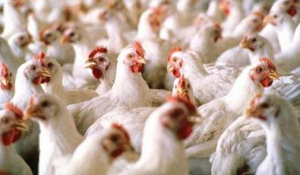
Morocco’s poultry sector association (FISA) is organizing, jointly with the Exports Control and Coordination Agency (EACCE), a B2B meeting with Togolese poultry sector’s players next September 25-27.
According to lematin.ma which reported the news, the initiative (which is part of a mission also covering Benin and Ghana), will allow both Moroccan and Togolese poultry farmers to explore business opportunities. The mission is in line with the “promotion of the Moroccan poultry sector and its export/investment capacities”.
It will mainly offer Moroccans the occasion to assess Togo's potential for investment. The implementation of such project should further boost the Togolese poultry sector, which performed well in recent years, in terms of productivity and growth. Over the period 2011-2017, the number of poultry increased from 8 million to over 20 million.
Togo: Tax revenues authority to implement new integrated public finance management system
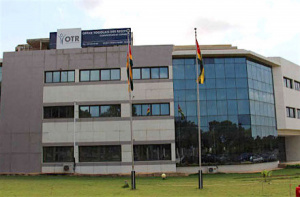
Togo’s revenues authority (Office Togolais des Recettes-OTR) is planning to implement the integrated public finance management system (Système Intégré de Gestion des Finances Publiques-SIGFIP). The institution in charge of tax and customs revenues collection is thus conforming to the new dynamic for a better management of public funds.
Indeed, this management system is said to have many advantages. It notably allows the secure registration of financial data, help prepare financial reports and connect decentralized financial audit units to the main center. It also facilitates operation record, permanent internal audit of data, transactions and financial reports production.
Its implementation by the OTR is prescribed in the framework of the tax administration support programme (Projet d’Appui à la Gouvernance Fiscale), funded by the African Development Bank via the African Development Fund.
A call for expression of interest has been launched to choose a cabinet for technical assistance for this implementation.
Séna Akoda
Seduced by Togo’s national development plan, Chinese giants announce investments in the country
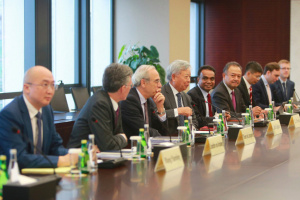
In preparation for the opening ceremony of FOCAC, the forum on Africa-China cooperation, Togo’s delegation led by the president Faure Gnassingbé, continued meetings with investors on Monday 3, September 2018 in Beijing. The stated objective of these meetings is to invite those investors into participating in the implementation of Togo’s 5- year action plan which is mainly focused on the private sector.
After meetings (the previous day) during which two giants of the construction sector announced their intention to invest in main projects of the National development plan, four other large investors also signified their interests in investing in the country during Monday’s meetings.
CRBC: a world-class civil engineering interested in the road infrastructure sector
With the first investor Du Fei, president of China Road and Bridge Corporation (CRBC), the discussions were essentially focused on the logistics corridor namely, the connection between Lomé port and the countries of the Hinterland and projects around nationale n°1. CRBC, a world-class civil engineering company, has already proved its worth with the construction of Amakpapé bridge within a record time. This long-time partner has also built many road infrastructures such as Lomé and Alédjo bypasses as well as the Lomé-Vogan road under construction.
China Railway Construction Bridge Engineering Group to invest in the railway sector
To boost the dying railway sector, various opportunities in the sector notably Togo’s strategic position in West Africa were presented to China Railway Construction Bridge Engineering Group during a meeting. The company specialized in railway infrastructures and already present in many large infrastructure projects in Africa expressed its will to invest into the infrastructure sector in Togo, for construction of the 600 kilometers long Lomé-Cinkassé railway notably.
Towards a partnership with YTO Camaco to accelerate modernization of the agriculture sector
Zhang Ting, director of YTO Camaco in West Africa, discussed investments in the agriculture sector. The world leader of farm machines commercialization is already selling equipment in Côte d'Ivoire, Cameroon, and Nigeria where it established subsidiaries. It is planning to set an assembly plant to manufacture ground preparation (tractors and its hitches) machines for agriculture products transformation and post-harvest equipment, in the country. Shortly, upon Faure Gnassingbé’s instructions, the two parties will start the negotiations to accelerate the support this company can provide to the second axis of the national development plan, focused on the promotion of a modern and green agriculture which will provide massive jobs.
Power China interested in the energy sector
Already present in Togo via its African subsidiary in charge of the joint Togo-Benin energy project, Adjarala wishes to accompany Togo in the implementation of its electrification strategy. It promises to include the social dimension (allowing to contribute to the population’s well-being) in its investment plan.
Asian Infrastructure Investment Bank (AIIB) pledges support to Chinese investors in Togo
Before attending the official launch of FOCAC 2018 at Great Hall of the People in Beijing, Togo’s president Faure Essozimna Gnassingbé, accompanied by his ministers visited AIIB’s headquarters to meet Jin Liqun, president of the Asian Infrastructure Investment Bank (AIIB). After he was informed of the three key points of Togo’s national development plan, Jin Liqun praised the development's institutional framework Togo elaborated and assured that AIIB would be ready to back Chinese investors willing to invest in Togo.
Fiacre E. Kakpo
China provided 30.2% of overall funds granted to Togo in 2017 – APD 2017
Every year, China and Togo boost their bilateral trade and cooperation relationship. According to the public development aid report (Aide Publique au Développement-APD) published by Togo’s ministry of planning and development in 2017, China is Togo’s second-largest lender with $19.85 million lent to the country.
This amount represents 24.92% of the overall loans ($79 million) reported by the APD. China was outrun by the West African Development Bank which lent $20.78 million to Togo during the period being reviewed.
As far as donations are concerned, in 2017, China provided 4.9% of total aids. This country, thanks to Exim Bank China, was the fifth largest donor behind the European Union, World Bank, the African Development Bank and the West African Development Bank.
Let’s note that according to the APD, China has also been the second largest fund (loans and donations) provider for Togo with 30.20% of the overall funds granted in 2017.
Séna Akoda
Togo : Free .tg TLD, hosting and email to be offered to 1000 companies this month

To promote company creation and digital inclusion in Togo, the ministry of digital economy launched a campaign to promote the country’s top-level domain (.tg). This campaign which started on September 1, 2018, will end on September 30, 2018.
The initiative is supported by the ministry of commerce and private sector development, the chamber of industry and commerce, the business registration center, the business climate cell (Cellule Climat des affaires-CCA) and the posts and telecommunications regulatory agency.
The symbol of Togo’s digital identity, .tg Top level domain will be offered, for free, to the first 1,000 companies to formalize themselves during the promotion period.
Apart from the domain name (.tg), these companies will be offered a hosting package and an email address. With this promotion, the ministry wants to increase the visibility of companies established in the country and facilitate their development nationally and internationally.
The .tg TLD and related tools will also foster companies’ credibility by boosting internet users’ trust.
Formerly managed by the private company CAFE Informatique, .tg TLD is being managed, since May 23, 2016, by the authorities who decided to increase the TLD’s popularity internationally and decrease its registration fees deemed too high.