

Togo First
Israel will support African agriculture via its NGO, Start-Up Nation Central
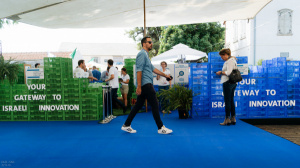
African farmers will now easily benefit from Israel’s technologies and solutions. Related memorandum of understanding was signed between the African Green Revolution Alliance (AGRA) and Tel-Aviv-based NGO Start-Up Nation Central (SNC).
This was during the 8th African Green Revolution Forum (AGRF) held Sept 5-8, 2018, in Kigali, Rwanda, under the theme “Lead, measure and grow”.
According to SNC’s president, Eugene Kandel, the partnership will help mitigate risks associated with food scarcity in Africa (actually more than 150 million people of more than 15 years are suffering from severe food insecurity).
Mostly financed by philanthropy, SNC offers solutions based on Israeli innovations to companies, governments and universities. It developed Start-Up Nation Finder, a platform that gathers more than 5,000 top innovative Israeli firms operating across various sectors, agriculture included.
AGRF is one of the main forum dedicated to African agriculture. Last year, it was held in Côte d’Ivoire.
Octave A. Bruce
Togo: CAD Fund announces investment in Asky Airlines

The China-Africa Development Fund (CAD Fund) plans to invest in Asky Airlines, a Lomé based pan-African airline which seeks new strategic partners.
Presenting interests and opportunities in Togo’s 2018-22 National Development Plan (PND), CEO Shi Jiyang, said the fund will support new projects in Togo including Asky Airlines.
“CAD Fund will continue to support projects in infrastructure, industrial parks, hydroelectric power, resource development and aeronautics,” the manager said during the China-Togo Business Forum in Hangzhou.
Mr. Shi indicated that the desire to enter into the company’s capital is subsequent to its good performance, particularly in 2016. In addition to the aeronautics sector, the fund also intends to support the project to extend the Port of Lomé and create an industrial park in Togo. Let’s note that CAD Fund is the Chinese private investment arm in Africa.
Fiacre E. Kakpo
Lire aussi:
https://www.togofirst.com/en/investments/1109-1578-togo-cad-fund-to-support-new-development-projects
Togo: UAC organizes African air travellers’ rights campaign in Lome
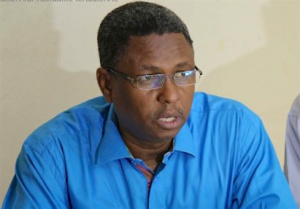
In Lome, in the framework of the launch of a campaign to promote passenger’s rights, Daouda Elhadj Adam (photo), president of Union Africaine des Consommateurs (UAC), a pan-african consumers’ union, presented a press conference on September 13, 2018.
During the conference on air travelers’ rights in Africa, the official presented the aims of this campaign to journalists. According to his statement, African air travelers are affected by several problems notably, the high cost of airline tickets, thus difficult to afford for the average traveler, the limited or rather absent supply of direct flights to towns on the continent, the delays, overstatements and flight cancelations without warning.
It is, therefore, an awareness-raising campaign and a plea will be launched for political authorities and airline companies to have greater respect for African travelers’ rights.
Let’s remind that though there are texts regulating air transport in Africa, those texts are less known (if not unknown).
“We will monitor the implementation of these measures to ascertain the impact of liberalization in this important sector for African consumers”, Daouda Elhadj Adam indicated.
During his stay in Lome, Daouda Adam will discuss with Togo’s members about this Pan-African association grouped under ATC (Association Togolaise des Consommateurs) and LTC (Ligue Togolaise des Consommateurs).
Octave A. Bruce
Togo: Lomé to host a 2-month video game event starting September 22

On the sidelines of the 2018 Video Game and Electronics Festival of Abidjan (FEJA), Togolese top gamers are planning a big event gathering all video game lovers from September 22 to November 22.
The event is set as a qualifying tournament with the objective to get prepared for FEJA scheduled from 23 to 25 November 2018. It will last for 3 days during which gamers from Benin, Burkina Faso, Côte d'Ivoire, Ghana, Guinea, Mali, Nigeria, Senegal, Togo and Cameroon will compete.
During the fair initiated by Paradise Game, participants will attend final phases of the eSport tournaments, which include FIFA, PES, Fortnite, Street Fighters, Tekken, Naruto, Dragon Ball Z, Clash of Clans and Candy Crush games. The jackpot is valued at nearly CFA13 million (€20,000).
Inscription for FEJA began September 12 on www.feja.ci and will end on November 22. Let’s point out that through the event themed “video game industry and job creation”, Paradise Game intends to promote video game-related jobs as to offer African youth new opportunities. Focus jobs include game designers, programmers, pro-gamers, etc.
Fiacre E. Kakpo
"Quality certification is not compulsory but essential for companies"-Kanda Roland
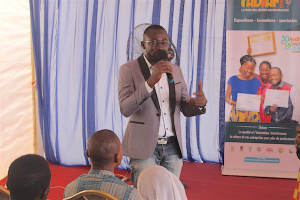
The 35th edition of "Jeudi J’ose", a support programme initiated by the Faiej (Fonds d’Appui aux Initiatives Economiques des Jeunes) for young entrepreneurs, was held on September 13, 2018, at Adjafi fair in Lome.
Articulated around the theme "L’introduction des normes de qualité dans les procédures des entreprises favorise-t-elle l’innovation ? " (Would the introduction of quality standard in the company creation process foster innovation?), this edition was moderated by Kanda Roland, a project manager.
The impact of quality standard on innovation within a company and the importance of certification were presented to the participants. "Quality certification is not compulsory but essential for companies. It will likely compel companies to provide quality service", the presenter said.
The second part of this edition was presented by Abitor Komi, CEO of M’ORSE group and managing director of ONG ETD. She explained what entrepreneurship entails and invited young entrepreneurs to draw on her career.
The participants also received the impromptu visit of Sahouda Gbadamassi, director of Faiej. The official expressed her Joy at seeing the youth’s growing interest in entrepreneurship, reiterated the government’s support and concluded the programme by exhorting entrepreneurs to move forward.
"Jeudi, J’ose" is a discussion panel initiated to let professionals and established entrepreneurs share their experiences with the young generation. Launched in November 2015 by the Faiej, it is held on the second Thursday of every month.
Octave A. Bruce
Togo : Government will now support technological research centres and creations

From now on, the government will financially support any public or private initiative that will contribute to Togo’s industrial and technological development. This was announced September 13 by Yaovi Attigbé Ihou, minister of industry and tourism, on the sidelines of the African Day for Technology and Intellectual Property.
On this occasion, both the State and civil society will discuss one of the continent’s major issues, that of industrial development. According to the minister, “various studies have shown that the level of industrial development of a given country is related to its capacity to develop and use inventions that help create industrial processes and products”.
The official hence urged various partners to better support research and inventors in Togo, in order to ensure a strong, sustainable, resilient and inclusive growth. This aligns directly with the government’s goal to make innovative SME/SMI development one of the main axis of the economy’s structural transformation.
“I encourage every national and international institution in charge of promoting or financing technological inventions, to support inventors and research centres, in order to boost our country’s industrial sector,” the minister said.
Let it be noted that the African Organization for Intellectual Property (AOIP) which celebrates its anniversary every September 13 will organize from October 24 to 27, 2018, the seventh edition of the African fair for technological invention and innovation (SAIIT).
Togo : Agoè to soon get its own movie theater

Soon, there will be a movie theatre in the Agoè Nyivè prefecture. Financed by the Vivendi group, the infrastructure will be located in the Bluezone Cacaveli where various sociocultural activities already take place.
Guy Madjé Lorenzo, minister of culture, recently visited the site to assess progress achieved on the project.
The theatre which will be powered with solar energy is built by the Bolloré Group and is the second of its kind in the country.
Séna Akoda
CPIA: Togo improved its score in 2017
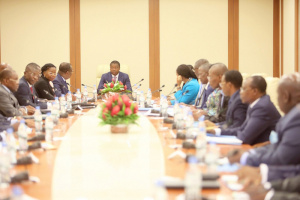
After falling last year, the CPIA score of the 38 African countries eligible for the International Development Association’s (IDA) loans is steady this year. This is disclosed in World Bank’s 2017 CPIA report released on Wednesday 12, 2017.
Overall, these countries scored 3.1 with sub-Saharan Africa getting a slightly better score than other nations benefiting from IDA’s support. Average score for the latter was 3.2.
With a 3.1 score, up 0.1pt in 2017, Togo is among African countries eligible for IDA’s loans that have improved the quality of their policies and public institutions.
Released yearly, the CPIA report rates every country that can benefit from IDA grants. The scores reflect quality of policies and institutions in the concerned countries. The CPIA consists of 16 criteria grouped in four equally weighted clusters: Economic Management, Structural Policies, Policies for Social Inclusion and Equity, and Public Sector Management and Institutions.
These are Togo’s ratings for each of these clusters: 3.2 pt, 3.2 pt, 3.4 pt and 2.8 pt.
Compared to 2016’s ratings, this is a good performance, which is to be attributed to the many reforms put in place by the government to improve the country’s macroeconomic environment.
Looking at economic management’s score, it improved by 0.4. Structural policies were stable, the same goes for policies for social inclusion and equity. Last is the public sector management whose score rose by 0.1 pt.
Economic Management : Carrot and stick
Though its score for economic management is the same as average for sub-Saharan African nations (3.2), Togo will have to improve its policy and debt management. Truly, the country’s debt soared significantly in 2016. And though the CPIA report notes a 0.5 pt improvement of its ratings in 2017, other major actions should be taken to fix things. Actually, a few months ago, the World Bank said it would send a mission to Lomé to help the government better manage its debt.
Concerning public sector management and institutions, Togo also needs to improve. In effect, this year, concrete actions were taken to raise the countries’ indicators. Such reforms include a new land code, a new tax code to come into force in 2019; a new custom code was also adopted by the parliament. These reforms could help the country improve its results for the next CPIA report.
Social and environment : Positive evolution
In regards to social and environmental conditions, Togo’s results are better. Indeed, World Bank’s report gave the nation a score of 3.4 for social inclusion and equity while average for the sub-Saharan African region was 3.2. The World Bank lauded Togolese authorities for the multiple reforms implemented over the recent years to increase ecologic sustainability. Also, for the equity in use of public resources, the report gave Togo a score of 3.5, against 3.2 for the SSA region. Regardless, once again, the country still has to fix various issues related to the valorization of its human resources, since it keeps lagging behind its neighbors in this aspect.
Structural policies
In regards to structural policies, Togo scored 3.2 as a result of regional standards imposed in the WAEMU and ECOWAS which the country is part of. The 2017 CPIA report assesses all reforms implemented in the Togolese trade industry up to 2017. Under these, measures aiming to simplify procedures related to external trade were well seen by the World Bank. Same goes for monetary and exchange policies, which are also strengthened due to Togo’s appurtenance to the above-mentioned communities.
A look at the past decade
From 2008 to 2017, Togo’s CPIA scores grew by 0.4 pt, driven by progress made in economic management, social inclusion and equity, public sector management and institutions. However, over the period, according to the World Bank, structural policies stagnated.
In the CPIA ranking, Rwanda still remains at the top, both across the region and worldwide, with a score of 4. Other well placed nations in the region include Senegal (3.8), Cape Verde, Kenya and Tanzania (3.7 each).
Let’s recall that the CPIA is a tool that allows the World Bank, through the IDA, to increase the amount of concessional loans it grants. It is also a great tool to develop public policies.
Fiacre E. Kakpo
Togo: Minister of trade launches in Kara a program to boost cashew and shea value chains
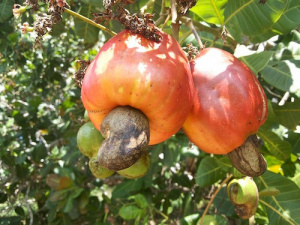
Togo’s minister of trade and private sector promotion, Bernadette Essossimna Legzim-Balouki, recently launched in Kara (in the northern region) a project to boost cashew and shea nuts sales and make them more sustainable (PRODAK).
Developed by the ministry of trade, the project will improve the “quality of shea and cashew nuts, and their derivatives, making the products, which have a great economic potential, more competitive and profitable in regards to exports”. The launch ceremony took place September 7, in the presence of the regional director for agriculture, who represented the minister of agriculture, husbandry and fishery.
“This ceremony marks, for the country’s various economic operators, the start of a new, huge project which aims at making cashew and shea nuts, as well as their derivatives, more competitive, by improving related processing and commercialization conditions, in the local, regional and international markets,” said Ouro-Koura Agadazi, minister of agriculture.
The project, let it be emphasized, falls under the national development plan’s second axis. The latter aims to create in the country, agricultural, manufacturing and mining processing poles.
About 120 people, operating in the cashew and shea sectors, partners and actors of both private and public sectors were present at the ceremony.
Séna Akoda
A Togolese delegation will be in Abidjan next month for ECOMOF forum
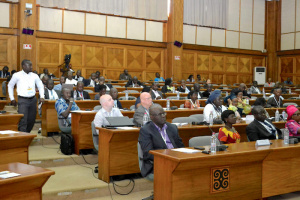
From October 9 to 11, 2018, a Togolese delegation is expected to attend ECOWAS’ second mining and petroleum forum and exhibition, ECOMOF, in Abidjan.
The forum is organized by the ECOWAS commission, Côte d’Ivoire and AME Trade Ltd, a British firm. It is themed “Strategies to promote the development of mineral and oil resources in West Africa”.
At the event will be present major government delegations from ECOWAS’ member-States, top executives from big oil companies, investors and service providers. Some major mining firms expected are Endeavour Mining, IDC, SAMA Resources, Concrete Canvas, X&M and MANAS Resources.
ECOWAS’ commission intends through the forum to “establish an economic cooperation between its member-States to attract new investments, by harmonizing their infrastructures, strategies and regulations”.
ECOMOF, where more than 1,000 participants are expected, will “focus on the West African infrastructure, local content policies, oil codes, as well as current and future opportunities in the oil and gas sector”. This is the chance for Togo to build new partnerships with major actors of the oil and gas sector in West Africa.