

Togo First
African nations wish to be more involved in the solar revolution, in Africa and worldwide
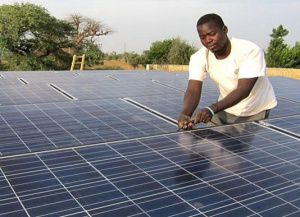
On Sept 10, six African countries, namely Benin, Burkina Faso, Gabon, Mali, Niger and Togo, officially launched a global initiative to raise funds, under the International Solar Alliance.
The initiative which is steered by the presidents of the mentioned nations falls under the Affordable Finance at Scale program. The latter’s purpose is to boost investments in solar energy.
According to the official statement disclosing the news, the program aligns with priorities set during the last New Delhi Summit. It was finalized during a meeting held in Lomé, on August 23 and 24, between the president’s advisors.
Commenting on the project, Togo’s president, Faure Gnassingbé, said : “Through this initiative, African nations wish to get engaged in the solar revolution, both in Africa and the World.”
For his part, Mali’s leader, Ibrahim Boubacar Keita, added that the initiative will help “lift legal, regulatory and institutional roadblocks preventing massive investments and innovative financing solutions.”
Last is Benin’s president, Patrice Talon who said : “This initiative will help implement more projects, faster, at a lower cost, and in a way that better fit our needs and interests.”
Nations involved will meet at the end of September for a second work session.
Let’s recall that since 2013, ECOWAS member-States have had their own clean energy development strategy.
The International Solar Alliance was established by India and France during the COP21. It aims to gather all 121 countries of the intertropical zone, leveraging their great solar potential to impact the sector, significantly.
Octave A. Bruce
Togo: CAD Fund to support new development projects
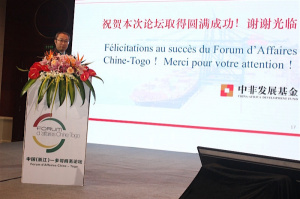
The China-Africa Development Fund (CAD Fund) announced September 6 it will support new projects featured in Togo’s national development plan (PND) for 2018-22.
Presenting interests and opportunities for targeted investments in Togo, the CAD Fund, which conditions its support on the feasibility and good control of the risk associated with these projects, said it will help mobilize Chinese sectoral investors for the Togolese PND. “Based on the LCT (Lome Container Terminal) project jointly funded with China Merchant, CAD Fund will continue to monitor projects in infrastructure, industrial parks, hydroelectric power, resource development and aeronautics”, said Shi Jiyang the Fund’s CEO.
Focus projects include the expansion of the Port of Lomé and the industrial park. “CAD Fund is currently studying ways to expand LCT and the industrial park. Once the feasibility studies is completed, we will advance to the project implementation,” Shi Jiyang said.
In addition to these two projects, CAD Fund plans to invest in Asky Airlines, a lome-based pan-African airline which serves about 20 destinations in West and Central Africa.
The Fund also announced investment in the Adjarala dam construction project and committed to help boost phosphate production. According to the manager, the Togolese phosphate is of “better quality” but the current volume generated are insufficient.
Let’s note that both sides signed a Memorandum of Understanding (MoU) during the China-Togo business forum. But no more detail has been revealed yet.
Fiacre E. Kakpo
Togolese entrepreneur Bemah Gado listed among 35 most influential young people in the Francophone world, in 2018
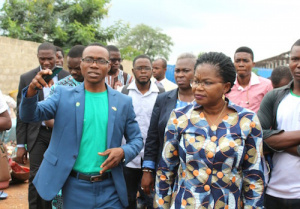
The young Togolese Bemah Gado, head of Green Industry Plast Togo, is ranked among the 35 most influential young people in the Francophone world in 2018, a report from Francophone 3535 revealed.
The plastic waste recycling promoter is the only one selected within “Environment” category. Like the 34 other young people aged 18-35 from various nationalities, he will receive his award in Abidjan during a meeting from 09 to 11 November 2018.
The “Prix Jeunesse Francophone 3535” makes it possible to bring together young innovators selected among the most inspiring and influential ones to participate in all activities initiated by Francophone 3535.
Target categories include agriculture and agri-business; arts, culture and fashion; blog, digital influence and media innovation; business leader; education; entrepreneurship; environment; film performance; music; internet personality, radio and media personality; civil society advocacy.
This year, in addition to the 35 prizes, there will be special prizes called “Elan pour la Jeunesse” granted to Francophones of all ages whose actions benefit young Francophones.
Séna Akoda
“J’nov pour les ODD”: Deadlines extended to September 17, 2018

In a statement published on its website, UNDP’s representation in Togo informs that the deadline for submission of application to the “J’NOV pour les ODD” competition has been extended by one week.
Initially set to September 10, 2018, this deadline is now extended to September 17, 2018, the institution informs.
“J’NOV pour les ODD”, jointly launched by the UNDP and Togo’s youth ministry, is a competition aimed at young Togolese aged 16-35. They will have to devise innovative solutions that will contribute to communities’ sustainable development.
At the end of this first edition, the ten best projects (5 devised by women and 5 by men), will be granted up to CFA5 million each.
Applicants can check the requirements on www.tg.undp.org or on www.devbase.gouv.tg. Application forms should be sent by email to This email address is being protected from spambots. You need JavaScript enabled to view it. or by post to UNDP’s office.
Togo: LNG storage and regasification installations to be built in partnership with Equatorial Guinea
Togo aims to diversify its gas supply and reduce its dependence on onshore pipelines. In that regard, with Equatorial Guinea, it is exploring the possibility to build liquefied natural gas storage and regasification facilities. It is also considering the possibility to conclude a sale and purchase agreement for an LNG terminal.
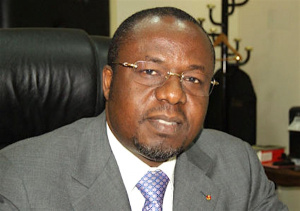
According to Marc Dedèriwè Ably-Bidamon (photo), the energy and mines minister, this project falls within the framework of the government’s ambition to have sufficient gas to satisfy its population’s need. During Equatorial Guinea’s LNG installations, the minister estimated that the implementation of such project would be a considerable asset.
In line with the government’s ambition, a framework agreement was signed in April 2018 in Lomé by Marc Dedèriwè Ably-Bidamon and his Equatorial Guinean peer Gabriel Mbaga Obiang Lima for LNG supply.
“It is fundamental for African countries to monetize their gas and for energy users to benefit from this cheaper and cleaner resource produced locally. Equatorial Guinea is committed to helping its neighbors find win-win solutions. We expect a strong partnership with Togo”, Gabriel Mbaga Obiang Lima said at the time.
Séna Akoda
Togo and China to set a special JV that will assess and steer Chinese investment projects in Togo
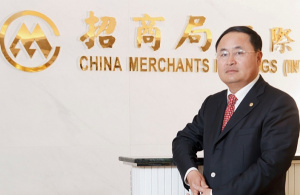
In Hangzhou, Togo Invest Corporation, the Togolese State’s investment arm, and China Merchant Port, Chinese state-owned major conglomerate, have laid foundations for the creation of a joint venture by end-2018.
The related agreement was signed by the managing director of the Togolese holding and executives from the Chinese conglomerate, last September 7, during the first Business Forum ever organized by Togo.
Togo Merchant Investment and Development, which is the announced joint venture, will assess and steer investment projects led by Chinese investors in Togo. Creation process for the JV should be accelerated in the weeks to come.
Regarding the joint venture’s shareholding, 51% will be held by China Merchant Port, and remaining 49% will be detained by Togo Invest Corporation. China Merchant Port, let’s note, is listed on Hong Kong’s stock market and is involved in various businesses such as port operations, general and bulk cargo transportation, container and shipping business, air cargo and logistics park operations.
Fiacre E. Kakpo
Pitch Agrihack Talent : Togolese developer, Dona Etchri, wins €15,000 award for his e-agribusiness platform
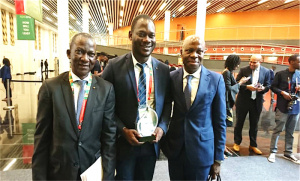
With seven other laureates of the 2018 Pitch Agrihack Talent, Togolese Dona Etchri who developed E-agribusiness, won €15,000 (about CFA10 million) each. The awarded laureates were picked out of 26 finalists.
Launched by the Technical Centre for Agricultural and Rural Cooperation (CTA) on the sidelines of the 8th Green Revolution Forum (AGRF) in Kigali, Rwanda, the contest aims to contribute to “the transformation of agricultural sector and boost youth employment. Also, its vision is to help the best startups participating to provide efficient services to hundred thousands of farmers and various actors of the agricultural sector across countries of the Africa-Caribbean-Pacific region”.
Dona Etchri took part in the contest, under the advanced solutions category for Africa. “Challengers were really tough. The competition was fierce but by God’s grace, I was selected among the 8 winners. Under the contest, four laureates were selected from the advanced solutions and beginner solutions categories. I belonged to the advanced solutions for Africa category”, he said.
Besides the financial support, the young Togolese will among others, have the chance to do some networking through CTA’s network. Indeed, there are “some incubators associated with that network that will help the youth better adapt their business and meet potential investors”, Etchri said.
Séna Akoda
A Hangzhou-based Chinese firm wants to set an agro-processing plant in Lomé to better operate in West Africa

International trade firm, Zhejiang Native Produce & Animal By-Products I/E Group Co., said it plans to set a tomato processing plant in Togo to serve the ECOWAS region.
Indeed, due to the high costs incurred by its product and international trade chain, the Chinese firm wants to strengthen its footprint in West Africa where it already exports food products (Togo, Benin, Ghana, Côte d’Ivoire and Burkina Faso). The group thus eyes Lomé as base, due to the Togolese capital’s stability and security.
“We are already exporting food products to Benin, Togo, Nigeria, Ghana, Niger and Ivory Coast. However, we have issues related to heavy costs. We therefore wish to assess the possibility to set a plant in Lomé so as to better sell our products and serve the region’s other countries,” Franck Qian, Head of the group’s Market Development Division, told Togo First, during Togo’s first Business Forum in Hangzhou.
First, the Hangzhou-based company intends to set a small packaging unit in Togo and progressively move to a bigger infrastructure. It will then transfer its whole production chain for the West African region to the country.
“We export mostly tomato paste to West Africa. First, we will proceed to packaging on site. Later, if things go well, we will directly process fresh tomatoes, into purée sold in tins or sachets,” Qian declared. “We will…later, think about the possibility to start production from scratch to end-product,” he added. In the long run, Togo could become the group’s supply station for the raw materials.
Established in 1975, Zhejiang Native Produce & Animal By-Products I/E Group Co exports food and rich textile to more than 100 countries around the world.
In the first half of this year, the group’s import-export transactions were valued at $411 million, up 5% compared to the same period the year before. In detail, exports amounted to $348 million (+2.5%) while imports stood at $62 million (+21.5%).
Fiacre E. Kakpo
Benedict Oramah, Ade Ayeyemi, heads of Afreximbank and Ecobank were both at Togo’s first Business Forum in Hangzhou
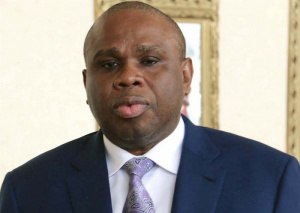
Invited by Togo’s Head of State, Afreximbank’s president, Benedict Oramah was in Hangzhou last Friday, for Togo’s first Business Forum.
The Nigerian executive came to support Togo in showcasing its 2018-2022 national development plan to Chinese investors.
More effectively, his presence could translate into a financial support from Afreximbank to Togo. Indeed, last July, Oramah had announced during the last African Union’s summit, that the Cairo-based bank would disburse a financing for some African countries, including Togo.
Besides Oramah were also present Ecobank’s CEO, Ade Ayeyemi, and the institution’s head for WAEMU, Paul-Harry Aithnard. Another important figure present was Carlos Lopes, Guinea Bissau's economist, who came to boast of Togo’s assets to Chinese investors.
Regarding the latter, more than 30 Chinese firms as well as many actors of Togo’s private sector attended the forum in Hangzhou.
Fiacre E. KAKPO
Togolese economic operators urged to take part in the next Chicago Economic Forum

From October 3 to 6, 2018, the third Chicago Economic Forum will take place. Ahead of the event, its promoters on September 6, gave some reasons why Togolese businessmen should attend the forum.
First, Togo is the event’s guest of honor. The second is the event’s theme which is “Digitizing Companies: An asset for the future”. Togolese businessmen should thus leverage the event to learn more about various challenges opposing firms’ digitalization and its importance for the future.
Planned during the forum are B2B meetings, workshops, panels and debates. There will also be networking and training sessions, all with exhibition stands installed all over the site. These will allow Togo’s business operators to build new partnerships and attract new investments in their country.
The forum, let’s note, aims as its theme indicates, to digitize management systems of firms and help increase financing capacities of participating nations, helping them attract more investments. It also aims at supporting the financing of digital infrastructures worldwide.