Togo, EU Create Permanent Investment Dialogue
 Sunday, 28 June 2026 17:33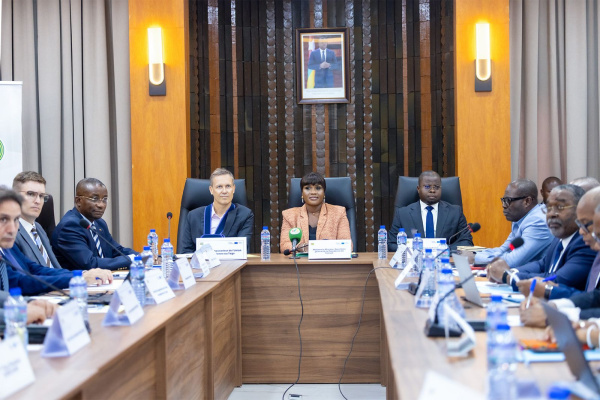
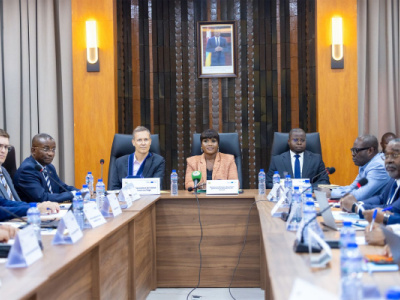
(Togo First) - The Togolese government, Team Europe and Eurocham Togo officially launched a tripartite dialogue on investment and the business climate in Lomé on Friday, June 26. The inaugural session, chaired by Sandra Ablamba Johnson, minister and secretary-general of the Presidency of the Council, established a permanent consultation framework aimed at strengthening the country's attractiveness and encouraging European investment.
The meeting brought together several senior officials, including Arthur Lilas Trimua, minister delegate for investment promotion and economic sovereignty, European Union Ambassador to Togo Gwilym Ceri Jones, and Eurocham Togo President Charles Kokouvi Gafan.
The mechanism, which will meet twice a year, establishes a regular forum for dialogue between the Togolese authorities, European institutions and European companies operating in Togo. It has two objectives: improving operating conditions for businesses already established in the country while attracting new investors to high value-added sectors.
The government also wants future investment to deliver greater benefits to the local economy through skills transfer, stronger local content and the integration of domestic small and medium-sized enterprises into value chains. The initiative forms part of the government's broader strategy to position the private sector as a driver of economic growth, job creation and domestic resource mobilization.
Capitalizing on Global Gateway Opportunities
The dialogue was launched as Togo seeks to capitalize on the European Union's Global Gateway strategy, which aims to mobilize more than 150 billion euros in investment across Africa between 2021 and 2027.
The government sees the initiative as a major opportunity to finance strategic projects in infrastructure, energy, digital technology and logistics.
Sandra Ablamba Johnson said the dialogue comes at a time of growing geopolitical uncertainty and weakening multilateral cooperation. She said reforms implemented in recent years—including the digitalization of public services, administrative simplification and tax modernization—had strengthened the country's macroeconomic fundamentals and improved its attractiveness to investors.
European Union Seeks Stronger Economic Partnership
EU Ambassador Gwilym Ceri Jones welcomed the institutionalization of the dialogue, describing it as an essential tool for strengthening synergies between public and private investment.
He said the aim was to attract more European investment while increasing its contribution to economic growth and job creation.
The ambassador said the first business climate dialogue marked the beginning of a new phase in cooperation between Togo and Team Europe, adding that the Global Gateway strategy provides the financing and instruments needed to support that ambition.
The European Union also highlighted Eurocham Togo's role in coordinating the implementation of recommendations emerging from the consultation framework among its members.
The discussions also underscored Togo's strengths as a regional logistics hub. Located along the Abidjan-Lagos economic corridor, the country benefits from a strategic position reinforced by investments made in recent years in port, energy and digital infrastructure.
According to the European partners, those developments have created opportunities across sectors including transport, logistics, manufacturing and services. The government said the country's strategic location is a key asset for attracting investment capable of supporting industrialization and deeper integration into regional and international value chains.
European Companies Play a Major Role in Togo's Economy
Eurocham Togo President Charles Kokouvi Gafan highlighted the significant contribution of European companies to the national economy. According to a European Union study, about 312 European companies currently operate in Togo, including 46 subsidiaries of European groups. They are active in sectors including transport and logistics, agribusiness, energy, construction, hospitality, information technology and services.
Their operations generate more than 800 billion CFA francs in annual revenue and support more than 9,000 direct jobs and 25,000 indirect jobs. In agriculture, about 90,000 Togolese producers are integrated into agro-industrial value chains supported by those investments.
Beyond their economic contribution, the companies are also among the country's largest taxpayers, making a substantial contribution to public finances.
The new dialogue provides a long-term framework for cooperation between the government, Team Europe and Eurocham Togo. The partners aim to identify strategic projects, turn discussions into concrete initiatives and encourage greater European investment in support of Togo's economic transformation.
Esaïe Edoh