
Togo First
Togo plans to build a new airport terminal in Lomé and also launch a new public airline
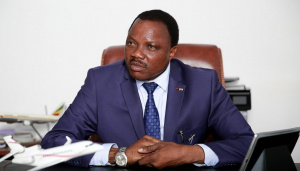
Togo will soon have a new local airline connecting its northern and southern regions. This was revealed on Jan 31, 2022, by Col. Dokisime Gnama Latta (photo), who currently heads the Société Aéroportuaire Lomé Tokoin (SALT). The announcement was made at the 35th-anniversary celebration of the SALT, which manages Lomé’s airport.
"There is a project, for a company - whose name I do not yet know - and which is already underway. This year, this company will provide Lome-Niamtougou flights, three times a week," SALT’s boss said.
Togolese authorities also plan to expand Lomé’s airport’s terminal, as well as build an airport at Gbatopé, near Tsévié (37 km from Lomé).
"Given the exponential increase in the number of travelers using Lomé’s airport, which has become a platform of trust and excellence, we plan to build a second terminal and open other lines. We are planning to build an airport with two parallel runways on 8,000 hectares at Gbatopé, close to Tsévié," Col. Gnama Latta said.
The news comes almost 20 years after the country’s former public airline, Air Togo, ceased operations. For now, Lomé, which hopes to become a sub-regional logistics hub, houses the headquarters of Asky, a private airline. This company currently serves 22 cities in 20 countries across West and Central Africa.
Ayi Renaud Dossavi
Free-Trade: Togo launches Trade Barriers Africa, an online platform to remove non-tariff barriers
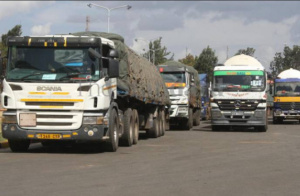
Togo recently launched Trade Barriers Africa, an online mechanism aimed at boosting trade by removing non-tariff barriers (NTBs) between African countries. The facility is a component of the African Continental Free Trade Area (AfCFTA).
"From now on, thanks to Trade Barriers Africa, Togolese traders will be able to report these barriers, also known as non-tariff barriers, and obtain their removal with the support of national authorities," said the United Nations Conference on Trade and Development (UNCTAD) in a statement released January 31, 2022.
The platform allows traders and companies that move goods across Togo’s borders to report NTBs that impede their activity in the country. According to the UN body, such NTBs include, among others, “quotas, excessive import documents or unjustified packaging requirements.”
"Trade Barriers Africa is a concrete response to the daily problems of micro, small and medium-sized cross-border businesses. If they should thrive, it is imperative that non-tariff barriers, which not only lengthen the procedures for transporting goods but also cost traders, disappear," said Simon Ognadou, National Focal Point of the Ministry of Commerce, Industry and Local Consumption for AfCFTA.
Trade Barriers Africa was developed by UNCTAD and the African Union, and launched in January 2020, to help make trade in Africa easier and cheaper. So far, UNCTAD said, the platform has reportedly helped remove over 600 non-tariff barriers.
Togo to invest CFA11bn in projects aimed at boosting living conditions, in 2022

The Togolese government officially projects to spend CFA11 billion this year on projects aimed at improving its people’s living conditions.
The funds, under the supervision of the Ministry of Urban Planning, Housing, and Land Reform, will be used to make cities cleaner, build roads, facilitate movement in urban areas while making road traffic safer. A part will also cover sanitation, waste management, flood risk management, and public health projects.
All these projects align with the first axis of the government’s 2025 Togo Roadmap. This axis is aimed at bolstering social inclusion, harmony and consolidating peace in the country. These projects include the Roads and Waterworks Rehabilitation Project which will be implemented in 10 of the country's main cities, and the $30 million Urban Infrastructure and Development Project (PIDU), which has been underway in several Togolese cities for several years.
Ayi Renaud Dossavi
Togo: More than 11,000 micro-enterprises were started by the youth in 2021
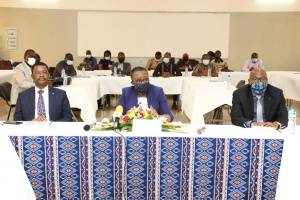
In Togo, over 11,200 micro-businesses were officially created by young entrepreneurs over the past year. The figure, disclosed by the Ministry of Grassroots Development and youth employment, is up by 20% compared to 2020 ( 9,400 microenterprises).
The ministry attributes the growth to several initiatives, among which is an entrepreneurship training program that enrolled 14,351 youth and women. Moreover, in 2021, nearly CFA6.3 billion of loans were distributed to promote youth entrepreneurship and self-employment.
Over the same period, the ministry added, more than 26,000 sustainable jobs were created for young people for 13,500 planned. This corresponds to an achievement rate of 194%.
The results, which exceeded expectations, were lauded by Myriam Dossou d’Almeida, minister of grassroots development and youth employment. She, however, urged for more actions to achieve goals of the 2020-2025 government roadmap – goals that include more jobs for the Togolese youth. "2022 will not be a year of rest. Many challenges await us on all fronts," said the official.
Esaïe Edoh
Togolese Facility for Acceleration and Innovation: 22 entrepreneurs receive a combined CFA200 million for their projects

In the past weekend, the 22 young entrepreneurs selected under the first edition of the Togolese Facility for Acceleration and Innovation (FTAI) program received their prize money. Per head, they received between two (2) and twenty (20) million CFA. Most of the funds came from the United Nations Development Program (UNDP) which backed the project with 200 million CFA.
In detail, the winners include 20 startups and 2 SMEs that operate in a wide range of sectors, from processing, services, to logistics, ICT, agriculture, and livestock. The 22 chosen ones were picked – out of 197 applicants – for the innovative nature of their projects which also match the needs of the Togolese economy.
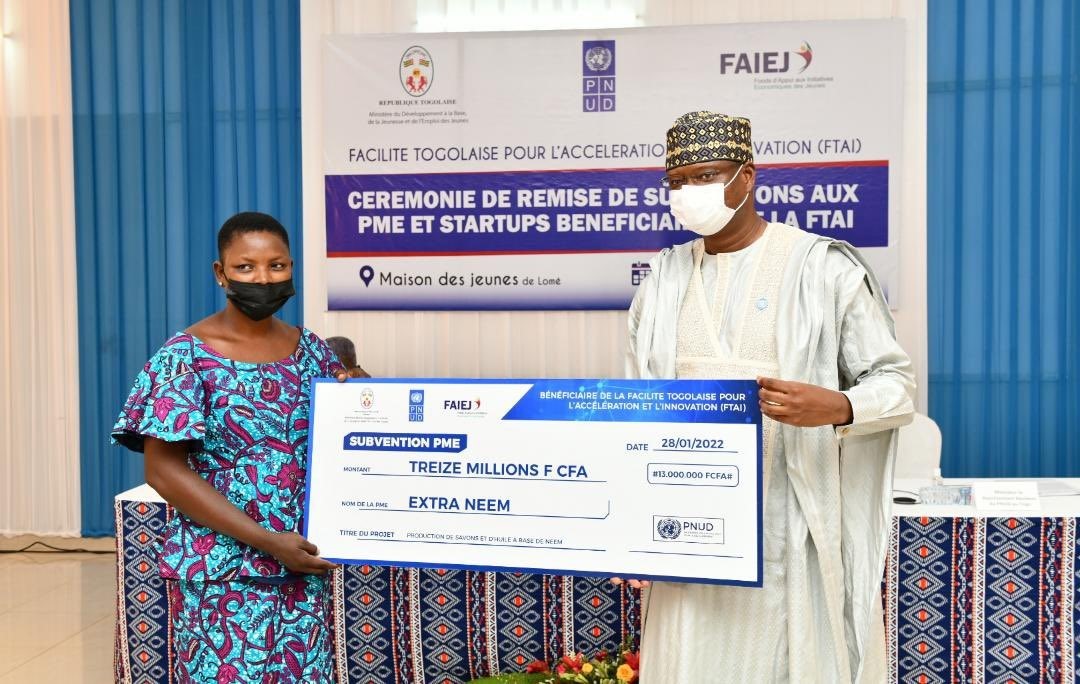
"I note with great interest that the fields covered by the initiatives contribute to twelve of the seventeen SDGs, including poverty, hunger, and nutrition, health, education, renewable energy, terrestrial ecosystems, etc.," said Alioune Mamadou Dia, UNDP Resident Representative in Togo. Dia hopes that the facility will help beneficiaries "accelerate their march towards sustainable entrepreneurship," which, he believes, offers "innovative solutions to populations, especially the most vulnerable.”
Launched in July 2021, the FTAI is carried out by UNDP-Togo and the Ministry of Grassroots Development, Youth and Youth Employment (via the Support Fund for Youth Economic Initiatives or FAIEJ). With an annual budget of CFA265 million, the initiative supports entrepreneurial projects with a strong innovative character.
Esaïe Edoh
2021 Togo Top Impact: Who were the winners this year?
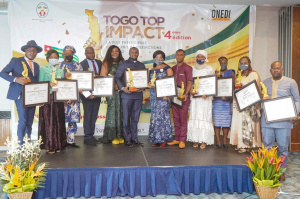
Last Saturday, the organizing committee behind the fourth edition of the Togo Top Impact (TTI) Awards named and rewarded all 17 winners it picked for the year 2021. These winners received 17 awards, including 7 special ones.
Launched four years ago by the National Organization for Integral Development (ONEDI-Togo), the TTI Awards recognizes men, women, youth, organizations, and businesses that contribute – actively and positively – to the development of their respective communities.
Every year, excluding special awards, a jury picks 10 people or entities spread across various categories. Then, after a public vote that counts for 60% of the final results, the jury proceeds to its vote (40%). This year, the jury was headed by Amégah-Atsyon Bertin, a bailiff.
"It is the only event that puts under the spotlight, known and unknown women and men, who, through their professional but also human or social qualities, positively impact citizens and contribute in an exceptional, significant and innovative way, to the influence of our country,” the organizers said.
The theme picked for TTI 2021 was "Fiscal citizenship and development: assuming one's role as a citizen for the post-Covid economic recovery." The event was sponsored by Kodjo Adedze, Togo’s Minister of Trade.
Full list of winners
- Personality of the Year: Serge Michel Kodom
- Woman Manager of the Year: Molgah Abougnima-Kadjaka
- Woman Leader of the Year: Kayi Dogbé
- Rural Entrepreneur of the Year: Dodji Kofi Ognankitan
- Young Leader of the Year: Beauty Sodokin
- Cultural Actor of the Year: Kodjo Enyonam Jacques Logo
- Journalist of the Year: Jean-Paul Agboh-Ahouélété Paul
- Model Municipality of the Year: Commune Golfe 3
- Organization/Association of the Year: Wep-Togo
- Digital Innovation of the Year: Edole Africa
SPECIAL AWARDS
- Woman of Influence Award, in recognition of her commitment to the empowerment of women in rural areas: Zibo Laouratou
- Good Governance Award, in recognition of her professionalism, willingness, and commitment to business management: Nathalie Bitho
- Excellence Award, in recognition of his merits and actions for the Togolese private sector: Tamégnon Laurent
- Excellence Award, in recognition of her actions for the promotion of girls' leadership: Anaté Kouméalo Germaine
- Excellence Award for the most reforming Togolese institution: University of Lomé
- Jury Prize: Esther Sogbo
- Special Prize, in recognition of her quality work, dynamism, and her support to the authorities in the fight against Covid-19: Bilitis Adama
A review of economic relations between Togo, Mali, and Burkina Faso
After imposing heavy sanctions on Mali, ECOWAS heads of state met on Friday to discuss the recent putsch in Burkina Faso, which led to the exit of Roch Marc Christian Kaboré. Unsurprisingly, they decided to suspend Burkina Faso from the sub-regional bodies. It is in this context of tensions between these two Sahel states and ECOWAS that we (Togo First), based on the latest economic data available, decided to review trade relations between Togo, Mali, and Burkina Faso. From trade and diaspora remittances to foreign direct investment (FDIs) and tourism, here, we look at all of it.
In recent years, trade between Togo and its two Sahelian neighbors, Mali and Burkina, has grown steadily. That is a fact validated by data from both the BCEAO and the UN’s Comtrade aggregator.
Mali
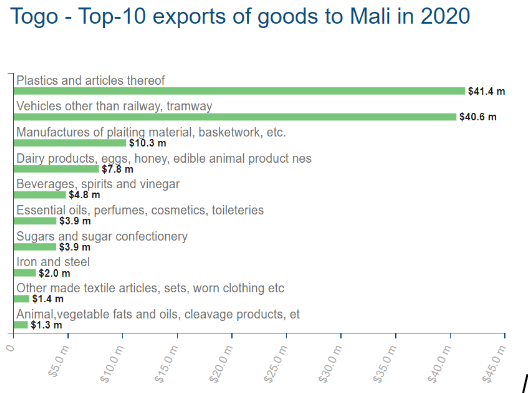
In 2020, trade between Mali and Togo was estimated at CFA85 billion, with Togo selling more than it bought. Indeed, despite its size, Togo is Mali's third-largest supplier of goods in the WAEMU region, behind Senegal and Côte d'Ivoire. Fuel, fertilizers, basic food products, and pharmaceuticals ... Togolese exports to Mali stood at CFA75 billion in 2020, compared to about CFA10 billion for imports.
Diaspora transfers
Remittances are another key component of economic relations between Togo and Mali. And just like in the case of trade, Togo seems to be winning on that ground as well.
In 2019, Malian migrant workers living in Togo sent CFA2.5 billion home (latest BCEAO figures). In the opposite direction, the Togolese diaspora living in Mali sent home CFA9.8 billion, almost four times more than the Malian diaspora did.
A source of FDI for Mali
Since 2017, foreign direct investments (FDIs) from Togo to Mali remained robust, year after year. Truly, except for 2020 when they dropped to CFA785 million, in part because of the pandemic, the FDIs stood above CFA3 billion over the period.
Togo to spend CFA19 billion on universal health coverage in 2022

The Togolese government plans to spend CFA19 billion on Universal Health Coverage (UHC) this year, official sources revealed. This is 18% of resources allocated to the Ministry of Health (CFA105.4 billion), according to Togo's 2022 appropriation bill.
The announcement comes a few months after the bill establishing universal health coverage (UHC) was adopted. Through the bill’s adoption, the government extended its compulsory health insurance project whose results were encouraging, according to the authorities.
Near the end of 2021, Togo and the World Bank signed a $70 million (CFA38.5 billion) agreement to finance the UHC. The project, steered by the National Health Insurance Institute (INAM), aims to provide the Togolese people – pregnant women and children, especially – with "quality health care at an affordable cost."
Togo: Government cuts budget allocation for Local Authority Support Fund by 40%, from CFA6.5B to CFA4B
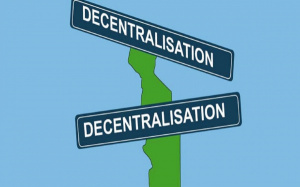
This year, Togo will allocate CFA4 billion to the Local Authority Support Fund (FACT) in line with its appropriation bill 2022. Compared to 2021, this is 36% lower.
The amount allocated last year was broken down into CFA2.5 billion for projects carried out by the National Agency for Grassroots Development (ANADEB), and around CFA4 billion for the country’s 117 municipal councils.
The FACT is a government-sponsored fund designed to support local authorities in mobilizing financial resources. It is backed by many technical and financial partners, such as GIZ, AFD, and the European Union (EU).
For example, in 2021, Germany and the EU provided 10 Togolese municipalities with modern premises and trained many municipal councilors on local governance. They did so via the Decentralization and Local Governance Program (ProDoGoL), in which they injected over CFA18 billion.
Esaïe Edoh
COFINA Togo commits to be more engaged in financial inclusion projects in 2022
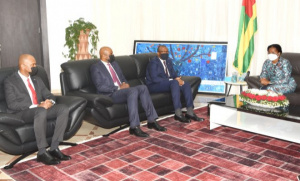
The Togolese subsidiary of the Compagnie Financière Africaine (COFINA) will reinforce its financial inclusion policy. This ambition was revealed on Jan 27 by the institution’s MD, Digbé Marcel, during an audience with Prime Minister Victoire Dogbé.
"We will accentuate financial inclusion,” Marcel said, adding that COFINA was open to "supporting and financing the government in its various endeavors.”
In Togo, the Ivorian group’s main goal is to "participate, sustainably, in the economic development of the country by contributing to the emergence and consolidation of SMEs." In this framework, COFINA Togo will support SMEs and all entrepreneurs left out of traditional financial systems.
In March 2021, the group partnered with CUBE, a Togolese incubator, to provide up to CFA25 million to growing businesses that have been operating in the country for a minimum of three (3) years.
In September 2021, the financial institution also signed a financing agreement with the Risk-sharing-based Mechanism for Incentive Agricultural Financing (MIFA), in favor of agricultural SMEs.
Esaïe Edoh