
Togo First
The 8th Annual International Tax Conference begins in Lomé tomorrow, President Gnassingbé will be there
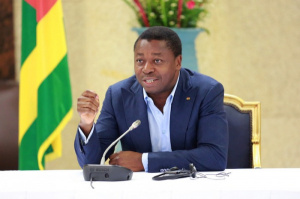
Lomé will host the 8th Annual International Tax Conference (CIAF), the largest sub-regional meeting on tax mobilization by States, on February 24-25. Major personalities, including the Togolese President, Faure Gnassingbé, and his Minister of Finance, Sani Yaya will be present.
The information was disclosed by the Togolese Revenue Office (OTR), the country’s tax mobilization body. The theme of the event is: “Progress made regarding the mobilization of domestic tax revenues in Africa in the 21st century.”
This is the first time that a West African country will be hosting the CIAF and this year it is organized by the OTR, the West African Union of Tax Authorities, and Togo’s Tax Professionals Association (APF-Togo). More than a hundred officials, local and foreign tax professionals, representatives of financial, regional, and international institutions are expected to attend.
This edition will revolve around four key issues, namely: the importance of the legal framework for linking public spending management to domestic tax mobilization, how taxation contributes to tackling climate change issues, "the issues, challenges, and prospects of the agreement on the global minimum tax to be paid by companies within the OECD-G20 inclusive framework" and the African Continental Free Trade Area (AfCFTA).
Ayi Renaud Dossavi
Cooperation: a delegation from the Saudi Development Fund is in Lomé
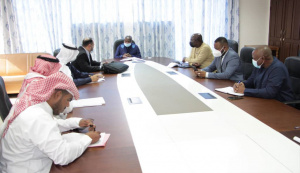
A delegation from the Saudi Development Fund (SDF) is presently in Lomé, led by Alzahrani Saeed Mubarak. The delegation was received on Feb 21 by the Togolese minister for water, Bolidja Tiem.
On the same day, President Gnassingbé received the Saudi ambassador to Togo, Mishaal bin Hamdan Al-Roqi. Among others, the two men discussed cooperation between the two countries, especially relative to agriculture, diplomacy, and economy.
The SDF delegation, the ministry of water said, is in Togo in the framework of a Saudi project to drill wells and contribute to rural development in Africa. Under this project, Togo received $5 million from the Middle Eastern State. The facility was aimed at helping the West African nation to build 17 Mini drinking water conveyances and 15 Autonomous Water Stations (AEW), in its Central and Plateaux regions.
Active since March 1975, the SDF finances development projects in low-income countries through concessional loans.
WAEMU securities: In 2021, Togo’s outstanding debt stood at CFA1,537 billion
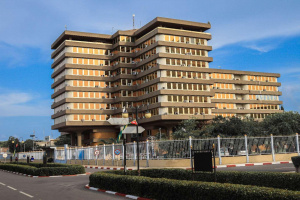
As of December 31, 2021, Togo's outstanding debt on the WAEMU market stood at CFA1,537 billion. That is CFA190 billion or 14% more than the figure reported for 2020.
The increase is mainly due to a surge in auctioned issues and long-term debt, as the country strives to reduce the refinancing risks associated with its domestic debt. Bonds issued through auctions rose from CFA1,191 billion to CFA1,414 billion (+18%). Meanwhile, syndicated operations slumped from CFA156 billion to CFA123 billion.
According to the latest available data, Togo's public debt is estimated at CFA2,768 billion (at the end of June 2021), or 59% of GDP. Its domestic debt is estimated at CFA1,756 billion, and most of it was raised on the WAEMU market.
Property Transfer in Togo: Improvements recorded between 2018 and 2021

Togo processed 1,125 property transfer requests in 2021, up from 252 in 2018. According to the country’s Business Climate Cell (CCA) which released the figures on Feb 21, 2022, this represents a jump of over 300%.
The CCA attributes the performance mainly to the digitization of 99.32% of land titles in the country, making it easier to research data related to the titles. Other reasons include the establishment of a property transfer office, and fixing transfer fees to CFA35,000 instead of taking 4% of the transaction’s amount as done previously.
As of the end of April 2020, the property transfer process took a maximum of six hours to be completed. The following month, 90 transfer requests were processed, within 3 hours on average; this is against 60 per month for the whole quarter going from January to March the same year, and an average processing time of 8 days per request.
In parallel, the number of mortgages registered was up as well, by 39%, climbing from 670 in 2020 to 933 in 2021. This is consequent to steps taken by the government to speed up related procedures; such as reducing the processing time to 4 days on average from 15, between the two years. Measures were also introduced to make bank loans more accessible to private operators.
All reforms undertaken by Togo regarding property transfer enabled the country to soar in the Doing Business rankings - in 2020 and 2021- before the index was taken down. These reforms also bolstered FDIs in the country to over CFA352 billion in 2020, from CFA191 billion in 2019, according to the United Nations Conference on Trade and Development (UNCTAD).
Esaïe Edoh
UMOA securities market: Where are Togo’s biggest lenders based?
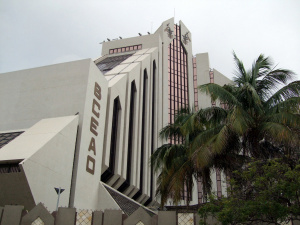
Togo's debt on the sub-regional financial market (Umoa) is mainly held by investors based in Togo, according to data from the Umoa Securities Agency in its latest quarterly report.
Indeed, at the end of December 2021, more than 30% of the country's public securities portfolio, or CFA424 billion, was held by local investors, the vast majority of them from the banking sector.
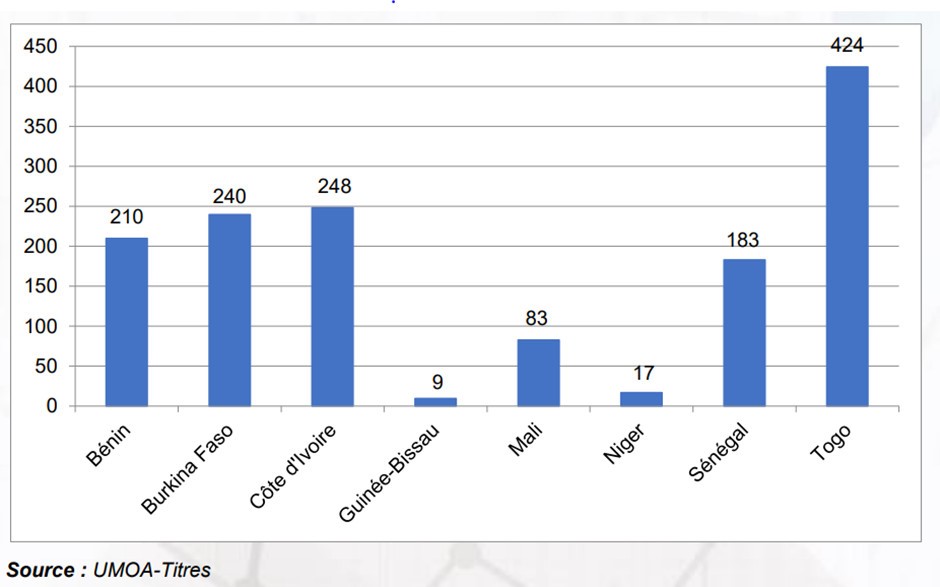
After Togolese investors, Ivorian investors were the country’s biggest lenders with more than CFA248 billion or 17.55% of the claims. The two are immediately followed by Burkina Faso (CFA240 billion or 16.95%), Benin (CFAF 210 billion), Senegal (CFA183 billion, or 12.94%). A little behind is Mali with CFA83 billion (5.85%), Niger with CFA17 billion (1.2%), and Guinea Bissau (CFA9 billion, 0.67%).
Most holders of the Togolese debt are commercial banks (90% in 2021 according to the UMOA-securities agency). According to the latest available data (2019), the largest banks investing in Togolese securities are Coris Bank, BOA, Orabank, Ecobank, and UTB.
Ayi Renaud Dossavi
Togo: pump price of petroleum products has not been increased, the government informs
The government of Togo does not plan to increase the pump prices of petroleum products in the country. The information was disclosed by the Ministry of Trade, to put an end to some misleading rumors that caused a rush to the stations, in Lomé especially.
The ministry explained that the rumors are due to “tensions in the supply of petroleum products.” It added that things “should be returning to normal starting from Saturday, February 19, 2022.” Kodjo Adedze, the minister of trade, also warned all retailers “against abnormal business practices, such as price increases or product retention,” saying “they are severely punishable by the law.”
To date, pump prices of petroleum products are as follows: Super Unleaded at 505 FCFA per liter, Lamp oil at 400 FCFA per liter, Gasoil at 520 FCFA per liter, and the 2-stroke mixture at 606 FCFA per liter.
Ayi Renaud Dossavi
Togolese government and Canal+ ink deal to make public TV station TVT accessible to more viewers
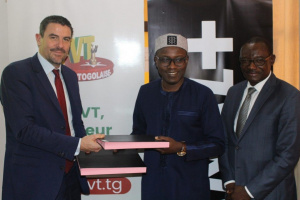
The Togolese television TVT has been added to CANAL+’s paid offer which is available in around 50 countries, in sub-Saharan Africa and the world. The related partnership agreement was signed last Friday, February 18, 2022, between the Togolese State and Canal+ Africa. The two partners were respectively represented by Akodah Ayewouadan, Minister of Communication and Media, and David Mignot, CEO of CANAL+ Africa.
Under the three-year contract, renewable, CANAL+ will broadcast TVT in high definition (HD) as soon as decoder migration is complete (in Q1 2023). TVT, which is currently available on channel no.260 of the Canal+ bouquet, will have a better position after Canal+ sets up a service plan specifically for Togo.
Besides, the deal will boost the quality of programs and images broadcasted on Togo’s first TV station. To this end, the TVT staff will benefit from Canal+’s technical support.
According to Minister Ayewouadan, the new partnership is consistent with Togo's commitment to shift from analog to DTT (Digital Terrestrial Television). In line with this commitment, the government has been working to transform the country's audiovisual landscape through various projects, such as the merger and transformation of Télévision Togolaise, Radio Lomé, Radio Kara, and the Audiovisual Production Agency (ANPA).
Esaïe Edoh
UNESCO backs Togo’s efforts to improve its education system

UNESCO will help Togo improve its education system. Last Thursday, the UN body held a meeting in Lomé, to assess the country’s needs in this sector, in line with the Educational Resources project which was launched in June 2021 and will be financed by the French Development Agency (AFD).
The meeting, which gathered actors of the education sector, allowed UNESCO to identify the steps it needs to take to help improve education in Togo. Ultimately, the organization’s support should enable the West African country to bolster its strategy for producing and disseminating educational resources, including textbooks.
Among others, UNESCO said it noticed that many French-speaking countries, including Togo, lacked textbooks and other educational resources essential for quality education. Hence, 16 countries will benefit from this project, starting with Togo and two others picked as pilot countries.
Over the past years, Togolese authorities have undertaken several initiatives to improve education. The latest is a project that aims to build 30,000 classrooms in the country by 2025.
Esaïe Edoh
Togo: Ministry of water launches new project to make drinking water more accessible in the maritime region
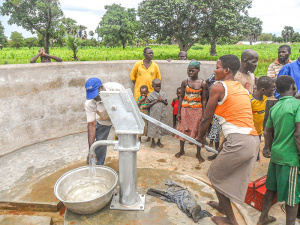
The Togolese Ministry of Water and Village Hydraulics launched last Thursday the operational phase of the PAGEPC, a project that aims to improve access to clean water and sanitation in the Avé 2 and Zio 2 municipalities. The project will be carried out by Pionniers en Action pour le Développement Intégré à l'Environnement (PADIE), a private association, at a cost of CFA437 million.
Concretely, the PAGEPC will involve supplying technical services related to clean water and sanitation, rehabilitation works, extending water networks, providing financial support, and training delegated managers in the municipalities concerned. It will also lead to the creation of a local institution and legal framework to manage clean water and sanitation facilities.
Bolidja Tièm, the minister of water, said that the project “falls under the National Action Plan for the Water and Sanitation Sector (PANSEA), the Support Program for Reforms and Governance (PARG), the National Development Plan (NDP) 2018-2022, and the 2020-2025 Presidential Roadmap.”
Planned over three years, this project is a pilot initiative of decentralized cooperation to create and experiment with the delegation of services to a private operator, it is indicated.
Togo, it should be emphasized, wants to achieve universal access to drinking water by 2030. Data from the ministry of water shows that respectively 60%, 50%, and 69% of urban, semi-urban, and rural areas have access to the resource presently. In 2022, the government, under its budget, intends to spend CFA23 billion to boost access to drinking water in the country.
Esaïe Edoh
WACA: Togo secures $12 million from World Bank’s IDA to protect its coastline
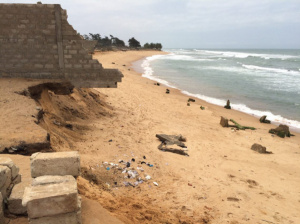
As part of the West Africa Coastal Areas Management Program (WACA), Togo received another $12 million (CFA7 billion) from the International Development Association (IDA) near the end of December 2021. Togo First obtained the information from experts close to the matter.
The funds, which are equally divided into a loan and a grant, will be used to continue anti-erosion works in one of the two areas that are most threatened by the phenomenon in Togo. The coastline concerned spans 18 km, going from Agbodrafo to Aného.
Togo received the financing at the same time as Benin which secured $24 million to protect 23km of its coastline.
Excluding the $12 million recently provided, funding for the WACA Togo project currently stands at $55 million. It was provided by the World Bank ($45 million), the Global Environment Facility ($7.5 million), and the Togolese State ($3 million), for five years.
The West Africa Coastal Areas Management Program is deployed in six West African countries that have access to the sea. In Togo, it covers the Mono, Zio, and Haho basins, as well as the Southern Togo lagoon zone and the Gbaga canal which are shared by Togo and Benin.
Ayi Renaud Dossavi