

Togo First
Togo working on action plan to regularize the informal sector

On November 26-27, 2018, Togo’s national social security fund (CNSS) organized a workshop related to the elaboration of a national strategy to regularize the informal sector, by providing social security to all.
Participants, in addition to working on the elaboration of this strategy, also developed an action plan in its regard, according to Togolese Press Agency (ATOP).
During the meeting, mutuals, associations, economic groups were identified. Same goes for initiatives developed for informal businesses, in all sectors of activities, all over the country.
Participants present wrote a report containing good practices and existing potentialities, related to the informal sector’s regulation and more.
Séna Akoda
University of Lomé to host next December 6 a forum on internet governance

On December 6, 2018, internet players will meet at the University of Lomé where will be held a forum on internet governance.
Including government representatives, the regulator, major societies, free speech defenders and civil society players, the dialogue platform will focus on current and upcoming challenges related to internet governance.
To be more precise, the event’s organizers plan to promote a better comprehension of issues related to internet governance within the respective communities of parties involved.
Various topics will be covered during the event. The first is themed “Protecting data and digital freedoms”, while the second is themed “digital economy, security and emerging technologies”, and the last’s theme is “Internet’s infrastructures and policies”.
For registration, visit: http://intgovforum.tg/
Séna Akoda
Sandra Johnson leads Togolese delegation to 9th edition of “Ease of Doing Business Initiative”

Sandra Johnson, Head of Togo’s Business Climate Cell and Advisor to the President, is currently in Côte d’Ivoire where she is attending the ninth Ease of Doing Business Initiative (EDBI) annual conference.
This conference focuses on the sharing of experiences and best practices to improve business environment, in the framework of the Doing Business. Initiated by the World Bank’s group, and the Ivorian State, it was officially opened on November 26, 2016, by Amadou Gon Coulibaly, Côte d’Ivoire’s Prime Minister and Minister of Budget.
Various panels are planned to let participants know about the best practices related to the ease of doing business. For example, there will be a top-class panel debating “the importance of reforms for the business climate amid economic growth challenges in Africa, and another on Trends in the region: Actualizing the Doing Business methodology and overview of Africa’s performances in the Doing Business rankings”.
The Togolese delegation which wishes to bring the country below the 100th rank, will learn the best practices taught at the conference.
Séna Akoda
Next November 30, CNSS will initiate its “Vendredi de la sécu” project
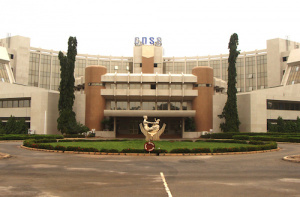
Togo’s national social security fund (CNSS) released a statement announcing a new project it is launching. Baptized Vendredi de la sécu, this is a quarterly rendez-vous to train officials, executives of firms and partnering institutions, to boost their capacities, especially in regards to laws, their rights and duties in relation to the CNSS.
The first session is to be held November 30, 2018, on the theme: “Registration of employers and workers at the CNSS, legal, regulatory and procedural frameworks.”
As the theme suggests, firms’ executives attending will be informed about laws applicable, both legal and regulatory, in regards to registration.
Séna Akoda
Chinese firm CTE to build in Togo a motorway and an industrial park
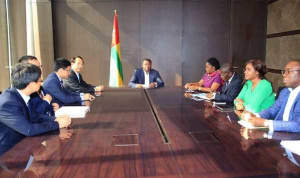
China Tiesiju Civil Engineering group Co. (CTE), Ltd, which specializes in infrastructures, confirmed that it will build in Togo a motorway and an agricultural industrial park.
“We want to invest in infrastructures and have discussed with the president of the national assembly about the construction of a highway and an industrial park,” said Wang Chuan Lin, head of a Chinese delegation, after meeting with Dama Dramani, the national assembly’s president, last Monday.
The head of the delegation emphasized that the firm would focus on training local workers. CTE “is ready to share with local firms its experience in infrastructures”.
The current announcement concretizes a commitment made by CTE last September, on the sidelines of the FOCAC, where Togo was to attract Chinese investors. At the time, Shao Gang, one of CTE’s executives, had, during a meeting with President Faure Gnassingbé, declared: “A study team will be in Lomé as soon as possible.”
The announced agricultural industrial park should be built in the Vo prefecture.
Fiacre E. Kakpo
Togo: BCP subsidiary Banque Atlantique launches Fintech Challenge for innovative startups
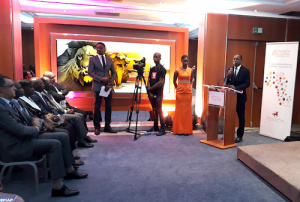
Banque centrale populaire (BCP), owner of Banque Atlantique, launched last Friday a Fintech Challenge, a contest for startups in Africa and elsewhere.
The related tender will close on December 23, 2018 and is accessible through the following website: www.bcpfintech.com. “Startups selected following the tender will have the opportunity to win a contract with BCP”, Banque Atlantique said.
According to the lender, the partnership will focus on co-construction and deploying innovative solutions, in response to skills challenges clearly identified by the BCP and its Banque Atlantique subsidiaries.
Moreover, the group’s Togolese subsidiary said “the collaboration will take place as a monitoring that will give the startups access to new markets. They will benefit from the global firm’s expertise. Also, an acceleration program will be developed for them. As a result, BCP’s ecosystem in Africa could serve as a springboard for the startups, in the framework of their development”.
Fiacre E. Kakpo
Togo: Moov pays first tranche of payment for 2G/3G/4G licenses obtained last June

In Togo, Maroc Telecom has announced it started paying data licenses it obtained last June via its subsidiary, Atlantique Télécom (Moov).
According to the firm’s financial report for 2018’s first three quarters, the Moroccan group has, in Q3 2018, disbursed “256 million dirhams (about CFA15.6 billion) as partial payment for 2G/3G/4G license in Togo (obtained in June 2018 at a cost of 477 million dirhams [about CFA28.9 billion])”.
Last June 11, the subsidiary which is detained by Maroc Telecom (95%) renewed its 2G/3G operating licenses, and obtained a 4G license in the country. The licenses should be valid until December 31, 2036.
Under agreements signed by Maroc Telecom relating to the licenses, the group will pay for the licenses in three annuities, starting last July.
On September 30, this year, Moov Togo had 3,288,000 subscribers really using its services, against 3,151,000 at June 30, 2018 and 2,782,000 in September 2017. This represents an annual growth of 18.2%.
Fiacre E. Kakpo
Edoh Kossi Amenounve appointed new vice-president of ASEA
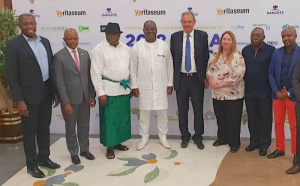
Edoh Kossi Amenounve, actual managing director of the Bourse Régionale des Valeurs Mobilières (BRVM) was just appointed vice president of the African Securities Exchanges Association (ASEA).
This occurred on the sidelines of ASEA’s 22nd general assembly and annual conference which started on November 25 and will end tomorrow. It is being held in Nigeria.
The Togolese was elected alongside Egyptian Karim Hajji, new president of the stock market, and actual managing director of Casablanca’s stock market.
The duet, according to the BRVM, will “steer the Association’s new strategy (2019-2023) as well as the African Exchange Linkage Project which aims to improve financing of African economies”.
Edoh Kossi Amenounve, it should be recalled, joined ASEA’s executive committee in 2014. Since 2016, he has been heading the association’s policy regulation committee.
Established in 1993, ASEA includes 27 stock markets. Its mission is to make African stock markets more visible, promote inter-stock markets, and provide an information portal for African public markets and global statistics.
Fiacre E. Kakpo
Togo: HAAC now regulates online media

Togo’s High Authority for Audiovisual and Communication (HAAC) now regulates online media also. Indeed, the organic law defining the regulator’s action field was amended by the national assembly last November 15, thus expanding the institution’s authority to these types of media.
The measure, according to the minister of communication, Guy Madjé Lorenzo, aligns with Togo’s desire to “adapt its legislation to standards set by technological evolution”. Indeed, the HAAC’s former regulation did not enable it to regulate online media platforms, thus preventing the institution from fulfilling its mission, knowingly regulating all media.
Regardless of the new improvement, the new law still does not take into account social networks. Hence, the HAAC will not be able to sanction, for example, fake news propagation via Facebook, Twitter, or blogs.
Servan Ahougnon
ECOWAS : EBID to invest $100 million in agricultural development next year

Next year, the ECOWAS Bank for Investment and Development (EBID) plans to raise $100 million for the agricultural sector in West Africa. This was reported by agricultural news website Agriditale.
The investment, a record actually, will mostly be spent to promote various agricultural value chains across the region.
Noting that EBID’s investment in the sector over the past three years amounted to $100 million, Hugues Goa, Coordinator of Public Sector Action and Head of Agriculture and Rural Development at EBID, said agricultural transformation is still slow.
With the bank’s decision to focus more on agricultural value chains, Togo, leveraging its Agricultural Financing Incentive Mechanism (MIFA), should capture a significant portion of the funds that will be disbursed in 2019.
Séna Akoda