
Togo First
This is the right time to be in Togo, according to Matteo della Volta, Project Developer at Siemens
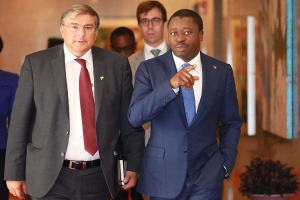
Matteo della Volta, Project Developer at Siemens in French-Speaking Africa, attended the forum on clean energy organized by BOAD last week. On that occasion, he answered some of Togo First’s questions relating to the Kekeli gas-fired power plant project, among others. Siemens, let’s recall, is engaged in the Kekeli project with Eranove and Spanish developer TSK.
Togo First: Siemens recently engaged in the Kekeli Efficient Power plant project, a major component of Togo’s new national electrification strategy. What motivated this decision?
Matteo della Volta (MDV): Siemens has been in Togo for a long time and other countries of the region where we support governments and private investors develop projects. In Togo, with our partners for this project, we found a favorable work environment and didn’t hesitate to take part to the competitive dialogue initiated by the government. The power sector is only a start, but one that is fundamental for the country. To quote the Ivorian President, at the opening of this forum: “There is no progress without electricity”.
Togo First: Could this be the beginning of a long and sustainable partnership between your group and Togo ?
MDV : All actions of Siemens in Africa fall under a sustainable development strategy. For example, we commit to maintaining the Kekeli plant in the years to come. I wouldn’t say this is a beginning but rather the continuation of an old, fruitful, relationship existing between Togo and the German industry. Siemens is also interested in working with Togo to multiply efforts and achievements realized in the power sector.
Togo First: Besides Lomé’s thermal plant, what other plans do you have in Togo?
MDV : We are already active in the Togolese industrial fabric, and in other countries of the region also. We are ready to help both the government and private investors, by providing them technology relating to electrification, automation and digitalization. Togo has a real potential but it cannot be exploited without first investing in its people, in their training to be specific. This is where we first plan to invest. The power plant will be operated by a Togolese staff as mentioned in a press statement recently released by the project’s various partakers.
Togo First: In this regard, Togo’s president who was in Germany a few weeks ago met with Siemens’ top executives. During the meeting, the Togolese delegation discussed with the executives of Togo’s national development strategy and Siemens said it was ready to support the roadmap’s implementation. In detail, could you tell us how Siemens plans to help Togo implement the five-year plan which should make the country an industrial power in the region?
MDV: During the meeting, Siemens and its partners committed to, in the presence of Togolese authorities, successfully carry out the Kekeli project. I can therefore say that our first action is already underway. As for our other plans in Togo, Siemens will monitor every major investment and public tenders. Siemens is ready to help authorities technically assess and financially structure opportunities available. Regarding the financial structuring, we noticed during the forum that many investors and industrials are getting interested in this developing nation. This is the right time. Siemens will hence maintain an open dialogue with authorities while paying attention to the country’s needs and trying to meet them with appropriate and sustainable solutions.
Interview by Fiacre E. Kakpo
Togo: Services exports tripled in value over the past 10 years

Togo’s services exports have since 2007 almost tripled in their value from CFA115 billion to CFA323 billion, at the end of 2017.
The growth is far above the one recorded by goods exports which, over the same period, stood at 36%.
In detail, the performance of services is to be attributed to transport services exports which almost tripled from 50 billion, ten years ago, to CFA140 billion in 2017.
Meanwhile, travel services exports generated CFA72 billion last year, four times more than they did in 2007. Same goes for communication services which generated CFA25 billion in 2017.
For insurance and finance services, however, the growth was less significant.
Fiacre E. Kakpo
Teolis SA partners with Microsoft to distribute its products and services in Togo

Internet Services Provider (ISP) Teolis SA revealed in a statement released recently that it signed a partnership with Microsoft to distribute and support the tech giant’s products in Togo.
Teolis which entered the Togolese market after securing its operating licence, initiated six months ago a process to certify equipment needed to deploy and support Microsoft’s services in the country.
The process should be completed in December 2019 but already enables Microsoft’s products and services to be distributed in Togo.
Teolis’s ambition is to “provide a reliable internet network, one that is fast and cost-effective, both for professionals and general public, with a top quality customer service”. Ultimately, “this network should become a bridge connecting among themselves and to the rest of the world”.
Séna Akoda
Togo: OHADA’s national commission urges magistrates to more professionalism

Yesterday, a five-day workshop to reinforce capacities of commerce chambers’ magistrates regarding the OHADA legislation started.
This meeting is expected to help the magistrates know more about the OHADA uniform act organizing securities and the other organizing simplified recovery procedures and measures of execution.
Adding to OHADA’s other legislations, these laws are safe tools to ensure legal and judicial security across its member States.
According to Koami Gaméli Lodonou, executive secretary of the OHADA’s national commission, “legal security is already achieved under the laws”. Now, however, it must be paired with judicial security by ensuring that “magistrates apply the law strictly and professionally”.
The current workshop, organized with the support of the World Bank’s International Development Agency (IDA), translates the will of the government, its technical and financial partners, to train magistrates to handling management of commercial conflicts better.
More generally, the move aligns with authorities’ reforms strategy aiming to make Togo’s business climate more appealing.
Séna Akoda
Teolis partners with CEET to offer optical fiber internet to Togolese residents
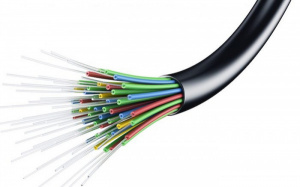
Initially positioned on the 4G (FH/LTE) market, Teolis, one of the new internet services providers in Togo, has just added fiber optics to its offers. Henceforth, fiber optics internet options are available for Teolis’ clients, the company which was launched in February 2018 announces.
In that regard, an agreement has recently been made with Compagnie d’Energie Electrique du Togo (CEET), Togo’s public energy company, for deployment of air-fiber optics via the power poles of CEET.
"The Fiber optics option will thus be offered to TEOLIS’ clients, and will systematically be deployed on high data consuming digital roads," Teolis explained. This is a new commitment for the company presided by Michel Bagnah.
With its arrival on the optical fiber segment, Teolis joins Togo Telecom, the incumbent operator and Vivendi group (GVA) which entered into Lomé’s market in March 2018. Let’s note that though GVA continues to deploy its optical fiber in Lomé’s neighborhoods, the operation seems to evolve quietly and slowly.
Fiacre E. Kakpo
Togo : Foufoumix opens up 36% of its capital
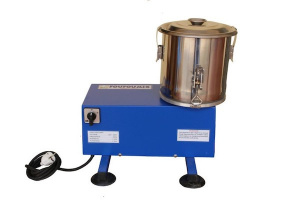
Foufoumix SA, subsidiary of Logou Concept Togo (LCT) which holds operating licence for foufou-making machine Foufoumix, recently announced the opening of its capital to private investors.
Overall, 48,200 shares with a nominal value of CFA10,000 will be issued for CFA482 million, thus nearly 36% of the startup’s restructured capital which will now be raised to CFA1.4 billion.
Following the operation, LCT will remain major shareholder with a stake of about 64%, valued at 900 million CFA. LCT’s activity will be refocused on research and development.
The fundraising, according to Foufoumix, will help start a more industrial production of its product to better respond to a growing demand “both in Togo, other parts of West Africa, and the diaspora, Europe and USA notably ”.
Minimum subscription is set to 482 shares worth 4,820,000 CFA.
Through this operation, Foufoumix SA which now holds LCT’s technological innovation and invention licences, hopes to start making profits after years of operating at a loss. It eyes a distributable net income of 109 million in 2019, and 138 million by 2021.
From 2013 to 2017, Foufoumix’s turnover grew by 42.16%, its operating result by 9.14%, its pre-tax result by 52.25% and its result by 36%. However, over the past two years, the firm had to restructure its activities as its results slumped. However, total balance sheet kept growing. From CFA82 million in 2013, the latter soared to CFA293 million in 2017, as financial assets and receivables increased.
Fiacre E. Kakpo
Togo: Government launches the Infrastructure and Urban Development Project

Togolese government has just kicked off the Infrastructure and Urban Development Project (PIDU), we learnt. Financed up to CFA16 billion by the World Bank, the project is expected to improve access to basic urban infrastructure. It covers the towns of Lomé, Kara and Dapaong.
In detail, this project set to end in 2023 includes the construction/rehabilitation of road networks, deployment of water drainage systems, establishment of drinking water access points. As well, it plans socio-educational and economic infrastructures such as schools, health facilities and markets, notably.
In addition to the three cities above-mentioned, Tsévié, Atakpamé, Kpalimé and Sokodé will also benefit from programs aiming at strengthening institutional capacity in urban planning and management.
According to the Minister of Urban Planning, Housing and Living Environment, “the initiative will make it possible to eradicate extreme poverty and share prosperity”. It aligns with the World Bank’s new partnership framework, which aims to set Togo on the path to more inclusive and sustainable growth, driven by the private sector and more effective public investment.
“We have a lot of money…now, we seek viable and bankable projects to support”- BOAD
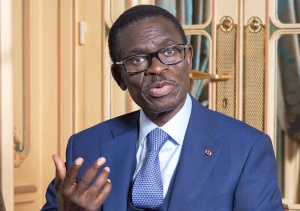
The forum on clean energy organized by BOAD on the sidelines of its 45th anniversary recently ended. Here, Christian Adovelande, the institution’s head, reviews its actions so far and projections.
Togo First : The BOAD is 45-years old. What is your review of its actions so far?
Christian Adovelande : Over the past 45 years, we have financed 1030 projects for CFA5,300 billion and raised more than 3,000 billion. Actually, almost CFA1,500 billion were mobilized during the past five years alone.
In terms of mobilization of resources, BOAD does very well. We have a strong cooperation with most institutions operating in the climate sector, especially the renewables industry. I recently talked about our accreditation with the green fund, the Global Environment Facility (GEF), and the Adaptation Fund. We are working with the European Union and the World Bank which are both really engaged in the sector. We have already started mobilizing funds as mentioned throughout this forum. It’s our duty and role to attract funds to our integration zone, and we will fulfill it. We have already put in place all mechanisms needed to achieve this role and we believe we will successfully carry out all projects.
TF : Following this anniversary, will BOAD continue actions in the same direction or will it set new goals ?
CA : Truth is, there will always be challenges as you very well know and while improving upon our current actions, we plan to explore new horizons. Recently, I spoke a lot about climate funding. Just seven years ago, this became one of our priorities and we had to establish many reforms in this framework. However, we remain strategically positioned on infrastructure funding, both in the private and public sectors.
BOAD is also much engaged in the issue of food security. We will keep supporting private sector. So far, 74% of our financing is injected in the public sector and 26% is in the private sector. We thus have to increase our support to the private sector since our nations are gradually focusing on this sector, through the transformation of raw commodities.
Hence, while reinforcing actions undertaken during the past 45 years, we will tackle new challenges that are rising. These include rural electrification solar power and everything related to the environment.
TF : The recent forum focuses on solar power, a sector where banks plan to invest in WAEMU States. What are the forecasts made in this regard?
CA : Before talking of forecasts, we must first talk about what has already been done. In the clean power sector, we have launched 18 projects at a total cost of CFA185 billion. This is far below what is needed.
Now, speaking of projections, our actions must respond to existing needs, as many as they may be. As long as we can mobilize resources, we will venture into projects that emerge, provided they are viable of course.
TF : What is the real potential of WAEMU states, for solar power development ?
CA : On November 15, all experts we met confirmed that we are the region that is most exposed to sunshine around the world. Therefore, there is no reason not to do everything to tap into this source of energy. Actually, Togo’s Prime minister referred to it as a “gift of God”.
I think that it is hence our responsibility to organize ourselves to use every modern mechanism possible to exploit this resource which is the future of, not only, our continent, but BOAD’s as well. This commitment, we took five years ago and are working on it. This explains the various accreditations we have secured from these various funds.
TF : Minister Wadagni of Benin recently recommended the use of innovative financial tools to increase fund mobilization at low rates. Has this helped you set your future course?
CA : We must say that we have already secured a lot of funds, in various forms. Now, what must be done is to evaluate how we could allocate the funds to the various projects we are conducting. We have a lot of money so it is not really an issue. The issue resides in finding viable, bankable projects to support.
It’s our role to help our targets present such projects and for a very long time, we have been acting in the background due to our status of financial institution. We often waited for projects to come our way. Now however, we have to back project carriers, train them, help them boost skills and capacities that will enable them to develop better projects. I believe this will be a role that we will be playing more, even if it is not our primary role.
TF : BOAD plans to pour CFA50 billion every year into the climate challenge. Does this mean the bank’s actions will now be oriented only towards clean energy and climate issues?
As I said earlier, we will improve upon what we already do as these challenges still remain in the region. These include challenges related to transport, food security, and private sector support. We will still tackle these issues but climate issues have become a new concern that must be taken into account by our actions. This means that while standing by our former strategy, we will add new priorities.
Interview by Fiacre E. Kakpo.
National Development Plan plans for creation of a million jobs by 2022. White elephant or…
A hundred thousand direct jobs per year and a million (both direct and indirect) over the next five years. That is the goal aimed at by Togo’s actual government. A laudable objective but is it truly achievable or will this path lead to a white elephant? How do authorities plan to finance this goal? What types of jobs will be generated? Will they be sustainable? Decent? Temporary? These are some of many concerns revolving around this forecast, which could, if attained, resolve Togo’s unemployment issue.
Regardless of all these interrogations, the government actually shows a strong will to achieve its target. Now, this will must be converted into palpable actions. Does the country have the means to realize this ambition, in the present context? That is the main question.
In response to the various concerns mentioned earlier, the government declared: “Government’s proactive political agenda is based on realist projections for decent and sustainable jobs. It could lead to the creation, over the 2018-2022 period, at an average growth rate of 6.6%, of at least 500,000 direct jobs, thus at least 100,000 direct jobs per year”.
Moreover, “adding various impacts that could create indirect jobs, we want to generate at least a million jobs (direct and indirect) in 2018-2022, at a pace of about 200,000 jobs a year,” the authorities added.
Targeting sectors with a strong potential for job creation
Togo has last August 3, during a highly anticipated ministers’ council, launched its 2018-2022 national development (PND 2018-2022). The 200-page document reviews the country’s economy following the implementation of the Strategy for Accelerated Growth and Employment Promotion (SCAPE).
The latter helped modernize various logistics infrastructures. As a result, Togo was ranked 12th in terms of transport infrastructures in Africa, under the latest Mo Ibrahim Index on Governance.
The PND which is an ambitious roadmap revolves around three strategic axes. It has already received a lot of support as it is being executed. Visible results include the beginning of a 65MW thermal plant. Siemens which was selected to ensure the maintenance of this infrastructure recently told Togo First it would hire local workers in this framework.
The document paves the way for a new paradigm under which the private sector will greatly contribute (65% of all investments) to the structural transformation of Togo.
The PND indeed positions the private sector, regrouping both local and foreign investors, as a major catalyzer of the process and targets sectors with high potential for job creation. In detail, sectors eyed are logistics, agropoles, manufacturing, tourism and digital; all sectors with great potential for job creation that should allow the government to achieve its goals for 2030.
However, the program will have to overcome old challenges such as authorities’ inefficiency which was highly criticized in the latest Mo Ibrahim and MCC reports.
On a more positive note, Togo’s business environment seems to be improving due to the various reforms implemented by the government in this regard. Across the ECOWAS, the country is the fourth most attractive economy, according to the latest Doing Business ranking where Togo gained 19 places compared to the previous edition.
Fiacre E. Kakpo
Togo : Government implements tax to boost cashew export revenues

After Benin, Burkina Faso and Côte d’Ivoire, Togo has also adopted a tax on cashew exports, baptized Cashew Nuts Tax (PNC).
The tax which was established in line with a decree issued on October 3, 2018, amounts to CFA40 per kg of raw nuts and CFA5 for processed nuts.
The fee, perceived by the tax administration, will be transferred to a special account, opened at the Public Treasury, named “management fund for Togo’s cashew sector”.
By collecting this tax, the government wants to boost tax earnings which it plans to use to support the sector’s growth. In this framework, the administration will back direct actors and local processing which is more profitable.
Let’s recall that Togo produced 12,000 tons of cashew nuts in 2017, according to the n’kalô report. The nation’s output is expected to rise to 15,000 tons.
Séna Akoda