
Togo First
Lomé to host next week a regional forum on ways to combat money laundering and terrorism financing
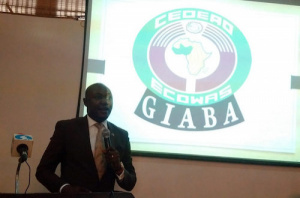
From November 27 to 30, 2018, Lomé will host a regional meeting where will be discussed ways to fight money laundering and terrorism financing.
According to the Inter-Governmental Action Group Against Money Laundering in West Africa (GIABA) which is behind the event, it will focus on recent changes made to the standards of the Financial Action Task Force (FATF) or Group d’Action Financière (GAFI) as it is known in French.
The GAFI is an inter-governmental organization that develops policies to combat money laundering and terrorism financing.
Results of GIABA’s first mutual assessment cycle reveal shortcomings relating to the implementation of policies to combat money laundering and terrorism financing, as well as loopholes in the regulation of financial institutions. In addition, cooperation between regulators and actors of the sector is weak, almost non-existent even.
Séna Akoda
Lomé is currently hosting a two-day forum on public-private partnerships’ role in agricultural transformation
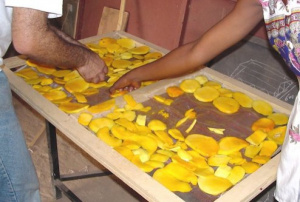
The top-class forum on the development of agro-industrial transformation zones via public-private partnerships will end today.
The two-day event was initiated by the Autonomous Centre for Studies and Capacity Reinforcement for Togo’s Development (CADERDT), with the support of the government and the African Development Bank (AfDB).
It aims to attract private investors in the framework of a public-private partnership in the agricultural sector. A move that falls under the second axis of the national development plan, knowingly the creation of manufacturing and agricultural transformation poles.
According to Odilia Gnassingbé, Director of CADERDT, “the State cannot be the only investor, which is why private sector must also get engaged to multiply efforts made”.
During the two days of the forum, investors, development partners and financial institutions, will exchange on the various business opportunities available in Togo, to foster the growth of the agricultural sector which, let’s recall, presently contributes 40% of its GDP.
Togo: CEET launches Lafia, a new meter management platform
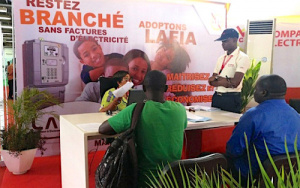
Togo’s power utility, Compagnie Energie Electrique du Togo (CEET), launched a new platform to manage its power meters and sales of prepaid power credit. Baptized Lafia, the solution aims to improve customer management.
The new platform replaces the former one which reached saturation, a notice from CEET reveals.
The switch went well according to the notice, both for all sales points as well as for mobile payment partners, namely FLOOZ and T-Money.
The notice further indicates that the Information and Services Centre (CIS) can still be reached on the 8228, for more information.
Let’s recall that the Lafia meter is a prepaid solution. It allows users to prepay electricity bills for consumption. It exists in both single-phase (two wires) and three-phase (four wires) models.
Séna Akoda
“Without the guarantee of a market receiving Africa’s industrial products, the structural transformation of the economy is not possible”- Yaovi Attigbé Ihou
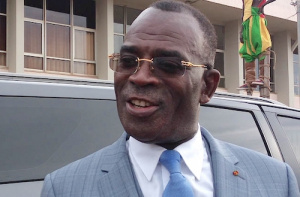
For Africa to industrialize more, it needs to find a market where it can sell its products. This was revealed by Togo’s minister of industry and tourism, Yaové Atigbé Ihou. “Without the guarantee of a market receiving Africa’s industrial products, the structural transformation of the economy is not possible”, the official said on November 20, African Industrialization Day.
Indeed, presently, the share of African industrial products in international trade is insignificant, the Togolese official indicated.
For all African economies, Togo especially, to undergo a structural transformation producing high added value for their industrialization, they should trade more among themselves, Yaovi Atigbé Ihou recommended.
Let’s recall that Togo, with its 2018-2022 national development plan, under which it plans to build various industrial parks, eyes a growth rate of 8% by 2022. The government also wishes to structurally transform the State for a strong, sustainable, resilient, inclusive growth, inducing the creation of decent jobs.
In this framework, authorities, be it in the sectors of pharmaceutical industry or ICTs, are creating a favorable environment to attract investors, according to Luciano Feou, Director of Industry.
Séna Akoda
Togo : Hungary expresses desire to invest in various development sectors
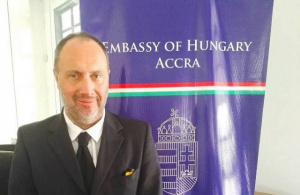
On November 21, 2018, Hungary’s new ambassador to Togo, Andras Szabo, presented his credentials to President Faure Gnassingbé. On this occasion, the European official affirmed that his nation wishes to build a strong relationship with Togo.
Comforted by its recent experience in Ghana where it opened an embassy two years ago, Hungary now wants to invest in Togo, in sectors such as energy, water, ICT, defense, security, agriculture and agrofood. “I told the President of the Republic that we would like to develop in Togo the same projects we did in Ghana, because if we could do it there, we can do the same here,” said Andras Szabo.
Soon, Hungary should have in Togo an honorary consulate. “We need someone here to represent us daily. Very soon, I hope to return to inaugurate our honorary consulate; it is very important,” Szabo added.
Séna Akoda
Former UK Prime Minister Tony Blair praises Togo’s business environment
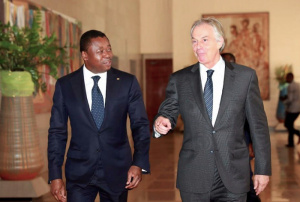
Yesterday, Nov. 21, Togo’s President, Faure Gnassingbé received UK’s former Prime Minister, Tony Blair, head of the Tony Blair Institute for Global Change.
Blair during the meeting lauded Togo’s business environment indicating that it is favorable to foreign investments. “Now, investors can be attracted here”, said the former minister whose institution supports the implementation of Togo’s 2018-2022 national development plan.
Tony Blair attributes the country’s attractiveness to foreign investments to “major decisions” taken by its authorities. Actually, these efforts helped Togo gain 19 places in the 2019 Doing Business.
Blair said he has great faith in Togo’s potential to develop, emphasizing on one of its main assets: its deep-water modern port. He added that his institution is ready to provide Lomé with the necessary support to make it a regional logistics hub.
Séna Akoda
Togo-EU economic forum to be held in Q2 2019, with focus on PND

After reaching out to Chinese investors, the Togolese government now turns to Europeans to invest in its five-year national development plan (2018-2022 PND).
Indeed, last Tuesday, on the sidelines of the 19th session of Togo-EU political dialogue, both parties decided to organize in the second quarter of 2019 a Togo-EU business forum, similar to the one recently held in China.
The projected business forum will give Togolese authorities the chance to introduce European investors to the PND’s key projects. A move that aligns with their desire to make the private sector the main driver of the five-year strategy.
PND contains many projects spanning across the following sectors: finance, manufacturing, extractive industry, agriculture (agropoles), logistics (port, airports, roads, railways), and tourism (business tourism, ecotourism, blue tourism). To secure financing required for the projects, which appear quite massive, Lomé relies strongly on private investors. In detail, the latter are expected to contribute 65% of the amount required, about CFA300 billion.
Fiacre E. Kakpo
BCEAO unveils top ten banking groups within WAMU

The following are the top ten banking groups operating within the WAMU, according to the Central Bank of West African States.
1- Ecobank
With 14% share of the market in 2017, Ecobank, whose headquarters is in Lomé, is the most important banking group operating within the WAMU. Present in every country of the union, it has 9.2% of the desks, 18.5% of the automated tellers and 15.2% of the accounts. It also contributes 15.4% to the interim result in the banking system.
2- Bank Of Africa
Constituted of eight banks and present in seven WAMU countries, Bank Of Africa (BOA) owned by the Moroccan BMCE is the second on this list with 10.5% of the total assets. It concentrates 10.8% of the desks, 9.8% of automated tellers, 16.7% of the bank accounts and generates 15.1% of the interim result.
3- Société Générale
Société Générale is the third with 9.8% of the assets. Present in five WAMU countries, it gathers 5.8% of the desks, 8.9% of the automated tellers, 7.4% of bank accounts and 15.3% of interim result. Société Générale Côte d’Ivoire is the largest subsidiary in the union.
4- Atlantic Business International (ABI)
At the fourth place comes Atlantic Business International (ABI), really active within the union with Banque Atlantique. The west African subsidiary of Moroccan Banque Centrale Populaire (BCP), is present in every country of the union with eight subsidiaries and one branch office. ABI owns 9.6% of the market share, 8.2% of the desks, 7.4% of automated tellers and 7.5% of accounts. Its result in 2017 was 4.6% of the interim results.
5- Attijariwafa bank
The fifth group in this ranking, Attijariwafa bank confirms Morrocco’s leadership in the WAMU banking sector. It has six subsidiaries and three branches for 7.7% of assets. It has its name on 12.3% of the desks, 7.9% of the automated tellers, 9.2% of bank accounts. Its result is estimated to be 9.3% of interim results within WAMU.
6- NSIA Bank, ex-Diamond Bank
The Ivorian group NSIA Bank, which newly entered this segment acquired the assets of Diamond Bank in 2017. With Two subsidiaries and three branch offices, NSIA Bank is at the fourth place and represents 5.5% of assets, 5% of desks, 5.4% of automated tellers, 5.2% of bank accounts and 5.4% of interim results.
7- Coris Bank International
Burkina Faso’s group Coris Bank International (CBI) is the seventh most important banking group within the union with 5.3% of assets, 2.7% of desks, 2.2% of automated tellers, 3.4% of bank accounts and 2.6% of interim result.
8- Oragroup
The Lomé-based Oragroup is the eighth in the ranking and has 4.3% of assets, 3.8% of the desks, 3.2% of automated tellers, and 3.2% of bank accounts. The bank which announced its introduction on the stock exchange by February 2019 realised 6.5% of the union’s interim result in 2017.
9- BNP Paribas
First bank in the eurozone in 2016 and fifth international banking group, the French bank BNP Paribas is the penultimate of this top 10. Its market share was 4.1% by the end of December 2017. With four subsidiaries, the group owns 3.7% of desks, 4.8% of automated tellers, 3.4% of bank accounts and 5.2% of interim results.
10- BSIC
BSIC Bank has seven subsidiaries in the union, 2.9% of total assets, 4% of desks and 2.1% of bank accounts. The Libyan bank is the tenth banking group within WAMU.
Fiacre E. KAKPO
Togo: Construction works for Lomé’s major bypass and administrative center are 67% and 90% complete, respectively
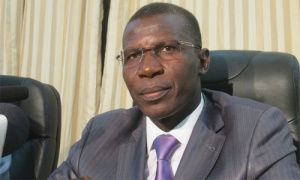
On November 20, 2018, Togo’s minister of infrastructures and transports, Ninsao Gnofam, and Chinese ambassador, Chao Weidong, toured various project sites in the country. These include construction sites for phase 2 of Lomé’s major bypass and Lomé’s administrative center.
According to the minsiter, works for the major bypass project have reached a completion rate of 67.2%. They should be ended in May 2019. “This road is a first-category inter-States route. Maximum driving speed on this road is 80km/h”, he added.
It connects to the road that comes from Ghana and “is part of a project that aims to boost transportation in the region, especially along the Abidjan-Lagos corridor”, Gnofam said. “On our side, we have planned a two-by-two axis that will mainly support heavy traffic, including heavy vehicles and buses”, the minister noted. The 21km-long road will enable heavy vehicles exiting the port to directly reach Noépé’s Control Stations.
Regarding the construction of Lomé’s administrative center, it is 90% complete and should be over in three months. The infrastructure cost more than the CFA18 billion provided by China as a grant.
Séna Akoda
From 2000 to 2015, BOAD spent CFA300 billion on non-commercial projects in Togo
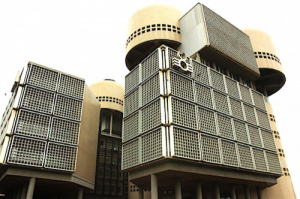
From 2000 to 2015, BOAD poured CFA300 billion into Togo’s development. The figure was disclosed by Patrice Gbaguidi, Head of Project Assessment at BOAD, during a country portfolio assessment session.
According to Gbaguidi, the session was the occasion to take a look at all projects financed by the bank over the period reviewed, taking into consideration the following five aspects: “technical, financial, environmental, institutional and partnership with other lenders”.
In detail, monies spent by BOAD were injected in infrastructures, power and development projects mostly. However, the bank also supported a grassroot development project that impacted all layers of the population, young people, men, women, according to the BOAD executive.
He emphasized on the project that led to the construction of a technical landfill centre along the Kpalimé road. This project, Gbaguidi says, had a positive impact on waste management in Lomé and its surroundings, and on populations’ health subsequently.
All the projects have been carried out in urban and semi-urban areas.
Séna Akoda