Faure Gnassingbé Makes Case for Togo as Entry Point for Africa's Next Investment Cycle
 Thursday, 18 June 2026 17:17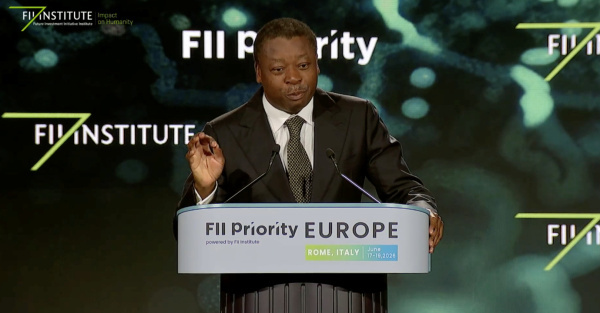
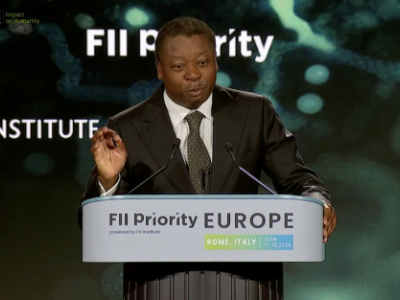
(Togo First) - Faure Gnassingbé on Wednesday, June 17, delivered a direct pitch to European and Middle Eastern investors gathered at the FII Priority Europe 2026 summit. The president of Togo's Council called on investors to finance integrated productive ecosystems in Africa rather than isolated assets, and positioned Lomé as a potential regional gateway for that approach.
Invited personally by Yasir Al-Rumayyan, governor of Saudi Arabia's Public Investment Fund (PIF) and chairman of the FII Institute, the Togolese leader spoke from the summit stage. The event, which is bringing together more than 1,600 executives through Friday, June 19, at the Waldorf Astoria Cavalieri, is being held under the theme "Europe Reimagined: Capital, Sovereignty & Strategic Autonomy."
The summit is taking place against a backdrop of projected euro zone growth of 1.2% in 2026, as European institutions seek to mobilize long-term private capital for reindustrialization efforts.
Strategic convergence
It was within this context that the president of the Council presented his proposal. The challenges are familiar. Health crises disrupt supply chains. Wars unsettle energy and grain markets. Geopolitical tensions restrict access to technology and financing.
In this fragmented world, strategic autonomy has become essential. But it should not be confused with isolation, Faure Gnassingbé warned. Rather, it is "the ability to better manage interdependence."
Europe is seeking reliable partners to secure its energy supplies, critical raw materials and value chains. Africa, meanwhile, needs "patient capital," technology and industrial capacity. Faure Gnassingbé described this as a "convergence of strategic interests."
According to him, this creates an opportunity to move beyond aid and toward "joint strategic investments."
In Togo, the proposal is built around four assets: the Port of Lomé, transport corridors linking to the Sahelian hinterland, trade facilitation measures and advanced digitalization of trade procedures.
"Capital must broaden its horizons. It cannot be satisfied with financing isolated assets. It must help build productive ecosystems: ports connected to corridors, industrial zones connected to energy, agricultural chains connected to processing," he said.
The next step, according to him, is to connect those assets to targeted value chains.
Timing and investment opportunities
The intervention is aligned with a specific window of opportunity. The African Continental Free Trade Area is entering its operational phase in 2026, while the European Union's Global Gateway strategy, backed by 150 billion euros ($173 billion) for Africa, is being implemented.
European and Gulf financiers attending the Rome summit are seeking bankable jurisdictions for these funding allocations, as supply-chain security and access to critical raw materials reshape investment decisions.
Togo's position is based on an explicitly regional approach. "When a port becomes more efficient, it reduces costs, accelerates trade and strengthens the competitiveness of several markets," the president of the Council said.
Investments in African value chains should be viewed, according to him, as a strategic investment in "shared resilience."
The argument applies to Lomé as well as Burkina Faso, Niger and Mali, much of whose external trade passes through the Port of Lomé. His stated objective, in closing, was "a new framework for partnership between Europe and Africa, leading to prosperity that is more broadly shared, more sustainable and more sovereign.
Fiacre E. Kakpo