How Togo Calculates Its Inflation Rate
 Monday, 23 March 2026 11:32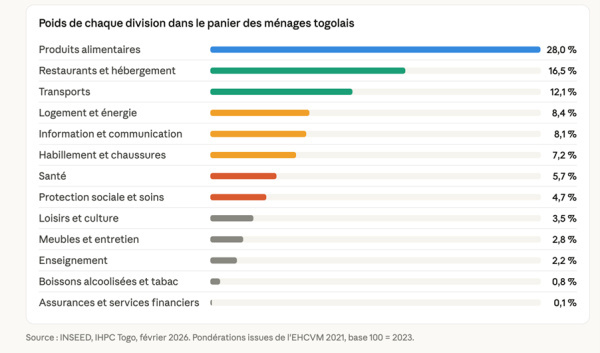
(Togo First) - Every month, the National Institute of Statistics (INSEED) publishes Togo's inflation rate. But how is that figure calculated? Who collects prices, where, and for what purpose?
The process starts with a simple principle: to measure whether life is becoming more expensive, statisticians compare the prices of a fixed set of goods and services over time. This set is known as the consumer basket. It currently includes 810 items, ranging from food and medicines to clothing, fuel, mobile subscriptions, school fees and rent.
The basket is carefully constructed. It is based on a major national survey, the Harmonized Survey on Household Living Conditions (EHCVM), conducted in 2021, which asked thousands of Togolese households what they buy and in what proportions. Items that account for the largest share of household spending carry the greatest weight in the index. These are known as weights: each item’s importance reflects its share of household budgets.
Food accounts for 28% of the basket, reflecting its status as the largest household expense. Transport represents 12%, housing and energy 8.4%, and clothing 7.2%. Insurance and financial services, by contrast, carry a weight of just 0.1%, reflecting their marginal role in most household budgets.
4,790 outlets: monthly price collection
Once the basket is defined, prices must be collected. Each month, INSEED deploys enumerators across 4,790 outlets nationwide, including markets, supermarkets, pharmacies, filling stations, neighbourhood shops and restaurants. In total, 29,200 prices are recorded each month, each corresponding to a specific item at a specific location.
Nationwide coverage has been in place since 2014, spanning both urban and rural areas across seven geographic zones: the Autonomous District of Greater Lomé (DAGL), the Maritime region, Plateaux-Est, Plateaux-Ouest, Centrale, Kara and the Savanes. This setup allows INSEED to capture price differences between the capital and the rest of the country.
Once all prices are collected, INSEED calculates the Harmonized Consumer Price Index (IHPC). In February 2026, the index stood at 103.6, against a base of 100 set in 2023, indicating that prices were 3.6% higher than in 2023. By comparing this figure with the index for the same month a year earlier, INSEED calculates the year-on-year inflation rate, which was 0.4% in February 2026.
INSEED also publishes a second indicator: the average index over the past 12 months compared with the previous 12-month period. This measure, which stood at 0.1% in February 2026, is more stable and less sensitive to monthly seasonal fluctuations. It is the benchmark used by UEMOA to monitor economic convergence among its eight member states, against a ceiling of 3%.
A shared methodology across eight countries
This methodology was not developed by Togo alone. The IHPC is based on a common framework adopted in 1996 by the eight UEMOA member states, Benin, Burkina Faso, Côte d’Ivoire, Guinea-Bissau, Mali, Niger, Senegal and Togo, and later revised in 2008 and 2023. Harmonization allows inflation to be compared across countries on a consistent basis and enables the calculation of a regional index.
Inflation measurement is not purely technical. It is a key economic policy tool. Governments use it to adjust social policies, index certain wages or benefits, and assess household purchasing power. The BCEAO, the central bank for UEMOA, relies on it to guide monetary policy, including interest rate decisions. Businesses, investors and lenders also rely on it when assessing a country’s economic stability.
Fiacre E. Kakpo