At First Media Days, Togo's Construction Firms Make Case for Sector Reform
 Monday, 15 June 2026 14:26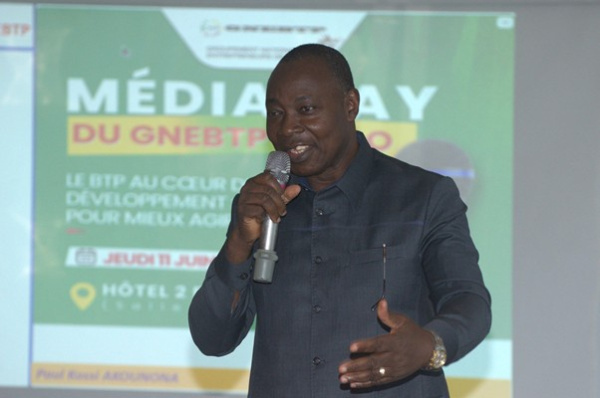
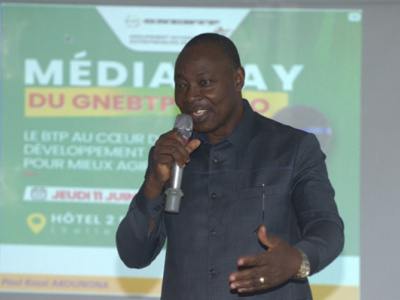
(Togo First) - Gathered in Lomé last week for the first "Media Days" organized by the National Association of Building and Public Works Contractors of Togo (GNEBTP-Togo), industry stakeholders provided a detailed assessment of the constraints affecting the performance of domestic companies.
Held under the theme "Le BTP au cœur du développement: comprendre pour mieux agir," the event brought together contractors, engineers, architects, technical laboratories and journalists. The aim was to improve understanding of the realities facing a sector that remains one of the main drivers of public investment.
Speakers said the difficulties encountered on construction sites cannot be attributed solely to contractors, since a project involves a chain of stakeholders that includes contracting authorities, engineering consultancies, inspection firms, financial partners and construction companies. Failures at any stage of the process can affect costs, timelines and the quality of completed works, they said.
"When there is a problem on a road or a building, it is often the contractor alone that bears responsibility in the eyes of the public, even though several actors are involved before and during execution," said Jessika Matsima Tiliwa, entrepreneur and national secretary-general of GNEBTP-Togo.
According to GNEBTP-Togo President Yawo Agbessi Tsogbé, domestic companies face near-impossible access to bank financing, even though they must secure guarantees, insurance and substantial financial resources before projects can get underway. Payment delays further weaken their cash flow, he said.
"Our companies are resilient, but they are now exhausted," Tsogbé said.
Industry professionals also highlighted the economic consequences of a weakening domestic construction sector. They called for greater involvement of small and medium-sized enterprises in public contracts, more robust technical studies, faster payments and stronger dialogue with banks.
"Supporting companies in the sector means supporting growth, employment and the economy of all of Togo. We have the skills, expertise and determination. We need a healthy ecosystem, quality studies, regular payments and committed banking partners," Tsogbé added.
A Sector That Remains a Significant Contributor to the National Economy
The concerns raised by GNEBTP-Togo concern a sector whose contribution to the national economy remains substantial.
According to quarterly national accounts published by the National Institute of Statistics and Economic and Demographic Studies (INSEED), value added in the construction sector increased by 16.9% in 2025, contributing 0.5 percentage point to real GDP growth. The broader secondary sector expanded by 7.5%.
According to the World Bank Group, Togo's growth during 2026-2027 is expected to be driven in part by ongoing and planned private investments, particularly around the Adétikopé Industrial Platform. The country also allocates a share of GDP to public investment that is above the average for the West African Economic and Monetary Union (WAEMU).
Reforms Already Undertaken by the State
In response to these challenges, construction sector stakeholders have also raised their concerns with government authorities.
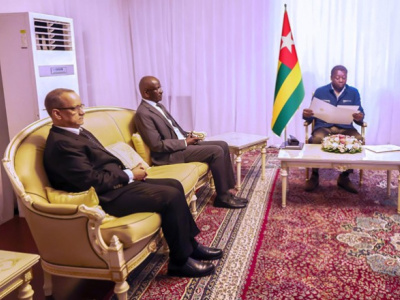
On Feb. 12, 2026, a sector meeting between the government and construction industry representatives, chaired by Finance and Budget Minister Essowè Georges Barcola and attended by Ministers Kodjo Sévon-Tépé Adedzé of Territorial Planning and Urban Development and Sani Yaya of Public Works and Infrastructure, helped establish a common understanding of problem contracts in the sector.
Poorly conducted technical studies, unrealistically low bids, payment delays and conflicts of interest were identified as recurring causes of unfinished or abandoned projects.
Following the meeting, several measures were adopted, including a comprehensive review of underperforming contracts and an audit of abandoned projects.
On the regulatory front, the Public Procurement Regulatory Authority (ARCOP) has launched several modernization initiatives since 2025. These include the introduction of new standard procurement documents covering competitive dialogue and requests for proposals, an annual review of awarded contracts, and, with World Bank support through the Public Administration Modernization Program for Service Delivery (PMADS), the rollout of electronic public procurement (e-GP), which is included under Pillar 3 of the government's 2025 roadmap.
GNEBTP-Togo Strengthens Its Organizational Structure
GNEBTP-Togo, led by Yawo Agbessi Tsogbé, has also intensified efforts to strengthen the position of domestic companies amid what it considers growing foreign competition on major infrastructure projects.
In September 2025, the association signed a partnership agreement in Rabat with Morocco's National Federation of Building and Public Works (FNBTP). The agreement focuses on capacity building and support for joint projects.
In December 2025, a meeting organized with support from development partners, including the Islamic Development Bank and Germany's KfW development bank, focused on promoting business consortiums and subcontracting as tools to improve competitiveness.
These first "Media Days" form part of an ongoing dialogue between the private construction sector, the government and financial partners. Beyond the demands advanced by the association, the event also reflected a desire to strengthen ties between infrastructure stakeholders and the media, which play an important role in shaping public perceptions of companies whose challenges directly affect users and residents in their everyday lives.
Ayi Renaud Dossavi