Togo’s Economy Expands 6.3% in 2025, GDP Exceeds 5.6 Trillion CFA Francs
 Friday, 22 May 2026 11:54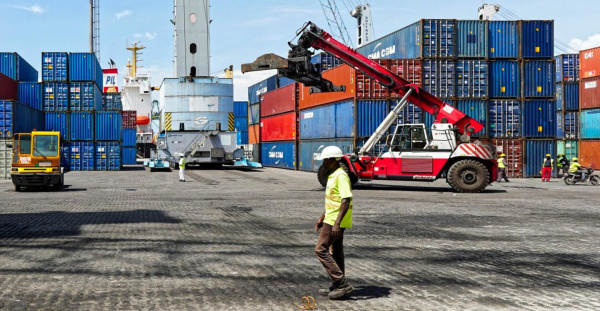
(Togo First) - Togo’s economy continued to expand strongly in 2025, outperforming forecasts from major international institutions. According to preliminary annual national accounts estimates published in May 2026 by the National Institute of Statistics and Economic and Demographic Studies (INSEED), real gross domestic product rose 6.3% to 5,649.2 billion CFA francs, from 5,314.8 billion in 2024.
In nominal terms, GDP increased 7.2% year-on-year to 6,919.1 billion CFA francs. The figures confirm a sustained post-pandemic growth trend, driven mainly by services but supported by all major sectors of the economy.
The performance exceeded expectations from multilateral lenders. The World Bank had forecast growth slowing to 5.0% in 2025, while the International Monetary Fund projected 5.3%. Official national estimates ultimately pointed to stronger-than-expected resilience.
Services Remain the Backbone of the Economy
Togo’s economic structure remained broadly unchanged in 2025, with services continuing to account for the largest share of wealth creation. The tertiary sector generated nominal gross value added of 3,403.8 billion CFA francs and posted real growth of 7.0%, slightly above the 6.8% recorded in 2024. The sector contributed 3.5 percentage points to overall GDP growth, more than half of the annual increase.
Transport and storage led the expansion, with output rising 16.2% in volume terms. Its contribution to growth increased sharply to 1.4 percentage points from 0.4 point a year earlier.
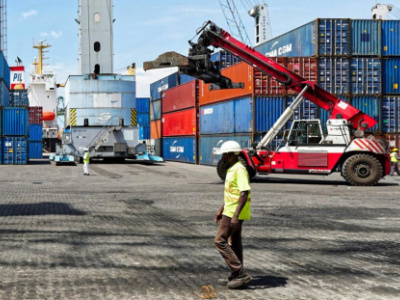
The performance reflects sustained activity around the Port of Lomé, whose traffic reached 2.06 million TEUs in 2024, up 8%. The port ranked 92nd globally in Lloyd’s List’s 2025 ranking, remaining the only sub-Saharan African port in the global top 100. Lomé continues to serve as a major gateway for goods destined for landlocked countries in the hinterland and the Sahel, while maritime transport accounts for around 90% of Togo’s trade flows.
Information and communication activities expanded 17.2%, contributing 0.8 percentage point to GDP growth, supported by rising digital adoption and continued telecommunications infrastructure deployment.
Commerce grew 9.9%, contributing 0.7 percentage point, reflecting resilient domestic consumption and transit trade activity.
Industry and Construction Maintain Momentum
The secondary sector, which includes manufacturing, construction and extractive industries, recorded real growth of 7.5% in 2025, slightly above the 7.3% posted in 2024. Its contribution to GDP growth remained stable at 1.5 percentage points.
Construction was the strongest-performing segment, with value added rising 16.9% and contributing 0.5 percentage point to growth. The expansion was supported by a 27.4% surge in construction materials manufacturing, reflecting ongoing infrastructure projects across the country.
Extractive industries also maintained momentum, growing 10.6% and extending a multi-year upward trend.
Earlier industrial indicators had already pointed to sustained activity. In January 2025, the industrial production index rose 10.5% year-on-year after an 11.0% increase in December 2024, foreshadowing the positive annual results.
Agriculture Slows but Remains Positive
The primary sector, dominated by agriculture, livestock and forestry, grew 4.2% in 2025, slowing from 5.7% in 2024. Its contribution to GDP growth declined to 0.8 percentage point from 1.1 points a year earlier.
While growth remained positive, the slowdown suggests less favorable agricultural or climatic conditions. Agriculture nevertheless continues to employ a large share of the rural population, even as its relative weight in the economy gradually declines.
Finance and Public Administration Weigh on Growth
Two services subsectors posted contractions in 2025. Financial and insurance activities shrank 9.6% in real terms after expanding 13.2% in 2024, reducing GDP growth by 0.3 percentage point. In nominal terms, value added in the sector fell to 188.9 billion CFA francs from 209 billion CFA francs a year earlier, reflecting pressure on banking sector margins.
Public administration activity declined 8.8%, shaving 0.6 percentage point off growth. The contraction likely reflected fiscal consolidation efforts by the government.
The adjustment comes as Togo reduced its public debt ratio to 65% of GDP at end-June 2025, down from 69% at end-2024, bringing it below the 70% ceiling set by the West African Economic and Monetary Union (UEMOA).
GDP Per Capita Crosses $1,300
GDP per capita exceeded $1,300 in 2025, according to Togo First estimates, supported by sustained economic growth and slower population growth. Revised demographic data from the 2022 census also contributed to crossing the threshold.
The preliminary INSEED estimates, based on quarterly national accounts compiled under the 2008 System of National Accounts framework and still subject to revision, point to an economy increasingly driven by services, supported by gradual industrial expansion and slower but stable agricultural growth.
The main challenge for 2026 will be sustaining that momentum in a regional environment marked by security tensions and an uncertain international outlook for transit-dependent economies.
Ayi Renaud Dossavi